




Responding to Violence Outside
This article is based on the Safety Member Certification training module “Violent Intruder Response V5” and the Church Security Guide article “Church Safety Teams and Active Shooter Training.” [1][2][3][4].
From the Bible –
Ancient battles began outside the walls of cities. The mission of the defenders was to keep the enemies from coming in:
nd the children of Ammon came out, and put the battle in array before the gate of the city: and the kings that were come were by themselves in the field (1 Chronicles 19:9).
And the king of Assyria sent Tartan and Rabsaris and Rabshakeh from Lachish to king Hezekiah with a great host against Jerusalem (2 Kings 18:17).
Introduction –
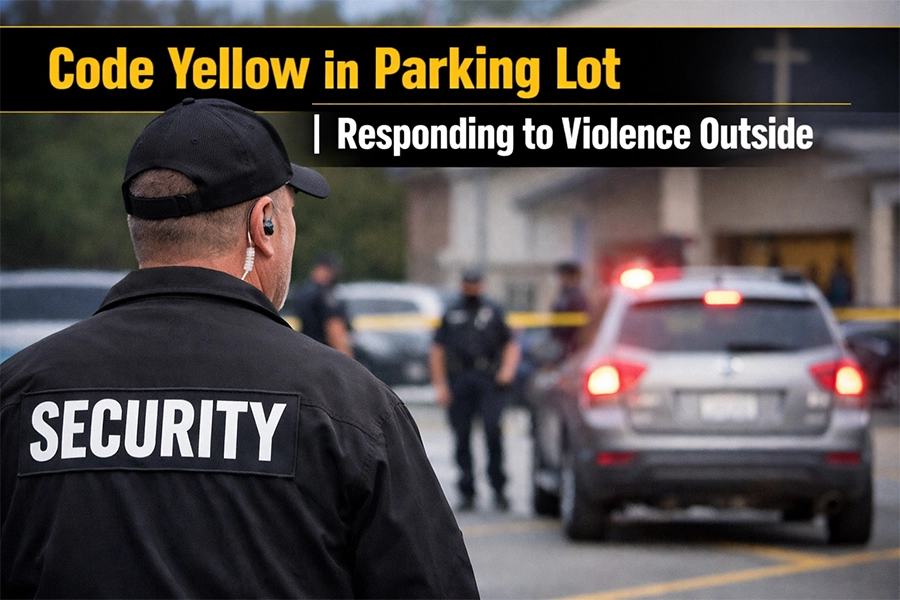
In radio codes for church safety & security, “Code Yellow” means there is a suspicious person. “Code Orange” means that there is a disruptive or violent person. A response to Code Yellow is meant to keep it from becoming a Code Orange or escalating to an outright attack on a person or persons. Most violent incidents in churches and other places of worship begin outside, in the parking lot, elsewhere on the campus, or on the sidewalk, alley, or street adjoining the church and its property.
Outdoor Violence at Churches -
Violent crimes outside churches do not always involve firearms. They can include the use of explosives, knives, and blunt force. Robbery is sometimes a motive.
Current News:
There was a violent incident outside a church this year on January 7, 2026. This was during a funeral at an LDS (Mormon) ward in Salt Lake City. The funeral was for someone in the Tongan community – this ward serves mostly Tongans (immigrants from Tonga, where there was a massive volcanic eruption on January 15, 2022). An argument arose in the rear parking lot among young adults, including some from a local gang. Guns came out and shots were fired. Two people were killed and six were wounded. [5][6][7].
Two of the shooters were identified and arrested. A federal grand jury has indicted them for firearms violations, but no one has yet been identified and charged in the deaths. Except for the ethnic identities, this incident is similar to other gang-related violence outside funerals in other cities.
Previous News:
Let’s list a few other examples from previous articles:
- Robberies on church property:
- Atlanta, Georgia, on February 8, 2025 – a deacon was personally robbed of his wallet. He was injured. [8].
- Vestavia Hills, Alabama, on November 6, 2022 – People playing basketball on a church’s outdoor court were robbed by three armed persons. [9].
- Cumberland and York Counties, Maine, on April 21, 2024 – A man with a handgun robbed people in three church parking lots on one Sunday. [10].
- Personal attacks on individuals:
- Brooklyn, New York City, August 31, 2020 – The caretaker of a church who also helped people in need, especially addicts and alcoholics, was shot as he was closing the church for the night on a weekday. [11].
- Fresno, California, November 5, 2017 – A man in his car in the parking lot of St. Alphonsus Catholic Church waited for the 8:30 mass to end. As his wife and her boyfriend came out and got into a car, he got out of his, walked to the other car and shot them both fatally. He then got into his car, drove home, and committed suicide. [12].
- Gang and random shootings:
- Chicago, Illinois, October 22, 2018 (gang) – The funeral for a drill rapper who was a gang member was held at the church where his parents were members. As attenders left the funeral, members of another gang shot and wounded another drill rapper, then left. [13].
- Aurora, Colorado, April 22, 2012 (random) – A collision of two vehicles outside of a church resulted in an armed confrontation. Some people came out of the church to see what was going on. A shot hit and killed the pastor’s mother. [14].
- Attacks on the church (these often start outside):
- Colorado Springs, December 9, 2007 – A young man with prior connections to the New Life Church and Youth With A Mission killed two and wounded two just after midnight at the YWAM mission in Arvada. Later, he went to New Life Church in Colorado Springs and waited in the parking lot for members to leave the service. As they came out, he shot four in the parking lot, killing two. Then he went to a side door and entered the church. The security team was ready for him. He was wounded in an encounter, then killed himself. [15].
- Sutherland Springs, Texas, November 5, 2017 – A man twice-married who had been convicted of domestic violence attacked the church where his second wife was raised and his mother-in-law and her mother attended. He began firing outside the church before going in, killing 26 and wounding 21 others. [16].
Vigilance Begins Outside the Door –
Greeters meet people entering the church for classes and worship services. As it is, that’s good. Security team members watch people in the foyer, the hallways, and the sanctuary. As it is, that’s good.
Ushers in the sanctuary watch people as they come in and as they great each other and sit down in the pews. As it is, that’s good.
Cameras send images and sounds of places in the church to monitors to be watched and recorded. As it is, that’s also good.
However good these measures are to keep our fingers on the pulse of people in the church, what about outside?
- Who’s watching the outer entry, the walkway, and the parking lot?
- How about the driveway (for Chabad Poway it’s part of a public street, and for Central Christian Church in Aurora – formerly occupied by Destiny Christian Center – it’s through an office park drive), or the alley behind the church? [17][18].
- How about the perimeters of the grounds?
- Some churches border the sidewalk. How do we watch that?
- If your church is located in a mall, who watches the concourse? And what about the outside entrance (if you have one)?
A well-worn concept is, “Security begins at the gate.” Realistically, this is not just the door, but all the area around the church. If your church has a campus with the building set back from the street or road, that makes outside security easier, but that’s more difficult in most city settings where at least one outside wall is by a public sidewalk, and that wall may include the main entrance. That is the case at Bethlehem Star Missionary Baptist Church in Chicago. People leaving the church went out to the sidewalk, and were easy marks for waiting shooters.
How to Watch Outside –
Four means of watching a church’s exterior are Sensors, Monitoring, Presence, and Patrols.
Sensors:
Sensors make sense, especially if there are few watchers (as with a small congregation). The natural locations for sensors are doors and windows. These can alert a watcher to someone coming through an open door or trying to get through a closed one (or a window). This is important for times the church is unoccupied. Nowadays, a sensor can alert someone off site. This can warn of an attempted burglary, vandalism, or arson. Sometimes a sensor alerts watchers to a person in need seeking help.
Sensors can also alert a watcher to vehicles entering the parking lot during a service, classes, or an event. Entering right in the middle of a service or event is usually a non-norm for security. Check it out. Some of these could be someone really late, a driver stopping to check a phone or an address, etc. This could be an opportunity to help, but a visit by a safety team member could deter a bad actor.
Monitoring:
Cameras and windows allow safety team members inside to better see what is outside. A violent intruder may park his vehicle where it can’t be seen through a window, but a well-placed camera will reveal him to someone watching a monitor screen. Not only intruders, but thieves targeting vehicles during a service or event can’t hide effectively. Of course, security effectiveness depends on someone monitoring the monitors. Some current cameras can be zoomed by whoever is at the monitor to get a better view.
Recorded camera data aids in reviews and investigations.
Sensors and cameras should work together. When a sensor is activated, check the camera covering its location.
Presence:
Presence of a safety team member in the parking lot or a walk-through area lets visitors know that the area is being watched. Parking lot attendants help people find parking spaces and are there to help. They can also be eyes and ears for the safety team. Equip them with two-way radios so they can communicate with the team.
Patrols:
You can’t be everywhere at once, but you can be everywhere serially. Patrols have the advantage of seeing things cameras may miss, and seeing things more closely. They also serve to deter would-be intruders, especially if the patrols seem random (unpredictable).
Patrols should be conducted before, during, after, and between services. Give bad actors an anxiety complex.
Things to Watch for –
There are a number of things outside that deserve our attention: Suspicious persons, Suspicious Activity, Suspicious items, Hazardous situations, and People in need.
Suspicious persons:
Some persons may look suspicious. This may be how they’re dressed. For instance, this may be a long coat, especially in warm or hot weather. The person could be dressed in all black or camo with a hood and mask. Maybe the person has a suspicious bulge indicating a possible weapon.
Maybe what makes a person look suspicious is the expression on his face. There could be a good reason for that, but check it out, such as by a friendly contact.
Suspicious Activity:
I don’t know about you, but someone sitting in a car for a long time watching the church seems suspicious, not only in the parking lot, but on the street. If you check it out, have a backup ready to radio for help and call 911. Also watch for vehicles going by constantly, especially with someone inside looking at the church.
Suspicious items:
Top on the list for suspicious items is anything that may be a bomb. For instance, in Illinois, a bomb in a picnic cooler was left outside a church in Oakwood for someone to pick up and trigger. Then, months later, a bomb was attached to an outside AC unit at another church and timed to detonate during the Sunday morning service. [19].
Properly placed cameras could have caught the acts of placement, and patrols could have found the devices. Overnight camera data should be reviewed early for suspicious activity during the night. Caution: do not handle suspicious items that may be bombs.
Hazardous situations:
A hazardous situation may not be so bad – like a minor fender-denter in the parking lot – but it could be bad, such as an overturned truck on the road, falling wires or trees, bad weather coming (such as a tornado), a local fire or wildfire, a vehicle fire in the parking lot, a shooter on the loose, etc. Especially bad are releases and spills of hazardous materials.
People in need:
This is not a Code Yellow, but does need attention, even if the need is not caused by a Code Yellow person.
Seeing Foreseeable Risks –
We’re in a litigious society. It is too easy to get sued. If you watch TV, listen to the radio, read online posts, etc., you may see or hear ads by law firms. They are available if you have suffered personal injuries or losses. If someone is injured or killed, or their vehicle is damaged, in a violent incident outside the church, the church can be sued for personal injury, wrongful death, or property damage with an allegation of negligence.
The ones suffering injury are not confined to those in the church or attending an event. An outdoor incident can affect neighbors and passersby. People not connected to the church may be more likely to sue. A person walking down the sidewalk or driving by in a car can be struck by a stray bullet. They can be injured or their car damaged by a perpetrator fleeing in a vehicle.
How can the church or its leadership be liable when someone else was at fault? How can a litigant claim negligence in such a case? The simple answer is, “You should have known.” A plaintiff can allege that the church did not take certain precautions for “foreseeable risks.” It seems wise to consider the foreseeable risks of a violent incident outside the church building. We can’t foresee every risk, but some risks may be foreseeable. How do we know? We need to know the flock, know the neighborhood, and pay attention to intelligence.
Knowing the Flock:
Many times, an outdoor incident comes from an internal problem. This may be personal disputes between members, such as in Salt Lake City. More often, it is domestic discord reaching a boiling point, such as the shooting at St. Alphonsus. [5][12].
Sometimes a former member shows up with a gun, as at Burnette Chapel Church of Christ. [20]. If you can, keep in touch with and/or stay aware of all members and former members of the church. When you’re not trying to persuade former members to come back, but are showing them you care, there’s a chance they’ll share their outlook and feelings with you or tell of circumstances in their lives which may be potential risks. Ministering to them might make a difference in their lives, even if they don’t come back.
Knowing the Neighborhood:
Take into account the community climate of where your church is located. It is a given that some communities are riskier than others, especially when gangs are involved. [21][22]
When you are aware of community risks, you can plan for them and take prudent precautions to keep the exterior of the church safe while still being welcoming. Especially risky are funerals of gang members. When that is held at the church, you need outdoor security that knows how to watch for signs of trouble and counter them. Coordinating security with local law enforcement is advisable. A private security provider should know how to safely handle those risks.
Heeding Intelligence:
Be alert to warnings or reports about security threats to the church, to members of the church, or in the neighborhood. A good relationship with law enforcement and social agencies in your area increases your chance of learning about increased local risks. This may include news about arsonists, activists, and planned demonstrations.
Code Yellow Response –
How do you respond when hearing a Code Yellow? That partly depends on where you are, what you are doing, and the situation. The member on the radio may update with details.
- If you are close enough, you may provide backup for the team member calling in the code.
- If you are in or near the children’s areas, guard the nursery, toddler’s room, and classrooms.
- You may be the one ready to call 911 if needed.
- If close enough, maybe you can use verbal de-escalation.
- In any case, be ready to respond.
What if Code Yellow Becomes Code Orange?
Be ready to defend, but more importantly to defuse the situation if it has not already gone too far. If you are not the team member on the scene, be available to be the backup. Also be ready to stop a violent person from coming in.
Training Notes –
All church safety team members are to be trained and certified through Safety Member Certification.
Drills:
Besides certification, hold regular drills on different aspects of the training. This includes exterior Code Yellow and Code Orange responses. Each member needs to know his or her role depending on where he or she is when the code is called. Also, the medical response team needs to drill outdoor responses.
Recommended Articles:
Here are some SDCS articles by Rachel Moloney on this topic:
Robbery and Assault Response | Safety Team Training,
Stopping a Killer Outside | Strengthening Exterior Church Security,
The Mission Trip Factor | Church Safety Beyond the Walls.
Conclusion –
Stop violence outside the church so it does not come in.
References –
- Kris P. Moloney, Safety Member Certification, Sheepdog Church Security, 2025 [https://sheepdog-church-security.thinkific.com/courses/safety-member-certification-v5-2025].
- Kris P. Moloney, “Violent Intruder Response V5,” Safety Member Certification, Sheepdog Church Security, 2025 [https://sheepdog-church-security.thinkific.com/courses/church-safety-violent-intruder-response].
- Kris P. Moloney, Church Security Guide, Sheepdog Church Security, June 9, 2023 [https://sheepdog-church-security.thinkific.com/pages/security-articles?c=church-security-guide], also 2018 at [https://sheepdogchurchsecurity.net/church-security-guide/].
- Kris P. Moloney, “Church Safety Teams and Active Shooter Training,” Church Security Guide, Sheepdog Church Security, June 9, 2023 [https://sheepdog-church-security.thinkific.com/pages/security-articles?p=church-safety-active-killer-response-strategies], and 2018 at [https://sheepdogchurchsecurity.net/active-shooter].
- Michael Sinkewicz, “Shooting outside Salt Lake City LDS church leaves at least 2 dead, 6 injured: police,” Fox News, Published January 8, 2026 [https://www.foxnews.com/us/shooting-outside-salt-lake-city-lds-church-leaves-least-2-dead-6-injured-police].
- Ryan Marion, “Two alleged gang members face firearm charges following church shooting,” Fox13 (SLC), February 27, 2026 [https://www.fox13now.com/news/local-news/northern-utah/two-alleged-gang-members-face-firearm-charges-following-church-shooting].
- Sonya Buyting, “Record-smashing Tonga volcano sheds new light on how underwater volcanoes blow,” Canadian Broadcasting Corporation - CBC Radio, January 26, 2024 [https://www.cbc.ca/radio/quirks/record-smashing-tonga-volcano-1.7096003].
- WGV, “Robbed,” Sheepdog Church Security, August 26, 2025 [https://sheepdogchurchsecurity.net/articles/robbed/].
- Carol Robinson, "3 charged with assault, robbery in Shades Mountain Baptist Church basketball court shooting," Birmingham Real-Time News on AL.com, Updated Nov. 10, 2022 [https://www.al.com/news/birmingham/2022/11/3-charged-with-assault-robbery-in-basketball-court-shooting-at-shades-mountain-baptist-church.html]; news article referenced in the SDCS article “Robbed!” (above, ref # 8).
- WGME Staff, "Suspect in custody after string of armed robberies at Maine church parking lots," WGME, April 21, 2024 [https://wgme.com/news/local/suspect-in-custody-after-string-of-armed-robberies-at-maine-church-parking-lots]; news article referenced in the SDCS article “Robbed!” (above, ref # 8).
- Rachel M. Moloney, “2020 Glorious Church of God in Christ Shooting,” Sheepdog Church Security, June 12th, 2025 [https://sheepdogchurchsecurity.net/articles/glorious-church-god-christ-shooting/].
- Rachel M. Moloney, "Shooting at St. Alphonsus Fresno Church | Lessons Learned," Sheepdog Church Security, December 18, 2025 [https://sheepdog-church-security.thinkific.com/pages/security-articles?p=2017-st-alphonsus-fresno-church-shooting-lessons-for-church-safety-teams].
- Rachel M. Moloney, "Lessons Learned from the Bethlehem Star Church Shooting," Sheepdog Church Security, November 6, 2024 [https://sheepdog-church-security.thinkific.com/pages/security-articles?p=lessons-learned-from-the-bethlehem-star-church-shooting].
- WGV, “2012 Destiny Christian Center Shooting,” Sheepdog Church Security, February 14, 2023 [https://sheepdogchurchsecurity.net/articles/2012-destinyd-christian-center-shooting/].
- Rachel M. Moloney The 2007 New Life Church Shooting: Lessons Learned, Sheepdog Church Security, June 5, 2024 [https://sheepdog-church-security.thinkific.com/pages/security-articles?p=lessons-learned-the-2007-new-life-church-shooting].
- Rachel M. Moloney, "Sutherland Springs Church Shooting: Lessons Learned," Sheepdog Church Security, December 25, 2025 [https://sheepdog-church-security.thinkific.com/pages/security-articles?p=sutherland-springs-church-shooting-lessons-learned].
- WGV, "2019 Poway Chabad Shooting and Dar-ul-Arqam Mosque Arson," Sheepdog Church Security, Published on December 17, 2024 [https://sheepdogchurchsecurity.net/articles/2019-poway-chabad-shooting-and-dar-ul-arqam-mosque-arson/].
- WGV, "2012 Destiny Christian Center Shooting," Sheepdog Church Security, Published on February 14, 2023 [https://sheepdogchurchsecurity.net/articles/2012-destinyd-christian-center-shooting/].
- WGV, “Oakwood and Danville Church Bombings,” Sheepdog Church Security, July 8, 2025 [https://sheepdog-church-security.thinkific.com/pages/security-articles?p=oakwood-and-danville-church-bombings].
- Rachel M. Moloney, "Shooting at Burnette Chapel Church | Lessons Learned," Sheepdog Church Security, January 29, 2026 [https://sheepdog-church-security.thinkific.com/pages/security-articles?p=2017-burnette-chapel-church-shooting-lessons-learned].
- WGV, “The Community Climate - Part 1,” Sheepdog Church Security, Published on October 30, 2023 [https://sheepdogchurchsecurity.net/articles/the-community-climate-part01/].
- WGV, “The Community Climate - Part 2,” Sheepdog Church Security, Published on November 07, 2023 [https://sheepdogchurchsecurity.net/articles/the-community-climate-part01/].