




Responding to Medical Emergencies
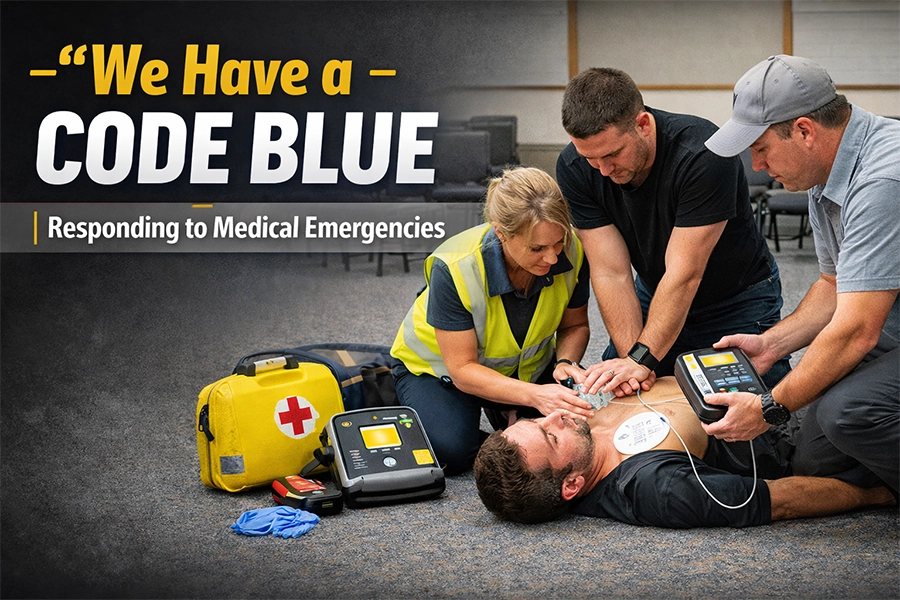
An article related to the Safety Member Certification training module “Mass Trauma Emergency” [1][2].
From the Bible –
* Preparing for Winter:
But when Jesus heard that, he said unto them, “They that be whole need not a physician, but they that are sick” (Matthew 9:12).
* Structural failures can cause life-threatening injuries:
“Or those eighteen, upon whom the tower in Siloam fell, and slew them, think ye that they were sinners above all men that dwelt in Jerusalem?” (Luke 13:4).
* Medical help was given to a wounded person:
“But a certain Samaritan ... went to him, and bound up his wounds, pouring in oil and wine, and set him on his own beast, and brought him to an inn, and took care of him” (Luke 10:33-34).
Code Blue can happen at any time, in any place:
- You’re in a class, and another member of the class collapses. What do you do?
- A girl carrying a glass pitcher trips and falls. The pitcher breaks and the broken glass cuts her arm. It is bleeding badly. What do you do?
- A driver pulls into the parking lot, fires a gun from the open car window, wounding a man in another car, and drives away. How do you help the victim?
- The youth are having an evening gathering around the fire pit out back. One teen is roasting a wiener when his sleeve catches fire. How do you respond to the burns?
Medical emergencies can happen anywhere anytime. They don’t always wait for a church-wide or community-wide damaging event, such as a fire, a mass shooting, or a natural disaster. This is when the Boy Scout Motto, “Be prepared,” counts. We need to always be ready for unexpected injuries and medical episodes.
In the News –
Pittsburgh, Pennsylvania, October 27, 2018 – In a mass shooting at a synagogue during Sabbath services, several persons were shot. Eleven died. There would have been more fatalities, but persons who had taken Stop the Bleed training kept several wounded persons from bleeding to death [3].
* Note: Stopping bleeding is one of the life-saving skills used in treating injuries.
Yucaipa, New Mexico, April 24, 2024 – An arsonist spread gasoline at the front door of a church and ignited it. The church included an attached day care center. Children and staff safely evacuated. The arsonist also tried unsuccessfully to set a strip mall afire.
The arsonist, who was caught, confessed to setting the church fire because of their religion. He was charged with a hate crime and plead guilty in federal court [4].
* Note: There was a chance that someone could have been burned.
Washington County, Utah, January 16, 2025 – A 40-year-old man, the father of four, was playing basketball in a church gym with members of other congregations. During a game, he fell on his face. Five of the players, who were not his acquaintances, quickly prayed and began using CPR and rescue breathing while others called 911. They rotated CPR until the medics arrived. He lived and has recovered. The men who treated him do not work in healthcare, emergency medical services, or law enforcement [5].
* Note: It pays for more people to know CPR and AED use.
When Life-Saving Skills Are Needed –
In church safety & security, “Code Blue” means a medical emergency, so you call 911, but how long will it be until the medics arrive? If there’s not a doctor, nurse, or medic in the house, who will be the first responder? Seconds and minutes count. If no one present can respond, the medics could be too late. If treatment has already begun, they’ll take over with hope for success.
Medical Response Situations –
There are a number of situations requiring a medical response. Here are a few:
- Accident inside the church –
- A fall from tripping or slipping,
- Collision between people,
- Kitchen accidents,
- Falling down stairs,
- Foreign material in eyes,
- Cuts while using sharp instruments,
- Accident outside –
- Two-vehicle collision,
- Vehicle hits building or solid object,
- Vehicle hits pedestrian(s),
- Playground accidents,
- Trips and falls,
- Cuts from broken vehicle glass,
- Spinal injury,
- Off-campus activities –
- Traffic accident on way to/from the activity,
- Medical emergency during the activity,
- Severe weather during an outdoor activity,
- Lightning,
- Hail,
- Tornado,
- Fire –
- Kitchen Burns,
- Burns from structure fire,
- Activity burns,
- Fire pit,
- Candles,
- Torches (outside),
- Smoke inhalation,
- Evacuation accidents,
- Medical condition –
- Heart attack,
- Stroke,
- Choking,
- Anaphylaxis (system allergic reaction),
- Diabetic shock,
- Poisoning,
- Assault –
- Edged weapon,
- Firearm,
- Blunt force,
- Empty-handed assault and battery,
- Offensive use of defensive devices,
- Explosive devices,
- Structural failure –
- Roof or ceiling collapses,
- Stairs break,
- Handrail breaks or comes loose,
- Candelabra falls
- Severe weather –
- Damage from winds,
- Flood hazards,
- Extreme temperatures,
- Hypothermia or frostbite,
- Heat stress,
- Dehydration
- Local disaster –
- Explosion,
- Large road vehicle wreck,
- Train wreck,
- Hazardous material incident –
- Transportation leak or spill:
- Train wreck or derailment,
- Truck leak or accident,
- Pipeline leak,
- Fumes from industrial fire,
- Leak or spill on the church property,
- Other –
- Food Poisoning at church meal or refreshments.
Needed First-Response Skills –
Several skills are needed by first responders to a medical emergency at the church or a church-related activity. Boiled down, they are
- First Aid,
- Trauma Response,
- CPR,
- AED use,
- Heimlich Maneuver.
First Aid,
First Aid is the oldest skill set for emergency response to injuries, and treatments were developed over thousands of years, especially in the treatment of battle wounds. The Roman army had designated medics.
It was formalized in the 1870s and was taught to Boy Scouts in the early 1900s. During World Wars I and II, the American Red Cross produced First Aid manuals for U.S. soldiers and sailors so they could treat those who were wounded or otherwise injured.
First Aid is now being taught to anyone who wants to take the course. It is a requirement for all professional first responders. Many workplaces have medical response teams.
Trauma Response,
This goes beyond simple First Aid. It includes severe bleeding control, treating gunfire wounds and severe burns, triage, and evacuation of severely-injured persons from dangerous locations to safer or less dangerous places. These are key skills during a mass trauma incident.
Cardiopulmonary Resuscitation (CPR),
Decades ago, this was called “Mouth-to-mouth resuscitation.” It was later realized that the most effective part was restarting the heart through compressions. The act of repeated compressions not only pumps the heart, moving blood through the arteries and veins, but also pumps air into and out of the lungs. Now the direct breathing is used only when the compressions don’t move the air and the patient does not begin breathing on his or her own.
Automated External Defibrillator,
A common heart disorder is atrial fibrillation (AFib). The heart beats so rapidly that it cannot move the blood efficiently. Defibrillators have been used in hospitals to end the AFib by stopping then restarting the heart. The operator had to know exactly when to trigger it.
Now there are defibrillators small enough to be used in the field (wherever a person has AFib), and they are automated to sense when to discharge. These are called automated external defibrillators (AEDs). They are found in many places, such as therapy centers, outpatient clinics, schools, public auditoriums, etc. Churches are encouraged to have them and train people to use them. Many lives have been saved by AEDs. Your church needs to have one or more and people who are trained in AED use.
Heimlich Maneuver,
This is a simple life-saver. If you have ever choked on food and couldn’t get it out quickly, you can appreciate this move. Anyone can learn it. Children have saved the lives of other children and of adults.
A person standing behind the person choking puts their arms around the victim with a fist just below the breastbone (clavicle) covered by the other hand. Strong pumps of the enclosed fist press up on the diaphragm, forcing air out of the lungs This will move the choking object up and out of the trachea.
Equipped for Medical Response –
There are several items needed for medical response. Trained persons may be able to make do with what’s available – to a point. These persons can do more and do it more effectively when they have the right equipment and supplies. Two of the sources recommended by Sheepdog Church Security are the SDCS Amazon store Recommended Equipment for Safety Ministries, and Mountain Man Medical.
Recommended Equipment for Safety Ministries:
The is Sheepdog Church Security’s store on Amazon. In addition to Kris Moloney’s 3 books, defensive spray, tactical lights, etc., it also has five items for medical response [6]:
- Philips HeartStart Home AED Defibrillator,
- Ergodyne Arsenal 5215 Large Medic First Responder Trauma Duffel Bag,
- North American Rescue C-A-T Combat Application Tourniquet,
- DynarexEmergency Pressure Bandage (Israeli Type),
- MOORE MedicalAirway Kit.
Philips HeartStart Home AED Defibrillator:
This is a small device with a carrying case. It also includes an on-the-spot guide to CPR. It automatically self-tests and recalibrates.
Ergodyne Arsenal 5215 Large Medic First Responder Trauma Duffel Bag:
This bag is designed to keep medical response supplies clean and dry. Its size of 19” x 12” x 8½” has a lot of room, and the zippered pockets at the ends aid in organization.
North American Rescue C-A-T Combat Application Tourniquet
A tourniquet is a life-saver for severe limb bleeding. It gives the responder time to treat the wound or cut, or for the triage person to apply tourniquets to other patients during a mass casualty event.
DynarexEmergency Pressure Bandage (Israeli Type):
Unlike a tourniquet, a pressure bandage can be applied not only to limb wounds, but also to those on the torso or the head.
MOORE MedicalAirway Kit:
This is a packet with 5 nasopharyngeal respiration tubes, each in a different size. This arrangement is important, because a small person’s nasal passage or throat may not be wide enough for the average size, while a large person will require a longer tube. It is popular enough to occasionally sell out, but Amazon has a few other brands.
Mountain Man Medical:
Mountain Man Medical (M3) was started in Colorado by persons who saw the need for a reliable source of quality First Aid supplies at reasonable prices. It is a Sheepdog Church Security affiliate (M3 lists SDCS as a partner). Kris collaborated with M3 is the design and supply configuration of two kits, the Sheepdog Belt IFAK and the Mass Casualty Trauma Kit [7].
Sheepdog Belt IFAK:
IFAK means Individual First Aid Kit. A Safety Church Team member can carry this kit on the belt, ready for immediate response to a medical emergency. It has a few key items:
- 1 SOF-T (tourniquet),
- 1 4″ Israeli Bandage,
- 1 Pair of Gloves,
- 1 Pair of Shears,
- 1 CPR Face Shield,
Mass Casualty Trauma Kit:
M3 liked this kit so well that they made it their own. In a mass casualty incident, 2 to 6 persons can be treated with the contents of one kit. The number of kits recommended for a church is based on the peak occupancy of the church’s facility. The general rule is one kit for every 50 persons. The advantage of this is that more responders can be equipped at one time than by having everything in one big bag.
One Mass Trauma Kit contains:
- 2x TacMed SOF-T Tourniquets
- 2x Dynarex 4″ “Israeli Style” High-Pressure Dressing
- 4x Pairs of Blue Nitrile Gloves
- 1x Compact Trauma Shears
- 2x North American Rescue Hyfin Compact Twin Pack Chest Seals
- 1x Mini Black Permanent Marker
- 1x Dynarex Emergency Rescue Blanket
- 2x Pre-Lubricated Combat Medical NPAs
- 2x ChitoGauze 3″ x 4yrd PRO Hemostatic Dressing
- 1x Dynared Krinkle Compressed Gauze 4.5″ x 4.1 yards
- 1x Dynarex Triangle Bandage / Cravat
- 2x CPR Face Shields
MARCH Supplies:
Mountain Man Medical has individual items categorized together as MARCH (Massive hemorrhage, Airway, Respiration, Hypothermia/head injury). This includes 37 items under various brands [8]. The MARCH categories are:
- Bandages,
- Chest Seals,
- Gauze,
- Hemostatic Dressing,
- NPA,
- Tourniquets.
Training for Medical Response –
Training is a key to an effective medical response. The responder should know both what to do and what not to do in the situation. The Sheepdog Church Security training module “Mass Trauma Emergency” deals specifically with incidents with several casualties. Training in this is a key to preparation and coordination for such an event.
However, more specific training is needed for the medical response skills themselves: First Aid, CPR, AED use, and the Heimlich maneuver. This can be group training in classes, or individual training. Local fire departments and colleges may offer training in these skills. Some persons can get this training through their employers, especially when they join the medical response team. Training is also generally available through major national organizations, such as the American Red Cross, the American Heart Association, and the National Safety Council [9][10][11].
Conclusion –
Be prepared to respond to medical emergencies.
References –
- Kris Moloney, “Safety Member Certification,” Sheepdog Church Security, 2025 [https://sheepdog-church-security.thinkific.com/courses/safety-member-certification-v5-2025].
- Kris Moloney, “Mass Trauma Emergency,” Sheepdog Church Security, 2019 [https://sheepdog-church-security.thinkific.com/courses/mass-trauma-emergency].
- Matthew D. Neal, “Pittsburgh trauma surgeon: ‘Stop the Bleed’ training saved lives after shooting, but stopping the need must be next,” The Conversation, November 5, 2018 [https://theconversation.com/pittsburgh-trauma-surgeon-stop-the-bleed-training-saved-lives-after-shooting-but-stopping-the-need-must-be-next-106301].
- Cameron Kiszla, “NM man admits to burning occupied church due to its ‘religious character’,” KTLA, Posted: Jan 17, 2025 [https://ktla.com/news/local-news/nm-man-admits-to-burning-occupied-church-due-to-its-religious-character/].
- Shara Park, “Utahns honored for saving man who suffered heart attack playing basketball,” KSL TV, February 14, 2025 [https://ksltv.com/local-news/utahns-honored-for-saving-man-who-suffered-heart-attack-playing-basketball/739640/].
- Kris Moloney (instructor), Sheepdog Church Security / Recommended Equipment for Safety Ministries, Amazon [https://www.amazon.com/shop/instructor_moloney/list/1ERD68BB0JGWR?ref_=aip_sf_list_spv_ofs_mixed_d&ccs_id=0b84ef58-c7a6-46ed-b00d-98516e610399].
- Mountain Man Medical [https://www.mountainmanmedical.com/].
- MARCH, Mountain Man Medical [https://www.mountainmanmedical.com/product-category/march/].
- American Red Cross, "Find a Class" [https://www.redcross.org/take-a-class].
- American Heart Association, "CPR & First Aid Training Classes" [https://www.heart.org/en/cpr].
- National Safety Council, “Learn First Aid from the Workplace Safety Experts” [https://www.nsc.org/safety-training/first-aid/first-aid-cpr-and-aed-courses].