




Protecting the Most Vulnerable
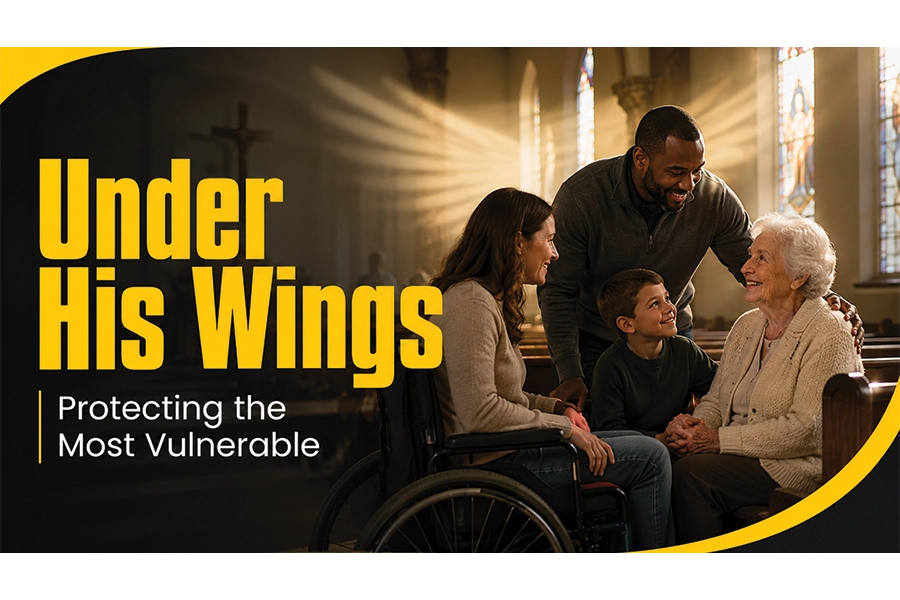
This article is based on the Safety Member Certification training module “Protecting the Vulnerable V5” and the Church Security Guide article “Protection of Children and Vulnerable Adults in the Church.” [1][2][3][4].
From the Bible
"O Jerusalem, Jerusalem ... how often would I have gathered thy children together, even as a hen gathereth her chickens under her wings ..." (Matthew 23:37, see also Luke 13:34).
Let a bear robbed of her whelps meet a man, rather than a fool in his folly (Proverbs 17:12).
"But whoso shall offend one of these little ones which believe in me, it were better for him that a millstone were hanged about his neck, and that he were drowned in the depth of the sea" (Matthew 18:6).
He that covereth his sins shall not prosper: but whoso confesseth and forsaketh them shall have mercy (Proverbs 28:13).
Introduction –
Many of us are familiar with the hymn “Under His Wings.” The chorus ends with, "Under His wings my soul shall abide, Safely abide forever." [5].
This hymn, a source of comfort to many, is based on the Psalms’ poetic imagery of God protecting His people under His wings (Ps. 17:8; 36:7; 91:4). This image refers to a mother bird sheltering her young with her wings (Mt. 23:37; Lk. 13:34).
Applying another image from Nature used in the Bible, a mother bear will fiercely protect her cubs (Prov. 17:12), even against a larger bear.
In the church, this is not only God protecting His people, especially the innocent and vulnerable. Leaders in the church, as under-shepherds to the Great Shepherd (1 Pet. 5:1), are also responsible for protecting the most vulnerable among us. We in the Church Safety Ministry are the sheepdogs, aiding the shepherds; our primary mission is protection. To use the Psalmists’ metaphor, the vulnerable should be under our wings.
On the Web –
This is an annotated list of news stories and web resources.
Meridian, Idaho, May 22, 2026 – In a weekly podcast, Keith Graves, the founder and leader of Christian Warrior Training, pointed out that there are more sexual abuse cases in churches than violent incidents. Also, that abuse by leaders tends to be hidden to save a church's public image. He pointed to what Jesus said in Matthew 18:6, that an abuser of innocent children would be better off if drowned. [6].
* This underscores the high priority of preventing and correctly responding to sexual abuse in the church. As to church leaders hiding cases of child abuse, see Prov. 17:12 above. When a long-hidden violation is uncovered, it damages the church’s image more than if it had been openly dealt with in the beginning.
Hanford, California, July 13, 2018 – A 19-year-old VBS male volunteer was accused of raping a 15-year-old volunteer in a church camp restroom after the day’s activities had ended. [7].
* If the assailant had been a year or two younger, it would be classified as peer-on-peer abuse, which occurs more often than we want to think. This shows the need of a responsible, mature, adult presence at youth activities, even after the event ends.
Bertie County, North Carolina, December 16, 2025 – The pastor of a church in Bertie County resigned in June 2025 following allegations of sexual abuse of a minor. In December, he was criminally charged with several charges. The Sheriff’s Office investigation uncovered suspected abuses over a ten-year period. [8].
* Sexual abuse by pastors does happen. A church needs to have structural, relational, and intentional accountability.
Lawrenceville, Georgia, April 22, 2026 – The pastor of a large church in Lawrenceville resigned over revelations that in a previous church where he’d pastored, he failed to report sexual abuse he had learned about. [9].
* Reporting abuse is the expected response when we learn about it. It is required by law.
Washington, D.C. – National Statistics on Child Abuse is a page on the National Children's Alliance (NCA) website.
It’s presentation on abuse statistics uses a series of questions:
- How big is the problem of child abuse?
- How does child abuse affect kids?
- Which kids are most vulnerable?
- Where and how does child abuse happen?
- How can I identify and stop grooming?
- Help prevent child abuse.
- Can kids get better after abuse?
- How else can CACs help kids? [10].
* The NCA site, including this page, refers to Children’s Advocacy Centers (CACs), local and state organizations working to support victims of child abuse. NCA members are state and local CACs.
Tallahassee, Florida, 2026 – Among other functions, the Florida Department of Children and Families (FDCF) handles reported cases of abuse of vulnerable family members, whether children or adults. Besides children, these also include individuals who are physically disabled, developmentally disabled, cognitively challenged, mentally ill, and elderly.
The FDCF acknowledges that not all reports are totally correct. Many are of suspected abuse, in which case investigations will determine whether it was abuse. However, some reports are malicious, intended to harm parents or others in a family – even the family itself. These false reports are not only harmful to the persons being reported, but abuse the agency and divert attention and resources away from cases of genuine abuse.
The FDCF site has a page on this: False Reporting Guidelines. It begins with,
Anyone reporting in good faith shall be immune from any civil or criminal liability. Any person who knowingly and willfully makes a false report or counsels another to make a false report is guilty of a felony of the third degree …
A few of the motives for a malicious report of abuse are:
- Harassing, embarrassing, or harming another person;
- Personal financial gain for the reporting person;
- Acquiring custody of a child or vulnerable adult; or
- Personal benefit for the reporting person in any other private dispute involving a child or vulnerable adult. [11].
* While we in the church are required to report abuse of vulnerable persons, we need to be aware that some persons may knowingly falsely report abuse to us. As a safeguard against our own liability, when we report abuse to the authorities, we should include the source of our information. For instance, if this was an anonymous phone call, include the caller ID and time of the call.
Denver, Colorado, March 30, 2022 – End CAN is the website of The National Foundation to End Child Abuse and Neglect. One page on this site is “How Teachers can Recognize the Signs & Support Abused and Neglected Children.” Since teachers are mandatory reporters, they need to know how to discern indications of abuse and neglect. It first notes the academic impact of abuse on students, then goes on to identify some signs of abuse and neglect. Also noted is that children may confide to their teachers abuse in their homes or neighborhoods. [12].
* In the church, teachers, childcare workers, and leaders of children’s and youth activities should be alert to most of these signs of potential abuse and neglect.
Indianapolis, Indiana, September 13, 2022 – The Indiana Charter School Board posted “Don’t Risk Going to Jail | The Duty to Report Abuse or Neglect.” Written by an attorney, it applies the wordings of state statutes and cites court cases. The bottom line is that in Indiana, no one is exempt from the requirement to report abuse or neglect of vulnerable persons. This presentation also describes some of the penalties for not immediately reporting.
A simple outline of this is:
- Who Has the Duty to Report?
- When Is a Report Necessary?
- To Whom Must the Report Be Made?
- What Happens If I Fail to Report? [13].
* Not reporting abuse has legal consequences. Details of requirements for reporting vary from state to state. In Indiana, for instance, “immediately” does not mean the next day, or even several hours later, but as soon as possible.
Washington, D.C., March 17, 2022 – The Morning Edition broadcast on Mar. 17, 2022 concerned violence experienced by teachers during and immediately after COVID. According to Morning Edition host Anya Kamenetz, 60% of teachers faced violence (including verbal aggression). [14].
* Pastors, teachers, and group leaders in churches may experience physical and verbal aggression. Two questions are, “How can we prevent it?” and “How do we respond?”
Seattle, Washington, November 2012 – In TEDxRainier, an event of TED (originally Technology, Entertainment, and Design), Leslie Morgan Steiner used her personal story to address the question of why victims of domestic abuse don’t just leave. She was abused by her first husband, and finally left. When she first met him, he was charming and visibly caring, also good-looking. In sharing their life stories, he revealed that he had been abused by his stepfather.
Steiner relates how the abuse began with drawing the potential victim in, creating a façade of love, care, and kindness. Later on, the abuse began. In her case, this was physical harm and death threats.
As to why a victim of domestic abuse does not leave, she cited the breaking of a relationship (which is an admission of failure) and, especially, fear. Many victims leaving violent abusive relationships experience harassment, stalking, murder, and attempted murder. [15].
* Many church shootings are spill-overs of domestic violence.
Recognizing Abuse –
“Know your enemy” is a widely used quote from “The Art of War” by Sun Tzu, an ancient Chinese general and philosopher. If we are to effectively prevent, respond to, and report abuse, we need to know it when we see it.
Knowing What Abuse Is:
Most people have an idea of what abuse is, but for many this is limited to some kinds, and some people mistakenly see as abuse things that are not abuse. A real-life example of mistaken abuse is calling not letting a child attend an inappropriate movie abuse. It has happened.
The Church Security Guide article “Protection of Children and Vulnerable Adults in the Church” shares the CDC’s list of 5 kinds of abuse:
- Sexual abuse,
- Physical abuse,
- Psychological abuse,
- Financial abuse,
- Neglect. [16].
The kinds of abuse that we in the church are most likely to encounter or learn about are sexual, physical, and neglect, though we may become aware of the other two kinds. Read the article for definitions/examples of these kinds of abuse.
Seeing the Signs:
There are usually signs of abuse which may be discerned if we know what to be aware of. End CAN categorizes them as Physical Signs, Emotional Signs, and Signs of Abuse by a Caregiver. Here’s an abbreviated list
- Physical Signs,
- Unexplainable injuries,
- Flinching, afraid to go home,
- Frequent baseless headaches or stomach aches,
- Oversized clothes to cover bruises, injuries, etc.
- Emotional Signs,
- Changes in behavior,
- Loss of confidence,
- Withdrawal,
- Absences,
- Needs more affirmation,
- Delayed or lost emotional development,
- Signs of Abuse by a Caregiver.
- Poor Hygiene,
- Parent lacks concern,
- Harsh language or belittling,
- Unreasonable expectations,
- Harsh discipline,
- Isolation. [12].
This list of signs concerns students, but a few of them may be exhibited in older persons, such as disabled adults and the elderly. The abusers could be parents, caregivers, spouses, co-renters, children of older persons, other family members, etc. Common abuses of dependent adults are financial abuse and neglect. Also, many perfectly normal adults (usually wives) can be – and are – abused by their spouses. While we are alert to reports of abuse in the church and at church activities, we may become aware of persons in the church being abused elsewhere, such as at home or in the neighborhood.
Open to Hear:
My sheep hear my voice, and I know them, and they follow me (John 10:27).
Many times, a victim confides in someone – a friend or classmate, a teacher, a counselor, a healthcare worker, an extended family member – about the abuse. Perhaps it’s so bad that he or she will tell anyone, but usually it is someone they know will listen and will believe them.
Johnny or Mary might tell a Safety Team member, but it will usually be a trusted teacher or group leader, maybe the pastor. Our role, then, is to encourage those persons to have an open ear – be persons who will listen to what those whom they lead tell them without appearing skeptical.
Reporting Abuse –
Whether we are told of the abuse by a third party or by the abused, or we have seen enough to make us reasonably suspect abuse (such as physical signs), it is our duty to report it.
Known or reasonably suspected abuse must be reported to the appropriate local or state agency. This may be, depending on the state, the health department, child protective services, a social services department, law enforcement, etc. Be sure you know the responsible agency in your state (for churches near state lines, this means where the offense took place).
Some states (not Indiana [13]) exempt certain persons from mandatory reporting when it involves client privilege.
Responding to Abuse –
But when king David heard of all these things, he was very wroth.
And Absalom spake unto his brother Amnon neither good nor bad: for Absalom hated Amnon, because he had forced his sister Tamar. (2 Samuel 13:21-22).
When Amnon raped his half-sister then locked her out, she told her full brother Absalom. Their father, King David, also learned of the crime. The responses of the father and the brother were not good. They were both rightly outraged and angry. However, David stewed without making Amnon accountable. Commentators say that this should have begun with removing Amnon from the apparent line of succession (however, Solomon had already been named successor). According to the Mosaic Law, Amnon should have been executed. Absalom took matters into his own hand and had his half-brother killed. No filing of a charge. No trial.
Our response to abuse should be two-pointed: Compassion for the abused and accountability for the abuser, both in the context of the church.
Compassion:
It is too easy for some people to blame an abuse victim one way or another. Some often-heard comments, among others, include, “She should have dressed differently,” and “He was too naïve.” No wonder many abuse victims are afraid to tell someone! They believe they’ll be blamed. It is no surprise that when one victim reports abuse, others come out of the shadows. It’s the “Now they’ll believe me” syndrome.
A victim does need compassion.
- This includes reassurance that they’re not to blame.
- They need to know that others care for and love them.
- They need to know they have a future.
- They need help trusting God.
- They may also need help rebuilding their lives.
The sad truth is that sexual predators look for prey – they’re wired that way. That’s why the church needs procedural fences and gates to keep the wolves away from the lambs.
Accountability:
An abuser needs to be held accountable. If he or she is not a worker – staff or volunteer – in the church, it’s up to the authorities. However, depending on the nature of the abuse, the offender may be banned from coming in or only be allowed under strict supervision. Parents who only mildly abuse a child might be counseled. Even if the children are taken away, the parents still need spiritual help.
If an alleged abuser is a church worker – minister, staff, volunteer – the first action needs to be suspending their work in the church. If the allegation is true, they’re off the list. In Bertie County, the pastor resigned.
Some kinds of abuse and negligence may be the result of ignorance or incapability on the part of the abuser. Sometimes a person can learn to do better in caring for the vulnerable and in handling situations. Many times, a parent or caretaker is overwhelmed and needs real help or occasional relief. This is an area of ministry where the church can make a real difference in lives.
Preventing Abuse –
There are measures the church can take to prevent abuse of children, the elderly, and other vulnerable persons in the church and in church families: vetting workers, policies and procedures, alertness to signs of abuse or suspicious behavior, and resources on how to recognize or prevent abuse.
Vetting:
All church workers, at any level, are to be vetted, especially in regards to their assignments. This involves applications, reference checks, background checks, and interviews. More on this is in previous articles.
Policies and Procedures:
Policies and procedures should deter abuse, catch it in the bud, or put a wall between offenders and intended prey. Here are a few samples from the Church Security Guide article [4]:
- Zero Tolerance for Sexual Conduct,
- Two Adults Present (the Rule of Two),
- Avoid One-on-One Contact
- Other Important Policies to Aid in Child Protection
- Age-Limited Substances:
- Technology Barrier between adults and minors:
- Protect Personal Privacy:
- Special Vetting for adults working with children:
- Invest in Training and Supervision:
- Open Environment Policies (no hiding):
Keep in mind the goal of protecting the vulnerable.
Alertness:
Be watchful for any indication of grooming or signs of abuse. Visible watchfulness acts as a deterrent.
Resources:
There are online resources to help and guide church leadership and safety ministries in protecting the vulnerable elderly against abuse:
- Protecting the Elderly from Abuse (Church Law & Tax) [17],
- Elder Abuse (National Institute on Aging) [18],
- Every Senior Deserves Respect: Preventing Elder Abuse in the Henderson Community (Always Best Care Senior Services) [19],
- Elder Financial Abuse: Common Scams, Warning Signs, and How to Report Them (NOLO) [20],
- Resources | Abuse of Older Persons (CDC) [20].
Train to Protect –
There are avenues of training for protecting the vulnerable in church:
Safety Member Certification:
The primary training venue for Sheepdog Church Security Academy is Safety Member Certification. Among its eight training modules is “Protecting the Vulnerable V5.” All members of a Church Safety Team need to be trained and certified. Additionally, teachers and childcare workers should take the Protecting the Vulnerable as a standalone class.
Articles:
We have articles covering various points in protection of children and vulnerable adults. An Expert Resources article by Kris Moloney is "Creating a Safe Environment for Vulnerable Congregants." Besides this and the Security Guide article, there are Team Briefing articles, such as:
- Fatal Family Feuds | Domestic Disputes Come to Church,
- Application Denied | Screening to Protect,
- Domestic Disputes at Church | Protecting Marriages And Families,
- Caring for the Lambs | Helping the Church to Protect the Children,
- Like a Shepherd | Protecting All Vulnerable Sheep from Abuse,
- Pick and Choose | Selecting and Vetting Church Staff and Volunteers.
Training Congregants:
Members of the congregation may be trained to recognize signs of possible abuse and report them to the Church Safety Director.
Conclusion –
Vulnerable persons in our congregations should be under our wings of protection from abuse.
References –
- Kris Moloney, Safety Member Certification, Sheepdog Church Security, 2025 [https://sheepdog-church-security.thinkific.com/courses/safety-member-certification-v5-2025].
- Kris Moloney, “Protecting the Vulnerable V5,” Safety Member Certification, Sheepdog Church Security, 2025 [https://sheepdog-church-security.thinkific.com/courses/Protecting-the-Vulnerable-V5].
- Kris Moloney, Church Security Guide, Sheepdog Church Security, 2023 [https://sheepdog-church-security.thinkific.com/pages/security-articles?c=church-security-guide], also 2018 at [https://sheepdogchurchsecurity.net/church-security-guide].
- Kris Moloney, “Protection of Children and Vulnerable Adults in the Church,” Church Security Guide, Sheepdog Church Security, June 9, 2023 [https://sheepdog-church-security.thinkific.com/pages/security-articles?p=protection-of-children-and-vulnerable-adults-in-the-church], also 2018 at [https://sheepdogchurchsecurity.net/child-and-vulnerable-adults].
- William O. Cushing, “Under His Wings,” (music by Ira D. Sankey), 1896, public domain.
- Keith Graves, “Roll Call/Intelligence Briefing for the Week of 22 May 2026,” Christian Warrior Training, [https://www.christianwarriortraining.com/podcast].
- KFSN News Staff, “California teen was raped in her church bathroom, police say,” KFSN (ABC7 News), Friday, July 13, 2018 [https://abc7news.com/post/california-teen-was-raped-in-her-church-bathroom-police-say/3756573/].
- Jimmy LaRoue, “Bertie Co. pastor charged with indecent liberties with child,” WAVY, December 16, 2025, Updated: December 17, 2025 [https://www.wavy.com/news/north-carolina/bertie-co-pastor-charged-with-indecent-liberties-with-child/].
- Mark A. Kellner, “Georgia pastor resigns over failure to report child sex abuse,” Roys Report, April 22, 2026 [https://roysreport.com/georgia-pastor-resigns-over-failure-to-report-child-sex-abuse/].
- Anon, “National Statistics on Child Abuse,” National Children's Alliance, no date given [https://www.nationalchildrensalliance.org/media-room/national-statistics-on-child-abuse/].
- Staff, “False Reporting Guidelines,” Florida Department of Children and Families, no date [https://www.myflfamilies.com/services/abuse/abuse-hotline/how-report-abuse/false-reporting-guidelines].
- Aiesha Hemeda, “How Teachers can Recognize the Signs & Support Abused and Neglected Children,” The National Foundation to End Child Abuse and Neglect, March 30, 2022 [https://endcan.org/2022/03/30/how-teachers-can-recognize-the-signs/].
- Joel D. Hand “Don’t Risk Going to Jail - The Duty to Report Abuse or Neglect,” Indiana Charter School Board, September 13, 2022 [https://www.in.gov/icsb/files/Duty-to-Report.pdf].
- Anya Kamenetz, “6 in 10 teachers experienced physical violence or verbal aggression during COVID,” Morning Edition, NPR, March 17, 2022 [https://www.npr.org/2022/03/17/1087137571/school-violence-teachers-covid].
- Leslie Morgan Steiner, “Why domestic violence victims don't leave,” TED (originally Technology, Entertainment, and Design), November 2012 [https://www.ted.com/talks/leslie_morgan_steiner_why_domestic_violence_victims_don_t_leave].
- R.T. Leeb, L. Paulozzi, C. Melanson, T. Simon, I. Arias, Child maltreatment surveillance | Uniform definitions for public health and recommended data elements [book], Centers for Disease Control and Prevention, Atlanta, © 2008.
- Lindsey Learn, “Protecting the Elderly from Abuse,” Church Law & Tax, Last Reviewed on February 11, 2025 [https://www.churchlawandtax.com/keep-safe/abuse-prevention/protecting-the-elderly-from-abuse/].
- Staff, “Elder Abuse,” National Institute on Aging, Content reviewed: July 21, 2023 [https://www.nia.nih.gov/health/elder-abuse/elder-abuse].
- Staff, “Every Senior Deserves Respect: Preventing Elder Abuse in the Henderson Community,” Always Best Care Senior Services, no date [https://alwaysbestcare.com/henderson/resources/elder-abuse-prevention-henderson-senior-safety/].
- Barbara Kate Repa, Updated by Valerie Keene, "Elder Financial Abuse: Common Scams, Warning Signs, and How to Report Them," NOLO, Updated February 20, 2026 [https://www.nolo.com/legal-encyclopedia/elder-abuse-financial-scams-against-29822.html].
- Staff, “Resources | Abuse of Older Persons,” CDC, no date [https://www.cdc.gov/elder-abuse/communication-resources/index.html].