



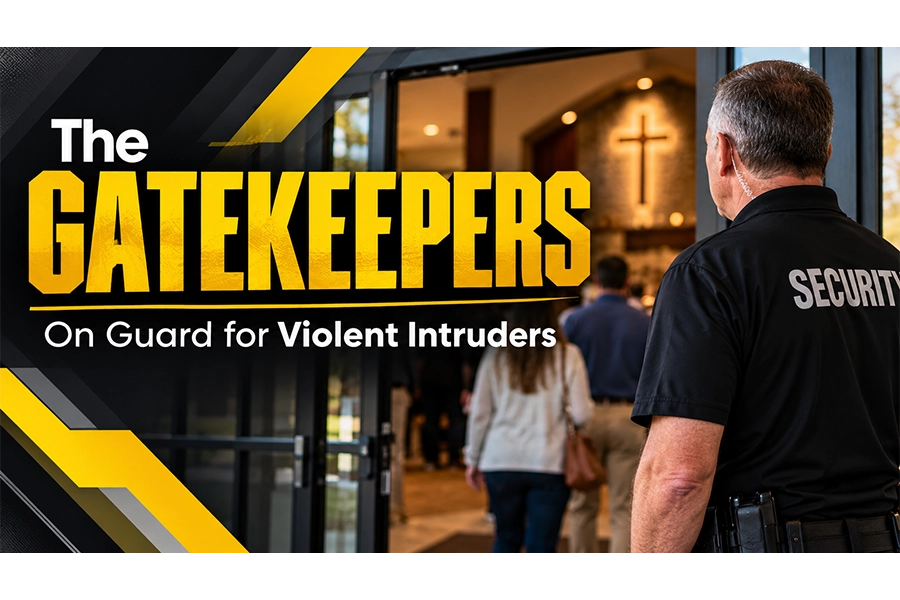
On Guard for Violent Intruders
This article is based on the Safety Member Certification core training module Violent Intruder Response V5, the Church Security Guide articles Church Safety Teams and Active Shooter Training and How to Conduct a Risk Assessment, and the Expert Resources articles How to Recognize Suspicious Behavior and Key Differences Between Church Safety and Law Enforcement. [1][2][3][4][5][6]][7][8].
From the Bible
Son of man, I have made thee a watchman unto the house of Israel: therefore hear the word at my mouth, and give them warning from me (Ezekiel 3:17).
For a day in thy courts is better than a thousand. I had rather be a doorkeeper in the house of my God, than to dwell in the tents of wickedness (Psalm 84:10).
Introduction –
It used to be that when you came to the door of a well-respected hotel, you were met by the doorman, who would greet you and open the door. A bellhop would take your baggage, and when you had registered, he’d accompany you to your room or suite. This was more than just being welcoming and helpful. They, the desk clerk, and room service were the eyes and ears of security, and they communicated with the hotel security guard.
By now, many of you see the analogy to church safety and security, with the greeters, ushers, teachers, staff, and safety team members. Together, they were and are the gatekeepers. While welcoming and helpful, they also work to keep violence outside the door.
On the Web –
There are several websites with listings of security risks, descriptions of typical situations, advice on what to watch for, and the security roles of people in church security. Here are a few samples from Religion News Service, USA Today, National Council of Churches in Christ in the USA (NCC), Cybersecurity and Infrastructure Security Agency (CISA), Smart Church Management, Church Law & Tax, Connections for Abused Women and their Children (CAWC), Shadows of Control, Ecclesiastical, Unitarian Universalist Association, The Gospel Coalition, Christian Warrior Training, Tina Rowe Training, and Omnilert,
Religion News Service,
The article “Violent acts in houses of worship are rare but deadly – here’s what the data shows,” by Jillian Peterson and James Densley, begins with a statistic from 2000 to 2024. During that time, there were 379 violent incidents, but not all had fatalities. Those with fatalities accounted for 487 persons killed, meaning that many of them resulted in multiple deaths. Most of the incidents were during service times on Sunday and Saturday. Targeted houses of worship were mostly churches and Christian schools, Synagogues and Jewish schools, and mosques. There were a few attacks on worship places of other religions. [9].
USA Today,
A USA Today article, “‘Always a bit on edge.' How religious leaders are confronting wave of violence,” reports on how religious organizations have been responding to a rising frequency of attacks by enhancing security in their places of worship. Religious holidays are sometimes the dates of attacks arising from religious hate. Gaining support from and cooperation with law enforcement agencies is a key to security preparation. [10].
National Council of Churches in Christ in the USA (NCC),
The NCC webpage, “Preventing Violence Against Places of Worship,” is based on federal agency resources, especially the Department of Justice, the Federal Bureau of Investigation, and the Cybersecurity and Infrastructure Security Agency (CICA). The outline of the NCC advice is to Develop a Plan:
- Establish roles and responsibilities,
- Conduct a self-assessment,
- Develop the appropriate security plans.
Additionally, several federal resources are listed:
- Developing Emergency Plans for Houses of Worship (FBI),
- Protecting Places of Worship through Education and Dialogue (DOJ),
- Helping Communities Prevent and Respond to Hate Crimes (DOJ),
- The Power of Hello Guide for Houses of Worship (2022) - (CICA),
- Mitigating Attacks on Houses of Worship Security Guide (2020) – (CISA),
- Preventing Targeted Violence and Protecting the Safety and Security of Houses of Worship through Faith and Community Based Approaches in the US and in Europe (a recorded webinar). [11].
Cybersecurity and Infrastructure Security Agency (CISA),
The pdf “Protecting Places of Worship” was developed by CISA staff and the FBI. Its outline is six steps. Step #4 is “Inform and Educate Greeters.” [12].
Smart Church Management (SCM),
We agree that smart church management should include safety & security measures. A 2023 SCM article by Patricia Lotich, “Mass Shootings – 6 Things You Can Do To Keep Your Church Safe,” focuses on the most horrific security concern of churches and other places of worship, massacres like the ones in Charleston and Sutherland Springs. [13][14].
The recommended things applying directly to gatekeepers are #2 Delegate Eyes and Ears, #4 Train on Response, and # 5 Guns or No Guns. [15].
Church Law & Tax,
The purpose of the organization Church Law & Tax is to advise churches and ministries on legal and tax-related issues. This includes protection of vulnerable persons and church safety in general. At least two of their blog articles relate to church and synagogue gatekeepers: “Protecting Your Church From an Active Shooter Scenario” by Andrew G. Mills (a police officer) and “Church Violence Statistics: 3 Steps to Keep Criminals from Targeting Your Church” by Matthew Branaugh. [16][17].
Mills’ 2015 article has four steps. Step 4 is “Prevent an incident (headings are quoted):”
Increase effort.
- Make it more difficult for an attacker to get in.
Reduce risk.
- Basically, this is putting distance between entry and the congregation or classes, giving the safety team more space and time to respond.
Plan in advance.
- This means forming response teams with trained members.
Reduce provocation.
- This is intervention with de-escalation.
Branaugh’s article is more recent. Now more churches have safety & security teams. The three steps are:
Appearances Matter: Crime Prevention Through Environmental Design.
- Keeping the grounds and building clean, neat, and in good repair makes a church less appealing to criminals.
Relationships Matter: Strengthen Community and Law Enforcement Connections.
- Then community members and law enforcement personnel will be more alert to what’s happening and more ready to help.
Common Sense Matters - Control Access to Church Facilities.
- This is the sense of Mills’ “Increase effort.”
Connections for Abused Women and their Children (CAWC),
The CAWC article “How to Recognize the Warning Signs of Domestic Violence” directly addresses a major cause of violent incidents in the church. It follows that recognizing signs of domestic abuse and violence should lead to compassionate intervention by the pastoral team and protective measures by the church safety team. [18].
Shadows of Control,
The website Shadows of Control is written under a pseudonym by a survivor of coercive control. She tells how coercive control usually begins small and escalates over time. It can result in psychological and physical abuse. This makes her article “Early Warning Signs of Violence: Recognizing Escalation Before It’s Too Late” relative to church safety and security. [19].
Ecclesiastical,
Ecclesiatical is an insurer of churches in the Anglican tradition in the United Kingdom, Ireland, and Canada. Thus, they have a vital interest in the safety and security of churches. Risk abatement begins with risk assessment, and Church Risk Assessments was written to guide churches in this. This takes into account the size of the church and whether or not it has employees (other than the pastor). Following this, they state, “You will then need to decide if the precautions already in place are adequate. If they are not, you may need to think about what more you can do.” [20].
Unitarian Universalist Association,
This is guidance within one denomination. By-and-far, they are not alone in recommending these measures to member congregations. “Safety and Security Training for Ushers and Greeters,” part of the handbook “Becoming a Safer Congregation,” states, “Greeters, ushers, ministers, teachers, and staff all share responsibility for the safety and security of the congregation.” [21].
The Gospel Coalition,
In 2017, three days after the Sutherland Springs church shooting that left 26 victims dead and 21 injured, The Gospel Coalition published “7 Ways to Prepare Your Church Against Violence” by Joe Carter. He begins by telling how a church in Virginia handled a homeless man in the back of the sanctuary. After pointing out that innocent encounters are more likely than deadly violence, he goes on to advise how to be ready for any level of potential violence, hence the 7 steps of preparation (the headings are quotes):
Communicate to your congregation.
Share your concern for safety with the leadership and the membership.
Be realistic about your security context.
What are the most likely threats and in what contexts?
Think outside the church door.
Most threats begin outside, then come in.
Understand the singular threat of domestic violence.
This is a major cause of violent attacks.
Identify and prepare the guardians.
This involves identification, recruitment, training, and coordination.
Protect the children.
This a must in any situation.
Prepare against anxiety and hardheartedness.
Leadership and members of the congregation should be ready to meet threats without becoming hardhearted. [22].
Christian Warrior Training,
In a video, Keith Graves told about an attack that was stopped just in time after a man went into a church with five bombs. He had planned to plant one bomb close to an individual targeted person, then leave the church. Someone knew his intentions and called the police. He intended to leave one bomb at that church and go to another place in the city to blow up others persons. Police arrived at the church and arrested the man, finding the bombs on his person and in his truck. They also found materials in his home. If that first bomb had gone off, more than one person could have been killed. This shows the importance of “See something? Say something.” [23].
Tina Rowe Training,
A part of Tina Lewis Rowe’s series on church security, Security Concerns For Churches, is The Role Of Greeters and Ushers. Greeters and ushers are there to welcome members and visitors and help them find seats or navigate the church hallways. They also are positioned to naturally have a role in church safety and security.
Greeters are in frontline positions of safety, since they meet those who are coming in. As they welcome attenders, they can observe their clothes, posture, facial expressions, etc. Like the doorman and the bellhop in the hotel, they may be able to spot indications of concern. If equipped with a radio, they can communicate with the safety team.
If properly trained, greeters and ushers may de-escalate a tense situation or respond to a medical emergency. Rowe covers their security roles in detail. [24].
Omnilert,
This company has an interest in church security. They are a provider of AI Gun Detection Solutions. Whether you have this advanced product or not, its existence underscores the value of observing people, alert for hidden weapons.
The company has a blog. Two of the articles directly address church security: “Church Shootings: What We Can Learn From the Patterns of Attacks on Houses of Worship” and “Camera Performance Can Change While a Camera Remains ‘Online’.” The first one mentions common characteristics among church shooters. The second considers security camera cleaning and maintenance. [25][26].
The Watchman on the Wall –
In Ezekiel 3, the LORD told Ezekiel the task of a watchman. He was to be alert for any signs of threats. If he saw an enemy approaching, he was to blow a trumpet (either a brass horn or a Shofar – ram’s horn) to alert soldiers and citizens of the threat so they could lock the gates and mount a defense. If they did not respond, and were conquered, they were responsible. If the watchman failed to blow the horn, then he was responsible.
That passage describes the role of a church safety team and its auxiliary help. The team members, greeters, ushers, and other volunteers and staff are to coordinate in their observations to be, as the Psalmist said, “doorkeeper[s] in the house of … God.” What does this entail?
Considering the Risks.
Gatekeepers need to be informed about probable risks so they know what to be alert for. For instance:
- A threat to another church or churches in general in that area: safety team members and greeters should be advised of it.
- A parent is in a custody dispute or has sole custody, and the non-custodial parent may try to either take the child or confront the other parent.
- A member or regular attendee is in a domestic violence situation. It may also be a coercive control situation which is escalating to violence. These members/attendees should have enough confidence in the safety director, pastor, and counselors to confide in them. The gatekeepers can then be advised on what to be alert for.
Observation.
Whether at the door, in the lobby or hallways, in the worship center, in the parking lot, or somewhere else on the church campus, these gatekeepers are to be alert for persons needing help, for suspicious behavior, for signs of concealed weapons, for suspicious boxes, etc. This also applies to interior and exterior patrols, as well as to whoever is monitoring the surveillance cameras.
Prepared.
A gatekeeper should be dressed for action. This differs by role. All need good shoes – enclosed with sturdy, non-slip soles. With the exception of incognito team members, they need role identification - a badge, nametag, team shirt, cap, or vest - that lets others know they are there to watch and help.
Equipped.
Communication is a key to coordination. Gatekeepers need two-way radios with ear pieces. They also know radio etiquette and situation codes. Also useful are discrete hand signs known by all gatekeepers.
Trained.
Gatekeepers are trained in their craft to know what their roles are in any situation. They have also practiced in drills so that they can respond quickly and confidently.
Dedicated.
Above all, a gatekeeper is dedicated to the safety and security of the congregation, willing to give his or her all when needed.
Conclusion –
In Mark 13:33, Jesus told His disciples, “Take ye heed, watch and pray: for ye know not when the time is.” As gatekeepers in the church, we prayerfully watch so we can guard the flock.
References –
- Kris P. Moloney, Safety Member Certification, Sheepdog Church Security Academy, 2025 [https://sheepdog-church-security.thinkific.com/courses/safety-member-certification-v5-2025].
- Kris P. Moloney, “Violent Intruder Response V5,” Safety Member Certification, Sheepdog Church Security Academy, 2025 [https://sheepdog-church-security.thinkific.com/courses/church-safety-violent-intruder-response].
- Kris P. Moloney, Church Security Guide, Sheepdog Church Security Academy, 2023 [https://sheepdog-church-security.thinkific.com/pages/security-articles?c=church-security-guide].
- Kris P. Moloney, “Church Safety Teams and Active Shooter Training,” Church Security Guide, Sheepdog Church Security Academy, June 9, 2023 [https://sheepdog-church-security.thinkific.com/pages/security-articles?p=church-safety-active-killer-response-strategies].
- Kris P. Moloney, “How to Conduct a Risk Assessment,” Church Security Guide, Sheepdog Church Security Academy, June 9, 2023 [https://sheepdog-church-security.thinkific.com/pages/security-articles?p=how-to-conduct-a-risk-assessment].
- Kris P. Moloney, Expert Resources, Sheepdog Church Security Academy, 2023 [https://sheepdog-church-security.thinkific.com/pages/security-articles?c=expert-resources].
- Kris P. Moloney, “How to Recognize Suspicious Behavior,” Expert Resources, Sheepdog Church Security Academy, February 1, 2024 [https://sheepdog-church-security.thinkific.com/pages/security-articles?p=building-awareness-recognizing-and-reporting-suspicious-behavior-for-church-safety-pioneers].
- Kris P. Moloney, “Key Differences Between Church Safety and Law Enforcement: A Guide for Experienced Professionals,” Expert Resources, Sheepdog Church Security Academy, February 1, 2023 [https://sheepdog-church-security.thinkific.com/pages/security-articles?p=key-differences-between-church-safety-and-law-enforcement-a-guide-for-experienced-professionals].
- Jillian Peterson and James Densley, “Violent acts in houses of worship are rare but deadly – here’s what the data shows,” Religion News Service, October 6, 2025 [https://religionnews.com/2025/10/06/violent-acts-in-houses-of-worship-are-rare-but-deadly-heres-what-the-data-shows/].
- Karissa Waddick, “‘Always a bit on edge.' How religious leaders are confronting wave of violence,” USA TODAY, October 2, 2025 [https://www.usatoday.com/story/news/nation/2025/10/02/churches-mosques-synagogues-preparing-amid-violence/86454249007/].
- NCC Staff, “Preventing Violence Against Places of Worship,” National Council of Churches in Christ in the USA, no date [https://nationalcouncilofchurches.us/preventing-violence-against-places-of-worship/].
- CISA staff with the Federal Bureau of Investigation, “Protecting Places of Worship,” Cybersecurity and Infrastructure Security Agency, May 9, 2023 [https://www.cisa.gov/sites/default/files/2023-05/Protecting-Places-of-Worship_20230509_508.pdf].
- Contributor and editors, “Charleston church shooting,” Wikipedia, June 18, 2015 to October 2, 2026 [https://en.wikipedia.org/wiki/Charleston_church_shooting].
- Contributor and editors, “Sutherland Springs church shooting,” Wikipedia, November 5, 2017 to October 2, 2026 [https://en.wikipedia.org/wiki/Sutherland_Springs_church_shooting].
- Patricia Lotich, “Mass Shootings – 6 Things You Can Do To Keep Your Church Safe,” Smart Church Management, April 4, 2023 [https://smartchurchmanagement.com/church-mass-shootings/].
- Andrew G. Mills, “Protecting Your Church From an Active Shooter Scenario,” Church Law & Tax, June 2, 2016 [https://www.churchlawandtax.com/keep-safe/crisis-management/a-shooter-in-the-house/].
- Matthew Branaugh, “Church Violence Statistics: 3 Steps to Keep Criminals from Targeting Your Church,” Church Law & Tax, Last Reviewed: February 10, 2025 [https://www.churchlawandtax.com/keep-safe/facility-management/3-steps-to-keep-criminals-from-targeting-your-church/].
- Anonymous, “How to Recognize the Warning Signs of Domestic Violence,” Connections for Abused Women and their Children, June 30, 2025 [https://www.cawc.org/news/how-to-recognize-the-warning-signs-of-domestic-violence/].
- Samara Knight (pseudonym), “Early Warning Signs of Violence: Recognizing Escalation Before It’s Too Late,” Shadows of Control, no date [https://shadowsofcontrol.com/articles/warning-signs-of-violence/].
- Staff, “Church risk assessments,” Ecclesiatical, November 26, 2025 [https://www.ecclesiastical.com/risk-management/church-risk-assessments/].
- Anonymous, "Safety and Security Training for Ushers and Greeters,” Unitarian Universalist Association, no date [https://www.uua.org/safe/handbook/covenant/training-ushers-and-greeters].
- Joe Carter, “7 Ways to Prepare Your Church Against Violence,” The Gospel Coalition, November 8, 2017 [https://www.thegospelcoalition.org/article/7-ways-prepare-church-violence/].
- Keith Graves, "Man Walks Into Church With 5 Bombs, Attack Stopped Just in Time," Christian Warrior Training, March 19, 2026 [https://www.youtube.com/watch?v=X3EouQ6z9lU].
- Tina Lewis Rowe, “The Role Of Greeters and Ushers,” Tina Rowe Training, 2008 to March 2019 [https://psec.org/wp-content/uploads/2019/03/The-Greeter-and-Usher-Role-In-Church-Security.pdf].
- Omnilert Staff, “Church Shootings: What We Can Learn From the Patterns of Attacks on Houses of Worship,” Omnilert, Updated: February 2, 2026 [https://www.omnilert.com/blog/church-mass-shootings-in-america].
- Omnilert Staff, “Camera Performance Can Change While a Camera Remains ‘Online’,” Omnilert, Updated: October 2, 2026 [https://www.omnilert.com/blog/security-camera-health].