




Safety During Roadway Emergencies
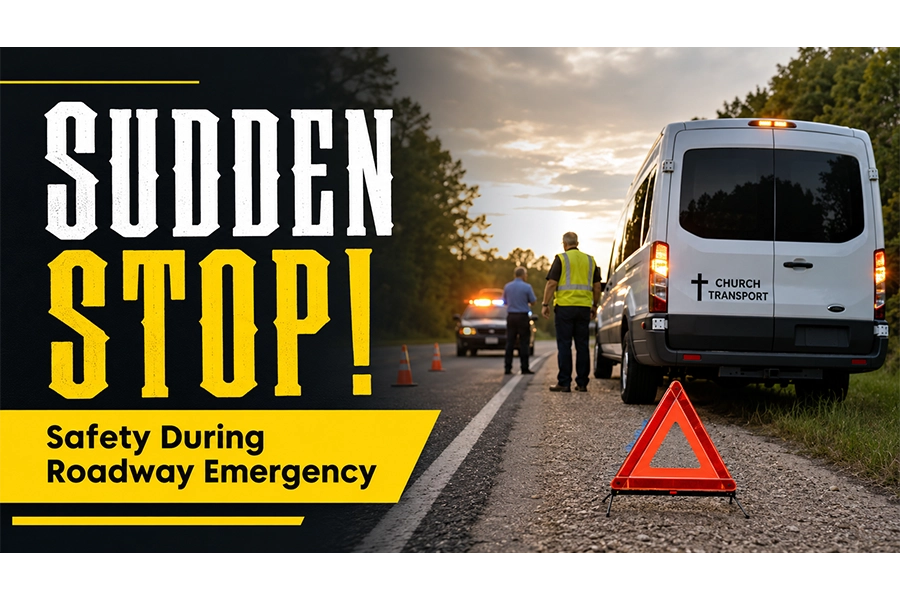
If you are in a church vehicle and there is an emergency on the road, how could you safely respond?
What Is the Core Lesson From the Panama City Auditor Incident?
* The Good Samaritan risked being robbed when he stopped to attend to a robbery victim on the Jericho Road:
And Jesus answering said, A certain man went down from Jerusalem to Jericho, and fell among thieves, which stripped him of his raiment, and wounded him, and departed, leaving him half dead... But a certain Samaritan, as he journeyed, came where he was: and when he saw him, he had compassion on him (Luke 10:30,33).
A domestic animal in a pit could be legally rescued on any day, even on the Sabbath:
And [He] answered them, saying, "Which of you shall have an ass or an ox fallen into a pit, and will not straightway pull him out on the sabbath day?" (Luke 14:5).
Introduction –
Emergencies happen on our roadways and streets. A few examples are accidents, disabled vehicles, fires, medical emergencies, obstructions, and road rage. If you are in a church vehicle or on your way to a church event, and there is an emergency, the response should not only be timely and effective, but also reasonably safe. Safety can be a relative term, depending on the situation. By reviewing emergencies that have happened and considering scenarios of likely events, we can develop our thinking to include safety in how we respond, for both us and the persons we help.
In the News –
In each of these stories, ask yourself, “What would I do?”
A second collision, persons on road:
Walnut Creek Township, Holmes County, Ohio, March 4 2026 – A young man in a Jeep was westbound on his way to work while it was still dark. A man on an e-bike was in the westbound shoulder. The cyclist turned left to go into a driveway. He hit the Jeep and landed injured on the eastbound lane. The Jeep driver made a U-turn and stopped on the eastbound shoulder. He then went to the cyclist to help him.
An eastbound sedan came over a rise and curve and hit the two men, killing the cyclist and critically injuring the Jeep driver. Since it was dark, the sedan driver saw the Jeep, but did not see the two men in time. [1][2].
Witnesses become rescuers:
Marion County, Florida, May 6, 2026 – When a school bus making a left turn failed to yield to oncoming traffic, it was hit by a truck. The truck driver was trapped in his vehicle. Other drivers, who had stopped, rushed to the truck and tried to rescue its driver. When fire department medics arrived, they had to use jaws-of-life. In spite of heroic efforts, the truck driver died. [3].
Private vehicle transported collision victims:
Habersham County, Georgia, June 29, 2024 – Six persons, 4 teens and 2 adults, were injured when a church van and an SUV collided at an intersection. Two were taken to hospitals by ambulance, and one was airlifted. Three with minor injuries were transported “by private vehicle.”
Two church passenger vans were taking the teens to tubing on a river at the end of a community service weekend. At an intersection of the state highway with another road, the driver of the SUV ran a red light, hitting one of the vans on the passenger side. The SUV driver was arrested and charged with DUI.
News articles do not name the person(s) who drove three of the injured to a hospital, but the phrase “by private vehicle” is singular and could refer to the other van. [4][5][6].
Medical emergency on a bus:
Glasgow, Scotland, United Kingdom, April 2021 – When a 67-year-old passenger on a Glasgow bus experienced atrial fibrillation, other passengers alerted the driver, who pulled the bus over and stopped. The driver saw the man’s lips turning blue. He positioned the passenger and began CPR, guided over a phone (that another passenger held) by the 999 operator. He continued CPR until responding EMTs took over. The passenger survived and recovered. [7].
Driver from stopped vehicle hit and killed:
Wasco County, Oregon, May 5, 2026 – Late at night, a woman whose vehicle had broken down was walking in the driving lane of US 97 in Wasco County. She was hit by a southbound fully-loaded semi from Spokane, landing in the northbound lane. There she was run over by a northbound car that drove off, presumably thinking an animal had been struck. At the time of posting, the Oregon State Patrol was asking for reports of hitting an animal in that section of US 97 close to the time of the incident. [8].
Bothell, Washington, May 4, 2026 – About 3:05 am, a northbound car stalled on I-405 in Bothell. The driver left it on the left shoulder (by the median), ran across the traffic lanes, and was hit by another car. The driver of that car called 911 and remained on the scene. The driver of the stalled car died on site. [9].
Good Samaritans respond to chain collision:
Lane County, Oregon, May 3, 2026 – A motorcycle on SR 99 W in Lane County rear-ended an SUV, then was struck by another motorcycle. Both riders were thrown onto the road. Good Samaritans stopped to help the two motorcycle riders before first responders arrived. One cyclist died on the scene, the other was seriously injured. [10].
Driver stops to save person in burning car:
Kenosha County, Wisconsin, May 2, 2026 – A couple driving along a state highway came across an accident scene. One car was burning with a woman in it. The couple stopped and the husband jumped out, went to the burning car, and pulled the woman out. [11].
When Decisions Matter –
In each of the news stories, someone decided what to do in an emergency. In two of the accounts, the person making the decision died, and in another he was seriously injured.
Considering Your Response:
For each incident, consider how you would respond. Is this the same as or different from decisions made by the persons on the scene? How and why? We’ll use the news incidents.
Injured person(s) on road:
In the first incident type, an injured person is lying on a driving lane, and a driver stops to help.
In this particular case, the responder's vehicle was involved, so it was his legal duty to stop and render assistance. However, we may not be involved but feel a moral duty to help. Therefore, what is the safest way to do this? Here’s my take on this event:
Since the victim is lying in a driving lane, oncoming vehicles must be diverted around the scene to protect both the victim and the responder. Day or night, park a vehicle in the driving lane with the flashers on, upstream from the victim, tail to oncoming traffic. If it is dark and you have flares, light them and place them behind the shielding vehicle. A driver should see this and go around. Turn the steering wheels so that if hit, the shield car will go to the side while the hitting vehicle might be diverted the other way.
Witnesses, Good Samaritans, become rescuers:
We may be witnesses or come upon the scene of an emergency. If responders are not already there, we may be led to help. The first question is, “Are we trained and equipped to help?” The second is, “What is the safe way to do this?”
To answer the second question, we need to take into consideration:
- Are the persons and vehicles out of the driving lane(s)?
- If in the lane, is it blocked?
- Is there a threat of fire, explosion, or hazardous materials?
- Is there another location hazard (such as on the edge of a drop-off, in the water, on the edge of a bridge, etc.)?
- Are there others helping?
We must help, but first call 911, then use questions to guide us in how to help. For instance,
- If an injured person is in a driving lane, can we move them off the lane without further injury?
- If not, how can we block the lane or divert traffic?
- If there is a fire, what is the best way to remove a victim?
- Is there a fire extinguisher available?
- If you’re not alone, one of you should be ready to meet emergency personnel when they arrive.
Each incident is unique in some way, so we need to be able to quickly assess the situation.
Private vehicle transported collision victims:
Usually, EMTs or police transport injured persons to medical facilities. In the related news account [5], there were two church vans, one not involved in the collision, and the three persons transported by private vehicle had minor injuries. In this case, the official responders permitted their private transportation, which was likely in the undamaged van.
Medical emergency in vehicle:
Members who are trained in medical emergency response (MER) should be present in the church and at off-site church events. It is advisable to have MER trained persons in a church vehicle transporting persons. Ideally, this includes drivers and chaperones.
Driver from stopped vehicle hit and killed:
Whether in a church vehicle or another, it pays to respond safely if for one reason or another the vehicle is disabled. In the two news stories, two drivers put themselves at risk when their vehicles stopped, one by walking in driving lanes in the dark, the other by running across freeway lanes, also in the dark. Here are some safety rules:
- If you can, get the vehicle off the driving lanes.
- Call for help (for safety reasons, this is why you take a mobile phone in your car).
- Stay in or with the vehicle if help is coming.
- If you have to go for help, follow pedestrian safety rules:
- Make yourself visible with bright colors during the day and light clothes at night.
- If you have a flashlight, use it.
- Stay off driving lanes when you can.
- Walk facing oncoming traffic (usually on the left side of the road). That way you can see a vehicle coming and get out of the way.
Driver stops to save person in burning car:
This should be a no-brainer. Some situations justify taking risks to save lives. Considering the circumstance, quickly find an effective way of loosing the person and pulling them out of the vehicle. This may mean breaking a window.
Conditioning Your Response:
We condition our emergency responses by mentally rehearsing actual incidents and hypothetical ones. We can also role-play them in drills. This conditions our minds to see, analyze, and act. News stories can provide scenarios for mental rehearsal. They do not have to involve church vehicles. Those roadway emergencies can happen no matter what vehicles are involved, and sometime down the road can involve church vehicles.
Equipped to Respond on the Road –
Church vehicles need to have some essential emergency supplies.
- Each vehicle should have a fire extinguisher.
- Flares and traffic-control pylons (cones) are used to warn other drivers.
- A First Aid kit is needed for medical emergencies and injuries. The size depends on the type of vehicle, whether sedan, SUV, van, or bus. An AED is advisable for vans and busses. Medical emergency equipment and supplies can be found on Sheepdog Church Security Academy’s Shopify store, Medical & Emergency Response. The Sheepdog Individual First Aid Kit and the Mass Trauma Kit can be found on Mountain Man Medical (an SCSA affiliate).
- A multitool, such as a Swiss Army Knife or Leatherman, can give you several options in one hand.
- A good tool for roadway emergencies is a tactical knife. It can be used for cutting straps to free persons after an accident. A good tactical knife also has a handle that can be used to break glass to rescue someone. A few examples of this need are
- Danger of fire or explosion,
- A vehicle which might slide off an embankment,
- A vehicle in water, or
- A person in a vehicle needing immediate treatment.
Are there any other items you consider needed for roadway emergencies?
Training –
First of all, every member of a church safety team should be trained and certified through Safety Member Certification with its eight training modules [12]:
- Safety Member Fundamentals V5
- Violent Intruder Response V5
- Deescalating Disruptive Persons V5
- Protecting the Vulnerable V5
- Use of Force with Andrew Branca V5
- Arson and Fire Safety v4
- Storms and Disasters v4
- Mass Trauma Emergency
Next, read available reliable articles related to roadway emergencies.
Conduct drills on responding to various kinds of road emergencies. Include tabletop exercises and role-playing. Continue with mental rehearsals, such as in the free download “Mental Rehearsal Guide: Building Confidence Through Preparation” – click *HERE* to get it. Considered situations should at least include accidents, disabled vehicles, medical emergencies, and vehicle fires. [13].
Conclusion –
Be ready to safely respond to any vehicle emergency.
References –
- Avery Williams, “Chain-reaction crash that killed e-biker under investigation in Holmes County,” WOIO 19 News, March 4, 2026 [https://www.cleveland19.com/2026/03/04/chain-reaction-crash-that-killed-e-biker-under-investigation-holmes-county/].
- Jordan Miller, “A Tuscarawas County man was killed and another driver critically injured early Wednesday morning in a crash involving an electric bicycle and two vehicles in Holmes County, authorities said,” Jordan Miller News, March 5, 2026 [https://www.jordanmiller.news/tuscarawas-county-man-killed-driver-critically-injured-in-double-crash-involving-e-bike/].
- Greg Fox, “Video shows heroic rescue attempt following fatal school bus crash in Marion County,” WESH 2 News, Updated: May 7, 2026 [https://www.wesh.com/article/video-shows-heroic-rescue-attempt-following-fatal-school-bus-crash-florida/71246074].
- WSBTV.com News Staff, “Multiple people injured after church van and SUV collide in Habersham,” WSB-TV, June 30, 2024 [https://www.wsbtv.com/news/local/multiple-people-injured-after-church-van-suv-collide-habersham/WCRXDJOWK5GXHFXKOOP6KH2RFY/].
- Jerry Neace and Joy Purcell, “GSP: SUV driver charged with DUI after crashing into church van,” Now Georgia, June 30, 2024 [https://nowgeorgia.com/breaking-now-church-van-crash-closes-ga-365-southbound-multiple-injuries-reported/].
- Jerry Neace and Joy Purcell, “Pastor: Grateful for prayers after ‘traumatic’ church van crash,” Now Georgia, June 29, 2024 | Updated: June 30, 2024 [https://nowgeorgia.com/pastor-grateful-for-prayers-in-wake-of-tragic-church-van-crash/].
- Lottie Tiplady-Bishop, “JUST THE TICKET: I collapsed from a heart attack on the bus – I’ll be forever grateful to the driver who saved my life,” The Scottish Sun, Published February 17, 2022 [https://www.thescottishsun.co.uk/news/8443436/glasgow-bus-driver-cpr-saved-life/].
- Staff, “Fatal Crash – Highway 97 – Wasco County - 05/07/26,” Oregon State Police, May 7, 2026 [https://www.flashalert.net/news.html?id=1002].
- Brian Henderson, “Everett Man Dies After Running Across I-405 Near Bothell,” Pacific Northwest Daily, May 6, 2026 [https://pnwdaily.com/2026/05/06/i405-bothell-pedestrian-fatality-may-2026/].
- Staff, “Oregon State Police responded to a three-vehicle fatal crash involving two motorcycles on Highway 126 near milepost 2.7 in Lane County.” Oregon State Police, May 3, 2026 [https://www.flashalert.net/news.html?id=1002].
- Anon, “Head-On Crash Injures 3, 2 Critically; Rescuer Describes the Ordeal,” WGTD, May 2, 2026 [https://www.wgtd.org/news/head-crash-injures-3-2-critically-rescuer-describes-ordeal].
- Kris Moloney, Safety Member Certification, Sheepdog Church Security, 2025 [https://sheepdog-church-security.thinkific.com/courses/safety-member-certification-v5-2025].
- Kris Moloney, “Mental Rehearsal Guide: Building Confidence Through Preparation,” Sheepdog Church Academy, © 2025 [https://sheepdog-church-security.thinkific.com/products/digital_downloads/mental-rehearsal-guide-building-confidence].