




Situationally Aware
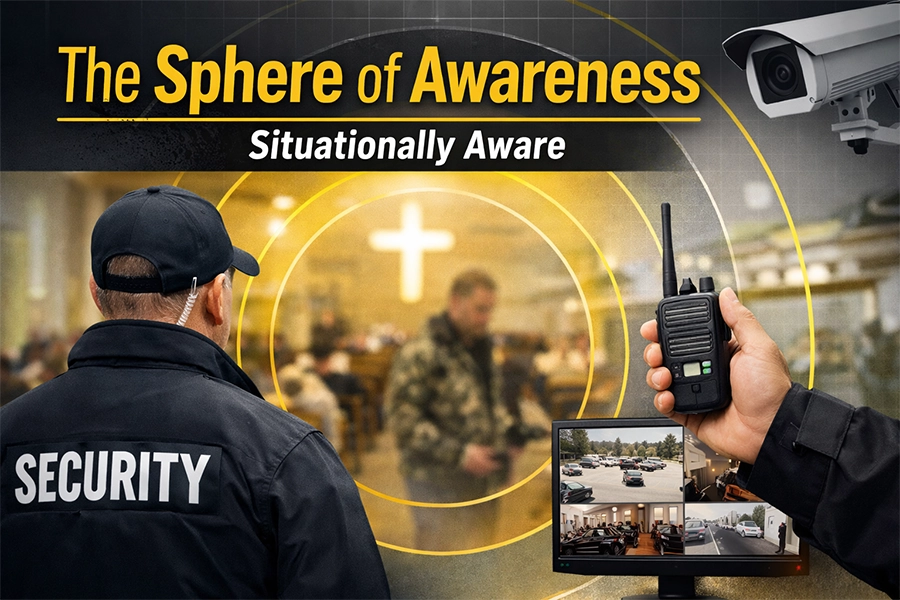
An article based on the Safety Member Certification training module “Safety Member Fundamentals” and the Church Security Guide article “Church Safety Team Basics.” [1][2][3][4].
From the Bible –
* Watchfulness (keeping their heads up, lapping water out of their hands) was the test for Gideon’s men:
So he brought down the people unto the water: and the Lord said unto Gideon, "Every one that lappeth of the water with his tongue, as a dog lappeth, him shalt thou set by himself; likewise every one that boweth down upon his knees to drink." And the number of them that lapped, putting their hand to their mouth, were three hundred men: but all the rest of the people bowed down upon their knees to drink water. And the Lord said unto Gideon, "By the three hundred men THAT LAPPED will I save you, and deliver the Midianites into thine hand: and let all the other people go every man unto his place" (Judges 7:5-7).
* Levites were to watch as they guarded the young king in the Temple:
And two parts of all you that go forth on the sabbath, even they shall KEEP THE WATCH of the house of the Lord about the king (2 Kings 11:7).
* We are to be watchful and alert:
Take ye heed, WATCH AND PRAY: for ye know not when the time is (Mark 13:33).
Be sober, BE VIGILANT; because your adversary the devil, as a roaring lion, walketh about, seeking whom he may devour (1 Peter 5:8)
Introduction –
Situational awareness is needed for many kinds of activities, such as sports, crowd management, hunting, walking down the street, military actions, and security, etc. The best way to describe the range of awareness is spherical. Essentially, this means in any and all directions, as close to simultaneously as possible. An example of this is in piloting an airplane, both on the ground and in the air.
This is especially true for fighter pilots. For them, spherical awareness means everywhere in every way. Visual awareness is enhanced by special eyewear, camera images, night vision aids, radar, electronic sensors, etc. Added to this is auditory awareness, being alert to the sounds of the aircraft and its engines, audible alerts from the instruments, radio communications, external sounds, and so forth. Tactile stimuli come into play as the plane maneuvers through changing trajectories, speeds, and g-forces.
Our situational awareness in a church safety ministry is not at the level of a fighter pilot, but it is spherical, alert to visual, audible, and tactile stimuli, as well as smells. Training and knowledge of special concerns educates our awareness, tuning us to certain indicators, such as signs of concealed weapons.
In the News –
West Bloomfield Township, Michigan, March 12, 2026 – A man drove a truck into the school entrance of Temple Israel in West Bloomfield Township just outside of Detroit. As we can see on Google Maps satellite and street views, the main synagogue entrance and the next one are shielded by bollards, but not the school entrance. There was also a clear approach path for the truck through the parking lot. The truck got into the school hallway. The driver got out and began heading down the hall firing a firearm. Meanwhile, the truck’s engine ignited.
Synagogue security and staff responded immediately. Trained security engaged the shooter, neutralizing him on the spot. School staff safely evacuated the children to school busses and took them to a nearby community shelter.
Not long before this incident, FBI and local law enforcement had trained security, staff, and teachers in hostile intruder response. The synagogue had not yet hardened the school entrance, but when it was breached, security and staff knew what to do. First, they were alert and saw that the truck was headed to the door. This accounted for their immediate response. [5].
Wayne, Michigan, June 22, 2025 – A deacon at CrossPointe Community Church in Wayne was late for church. He saw a man wearing tactical clothing and carrying a rifle and a handgun driving recklessly in the parking lot. He called 911. While talking with the dispatcher, he saw the man get out of the car and start to head for the church with the rifle in shooting position. The deacon drove his Ford 150 toward the gunman, who began shooting at his truck. Staff members coming out encountered the shooter and neutralized the threat. Since they had all received training in shooter response, they were alert to suspicious activity outside the building.
Meanwhile, the pastors and ushers evacuated everyone in the church to safety. [6][7].
Houston, Texas, February 11, 2024 – Spherical awareness was missing: A mentally ill woman with an AR-15 enters Lakewood Church with her 7-year-old son. Inside in a corridor, she pulls the rifle out of her trench coat and begins threatening everyone she sees. Firing shots, she wounds one man in the leg before off-duty police officers acting as church security engage and neutralize her. In the action, her son was wounded.
Since she had come in through a door manned by a posted guard, and her improper parking and exiting of the vehicle were caught by security cameras, there should have been an awareness of her presence and indications of the weapon. She could have been safely stopped at the door, saving her life and sparing her son and the man from wounding. [8][9].
Tulsa, Oklahoma, October 5, 2022 – When students of the Holy Family Catholic Cathedral school were on the church steps posing for class pictures, a man walked up a side street toward the cathedral, armed with a sword. Teachers spotted him coming up a side street and ushered the children inside, locking the doors. The church’s main entrance was also secured, keeping the would-be assailant outside.
One staff member was wounded while covering for the students, knocking the sword away, he then ducked inside, locking the door. The man tried to get in without success. He also tried to throw firebombs through the windows (they bounced off). Police were alerted, and he was arrested a mile away. [10].
Spherical Awareness Makes a Difference –
In our Lessons Learned series, we have seen many church security situations where earlier awareness of danger could have made a difference. Besides armed attacks, severe weather, fire, and other hazards also call for early detection and action. The key is being alert to our surroundings, both immediate and remote. Just as the fighter pilot is equipped to see more than what can be seen by turning his head, we should have and make use of technical extensions of our awareness. Some of these means are cameras, sensors, alarms, and weather radios.
In a personal example, in 2010 we were at a wedding when the power went out. Someone listening to weather reports informed us of a tornado warning, and everyone went to the basement hallway.
Lives have been saved because fire was detected early, a tornado warning was heeded, etc. Someone was aware of threats in the outer sphere outside of the church property and acted on this knowledge.
Shared Awareness –
Sometimes, one person becoming aware of a situation can take care of it. For example,
- Closing and locking an open door,
- Straightening a rumpled door mat so nobody trips on it,
- Moving a combustible item away from a heat source.
Reporting and logging the situation shares this knowledge with others. This way others will be made alert for similar things. Being aware of discovered dangers should lead to prevention of common security concerns.
This brings up a benefit of patrolling. For the persons on patrol, their sphere of awareness is expanded. Sharing their observations expands the sphere of awareness for other team members.
Many times, however, a potentially dangerous situation requires immediately shared awareness. Here are four examples:
- A greeter signals a safety team member that a suspicious person is coming in.
- A parking lot attendant radios that a vehicle is loitering with the occupant watching the entrance.
- A safety team member spots an abusive spouse and radios the team to get the abused spouse to safety.
- A team member shares intelligence about a concerning situation.
Shared awareness through communication facilitates coordination in both prevention and response. One lament we do not want to hear is, “Why didn’t you tell me?”
Ways to Share:
We can share our awareness by in-person oral communication, hand signs or signals, over the radio, phone, written logs, reports, and notes, text messages and recorded audio.
In-Person Oral,
We can go to a person to tell them what we have seen or heard, or tell them when we happen to meet them. Briefing and de-briefing should happen during a shift change.
Hand Signs or Signals,
A few hand signs are obvious. However, most need prior arrangement. This works better when everyone knows the proper signs and signals. One advantage of this is that they are not heard by unauthorized persons. A prearranged sign may be done discretely, unseen by only the intended recipient. One occasion would be the backup for a member in verbal de-escalation signaling to others that more help or medical response is needed, or to call 911. This is effective if team members in a position to see are alert to any communication by the de-escalator or the backup.
Radio,
This is the most common means of sharing awareness during services or events. The use of earpieces makes it discreet for a member in a crowd. He or she can hear what other members are saying without disturbing the service or event.
Phone,
This is not the usual way of sharing awareness within the church or on the campus. It is a way to inform or alert a team member or someone else who is not on site.
Written Media,
This can be in a log, on an incident report, or generally sharing observations in a bulletin. A key advantage of writing observations or received information is having it on the record when accurate information is needed, such as in an investigation, in a review, or in assessment and planning.
Mass Notifications,
When we become aware of some situations, we need to notify more than other team members or church leadership. That kind of an urgency would be a general emergency, such as a violent intruder, a structural threat (such as leaking gas, roof in danger of collapse, breaking wall, etc.), fire, severe weather, local disaster, etc. Ideally, the first person to contact will be someone who can initiate a mass notification.
Recorded Audio Messages
Nowadays, with most smart phones, this may be an audio log. An audio log can be used by the team member when writing findings in a patrol log or incident report. An audio message can be left for or transmitted to other persons, including team members, the Safety Director, congregation members on a call list, etc.
On the other hand, it can be voice messages when persons do not answer their phones. It can also be text messages to an individual or a group. For instance, to let members on the next shift know beforehand that they will have to be on the alert for a certain person, such as a threatening spouse or non-custodial parent. This might be the case in a church with multiple morning services.
To sum up sharing awareness, it has the purpose of expanding other persons’ spheres of awareness when needed.
Over Your Shoulder –
Spherical awareness is active awareness. It’s not standing like a statue, but moving your head and body so that you can be aware of what is off to your side, over your shoulder, over your head, or, in an elevated position, what is below you. It is monitoring the camera screen, having your earpiece in and your radio on, listening to the sounds around you, being ready to sense the unfamiliar in the midst of the familiar. On the Cooper Scale, it is not white, but yellow, then if needed, orange or red.
Training –
All safety Team members should be trained and certified through the Safety Member Certification (SMC) program. Spherical awareness is a key skill to be applied in all the training modules, for instance, being aware of
- Abusive domestic situations,
- Child abuse,
- Fire hazards,
- Severe weather forecasts, watches, and warnings,
- Suspicious persons and items,
- Disruptive and potentially disruptive persons,
- Safety hazards,
- The best level and means of force to use,
- The start of a medical incident.
This is only a sample of the kinds of awareness to be honed when taking the SMC classes. More can be learned in the Church Security Guide and the various articles, including Lessons Learned, posted on the New Sheepdog Bulletin.
Conclusion –
You are in the center of a sphere. Be aware in each direction in the sphere.
References –
- Kris P. Moloney, “Safety Member Certification,” Sheepdog Church Security Academy, 2025 [https://sheepdog-church-security.thinkific.com/courses/safety-member-certification-v5-2025].
- Kris P. Moloney, “Safety Member Fundamentals V5,” Sheepdog Church Security Academy, 2025 [https://sheepdog-church-security.thinkific.com/courses/Safety-Member-Fundamentals-V5].
- Kris P. Moloney, “Church Security Guide,” Sheepdog Church Security Academy, [https://sheepdog-church-security.thinkific.com/pages/security-articles?c=church-security-guide].
- Kris P. Moloney, “Church Safety Team Basics,” Church Security Guide, Sheepdog Church Security Academy, June 9, 2023 [https://sheepdog-church-security.thinkific.com/pages/security-articles?p=church-safety-team-basics].
- John Wisely, Andrea May Sahouri, Dave Boucher, Darcie Moran, Nushrat Rahman, "Temple Israel attacker dead, guard injured, kids safe: Latest updates," Detroit Free Press, March 12, 2026; Updated March 13 [https://www.freep.com/story/news/local/michigan/oakland/2026/03/12/temple-israel-shooting-west-bloomfield/89119641007/].
- Doc Louallen, “Church security guard reveals moments he stopped would-be mass shooter,” ABC News via MSN, June 24, 2025 [https://www.msn.com/en-us/public-safety-and-emergencies/health-and-safety-alerts/church-security-guard-reveals-moments-he-stopped-would-be-mass-shooter/ar-AA1Hlj6y].
- Corey Williams, “Deacon hailed as a hero after helping thwart church shooting gets a new pickup truck,” The Daily News, July11, 2025 [https://www.ironmountaindailynews.com/news/2025/07/deacon-hailed-as-a-hero-after-helping-thwart-church-shooting-gets-a-new-pickup-truck/].
- Lucio Vasquez, “Lakewood Church shooting: Surveillance video, bodycam footage released by Houston police,” Houston Public Media, February 26, 2024 [https://www.houstonpublicmedia.org/articles/police/2024/02/26/478867/lakewood-church-shooting-video-bodycam-houston-police-genesse-moreno/].
- John Wayne Ferguson, “Timeline: How the deadly Lakewood Church shooting unfolded in Houston,” Houston Chronicle, Updated February 13, 2024 [https://www.houstonchronicle.com/projects/2024/lakewood-church-shooting-timeline/].
- Emmett Jones and Timothy H.J. Nerozzi, “Man in Tulsa, Oklahoma arrested after attack on cathedral attendant with sword, attempt to set church on fire,” Fox News, October 7, 2022 [https://www.foxnews.com/us/man-tulsa-oklahoma-arrested-attack-cathedral-attendant-sword-attempt-set-church-fire].