




Structure a Church Safety Plan
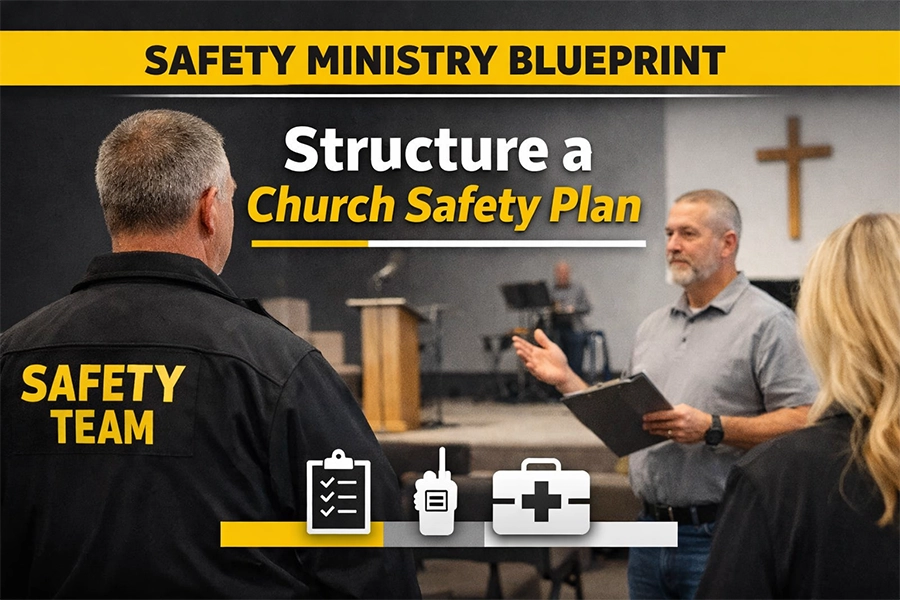
How to Start, Structure, and Sustain a Church Safety Plan
If you are starting a church safety ministry, you likely feel both responsibility and uncertainty. Pastors, board members, and volunteer leaders know the risks are real—but many do not know how to build a church safety plan that is organized, lawful, and ministry-aligned.
This guide provides a clear, biblical, and practical blueprint for starting a Church Safety Ministry. Whether your church runs entirely on volunteers or includes former law enforcement members, this framework will help you move from “we should do something” to “it’s in the plans.”
Why Every Church Needs a Written Safety Plan
Churches today face a range of foreseeable risks:
- Medical emergencies
- Disruptive individuals
- Domestic situations spilling into church
- Child protection concerns
- Severe weather events
- Facility fires
- Violent intruder incidents
While high-profile shootings receive media attention, experienced safety leaders consistently observe that medical emergencies and disruptive behavior are far more common. A well-structured church safety plan addresses both everyday disruptions and low-frequency, high-impact events.
A safety ministry does not exist to create fear. It exists to support worship, protect the vulnerable, and ensure ministry continuity.
What Does the Bible Say About Planning for Safety?
Scripture affirms careful planning, wise counsel, and orderly leadership.
“The plans of the diligent lead surely to abundance…” (Proverbs 21:5)
“Without counsel plans fail, but with many advisers they succeed.” (Proverbs 15:22)
“Commit your work to the Lord, and your plans will be established.” (Proverbs 16:3)
Planning is not a lack of faith. It is stewardship.
A church safety ministry is not about creating a “security force.” It is about:
- Protecting the flock
- Supporting pastoral leadership
- Acting decently and in order (1 Corinthians 14:40)
- Operating within governing authority (Romans 13:1–7)
The Church Safety Ministry Blueprint
A blueprint in construction defines structure, materials, roles, and specifications before building begins. A church safety ministry blueprint does the same.
It answers:
- Who leads?
- What are our limits?
- What do we do first in an emergency?
- How do we stay lawful and insurer-aligned?
Let’s walk through the essential components.
1. Name the Ministry Carefully
The name of your ministry influences perception.
In some regions—especially states like California—titles that imply regulated “security” roles can create legal complications. A safer approach is to use functional titles, such as:
- Safety Team
- Emergency Response Team
- Care & Safety Ministry
- Preparedness Team
The goal is to describe function, not status.
This reduces liability confusion and keeps the ministry aligned with pastoral authority.
2. Define a Clear Mission Statement
Every Church Safety Ministry needs a simple mission statement.
For example:
“To promote the safety and well-being of members and guests while supporting the worship and ministry mission of the church.”
Clarity prevents drift. Your team exists to support ministry—not replace it.
3. Establish a Simple Leadership Structure (No Committee Model)
Many churches assume they need a large committee to run safety. In practice, that often slows progress and diffuses responsibility.
A healthy Church Safety Ministry structure is simple:
Pastoral Sponsor
- A pastor or senior leader who provides spiritual and institutional covering
- Ensures alignment with church mission and leadership direction
- Serves as the final authority when needed
Safety Director
- The operational leader of the ministry
- Recruits and trains team members
- Schedules volunteers
- Oversees procedures and documentation
- Reports directly to pastoral leadership
Safety Team Members
- Serve during services and events
- Respond to incidents
- Conduct safety checks
- Document events
This flat structure creates clarity. The Safety Director leads operationally. The pastor provides oversight. The team executes.
Committees are not required for most churches and can unintentionally create confusion about authority during emergencies.
4. Why Written Policies and EAPs Matter
A verbal plan is not a plan.
Churches should maintain:
- Policies (what we do and don’t do)
- Emergency Action Plans (EAPs) (what we do first in specific scenarios)
- Short incident reports
- Training logs
What Is an Emergency Action Plan (EAP)?
An EAP is a one-page, scenario-based document outlining:
- Who is in charge
- Immediate priorities
- Communication steps
- Where people go
- What happens after
Common baseline EAPs include:
- Disruptive person
- Medical emergency
- Fire
- Severe weather
- Evacuate / Shelter / Lockdown
Best practice: Run a tabletop discussion before any live drill. Never surprise the congregation with unannounced drills.
5. Address Legal and Insurance Alignment Early
A church safety ministry must operate within:
- Federal law
- State law
- Local ordinances
- Insurance policy terms
Churches should:
- Confirm endorsements and exclusions with their broker
- Use functional titles aligned with coverage
- Avoid implying sworn or regulated authority
- Maintain annual policy reviews
If armed volunteers are involved, separate counsel review and insurer confirmation are strongly recommended.
Educational and general safety information for houses of worship; not legal advice. Confirm compliance with your laws, insurer, and counsel before implementation.
6. Start With a “Minimal Viable Packet”
Many churches stall because they try to build a 100-page manual.
Start with a minimal viable safety packet:
- Purpose & scope
- Roles and reporting lines
- Communications protocol (plain language, no codes)
- Disruptive behavior procedure
- Medical response outline
- Incident reporting form
- Drill and training cadence
Build from there.
7. Handle Initial Safety Concerns First
Most churches start safety planning because of a triggering event:
- A heart attack during service
- A disruptive individual
- A break-in
- A child protection scare
- Severe weather damage
Focus your first blueprint draft on the most immediate concern. Quick wins build credibility.
Avoid starting with violent intruder drills if your team has not yet:
- Standardized roles
- Practiced radio communication
- Learned de-escalation basics
- Built incident documentation habits
Strong foundations prevent reactive overcorrections.
8. Training: Beyond “Active Shooter Only”
Churches often over-focus on active shooter response.
In reality, the most common operational needs include:
- De-escalating disruptive persons
- Managing access control
- Medical response coordination
- Clear radio communication
- Role clarity
A balanced training baseline builds competence across:
- Fundamentals
- De-escalation
- Violent intruder response
- Use-of-force decision awareness
- Protecting the vulnerable
Consistency across the whole team is critical. Certification requires individual completion—not group viewing alone.
9. Documentation Protects the Ministry
If it isn’t documented, it didn’t happen.
At minimum, maintain:
- Training rosters
- Drill debrief notes
- Incident short forms (facts only, no speculation)
- Annual review logs
Documentation demonstrates discipline to:
- Church boards
- Insurance carriers
- Counsel
- Future leaders
Keep personal identifying information tight and restricted.
10. Presenting the Blueprint for Approval
When presenting your Church Safety Ministry proposal to leadership:
Keep it simple.
Include:
- Mission
- Leadership structure (Pastoral Sponsor + Safety Director)
- Initial focus areas
- Training plan
- Documentation approach
- Legal/insurance review plan
Avoid proposing everything at once. Start with a focused, realistic rollout.
Credibility grows through execution.
Common Mistakes to Avoid
Many churches unintentionally undermine their own safety efforts. Avoid these early errors:
- Starting with dramatic drills before basic training
- Using “security officer” titles without counsel review
- Teaching radio codes instead of plain language
- Building policies without training people to follow them
- Failing to debrief incidents
- Assuming insurance automatically covers all volunteer activity
Safety maturity grows through steady implementation, not urgency spikes.
What Does “Healthy” Look Like at 90 Days?
After three months, a healthy Church Safety Ministry should show:
- Named pastoral sponsor
- Identified Safety Director
- Clear volunteer roster
- Standardized radio communication
- De-escalation training completed
- At least one tabletop discussion completed
- Simple incident report form in use
- Written minimal viable policy packet drafted
This is sustainable progress—not perfection.
Key Takeaways: Church Safety Ministry Blueprint
- A church safety ministry is stewardship, not fear.
- Written plans protect both people and testimony.
- Functional titles reduce legal ambiguity.
- Medical and disruptive incidents are more common than violent attacks.
- Start small. Build structure. Document progress.
- Train consistently across the team.
- Align with insurance and counsel early.
- Tabletop before live drills.
- Keep language conservative and insurer-aware.
Your Next Step
If your church is starting from scratch, refreshing an informal team, or rebuilding after an incident, begin with a clear, structured path.
You may consider:
- Safety Member Certification (SMC v5) if your primary need is a consistent training baseline for volunteers.
- A Church Safety Program Kit (Basic or Premium) if you want a full roadmap including policies, templates, training systems, and documentation tools.
If you are unsure which path fits your church size, structure, or state environment, schedule a Safety Program Discovery Call and we will map the safest starting point.
A strong safety ministry does not distract from worship. It protects it.
Plan diligently. Lead calmly. Serve faithfully.
Sources
- Avigilon. “Church Security Plan and Checklist: How to Enhance Safety.” Avigilon, n.d., https://www.avigilon.com/blog/church-security-planning-checklist. Accessed 28 Feb. 2026.
- Cybersecurity and Infrastructure Security Agency. Mitigating Attacks on Houses of Worship: Security Guide. U.S. Department of Homeland Security, Dec. 2020, https://www.cisa.gov/sites/default/files/publications/Mitigating%20Attacks%20on%20Houses%20of%20Worship%20Security%20Guide_508_0_0.pdf. Accessed 28 Feb. 2026.
- Miller, Dylan. “How To Create A Church Security Plan In 6 Steps And Why You Need One.” The Lead Pastor, 30 Jan. 2026, https://theleadpastor.com/church-management/church-security-plan/. Accessed 28 Feb. 2026.
- Risk Strategy Group. “Church Safety and Security: Guide to Policies, Procedures, and Team Training.” Risk Strategy Group, n.d., https://riskstrategygroup.com/church-safety-and-security-policies-procedures/. Accessed 28 Feb. 2026.
- Samuel. “Church Security Plan Template.” My Church Security, n.d., https://mychurchsecurity.info/church-security-plan-template/. Accessed 28 Feb. 2026.
- Sheepdog Church Security. “90-Day Church Safety Launch Plan | Build a Ready Ministry.” Sheepdog Church Security Academy, 2025, https://sheepdog-church-security.thinkific.com/courses/90-Day-Church-Safety-Launch-Plan. Accessed 28 Feb. 2026.
- Thompson, Phil. “7 Principles to Prepare Your Church for an Active Shooter.” The Gospel Coalition, 9 June 2022, https://www.thegospelcoalition.org/article/prepare-church-active-shooter/. Accessed 28 Feb. 2026.
- U.S. Department of Homeland Security. Safety for Faith-Based Events and Houses of Worship. 31 May 2017, https://www.dhs.gov/sites/default/files/publications/17_0531_NSI_SAR-Faith-Based-Events-Houses-Worship.pdf. Accessed 28 Feb. 2026.