




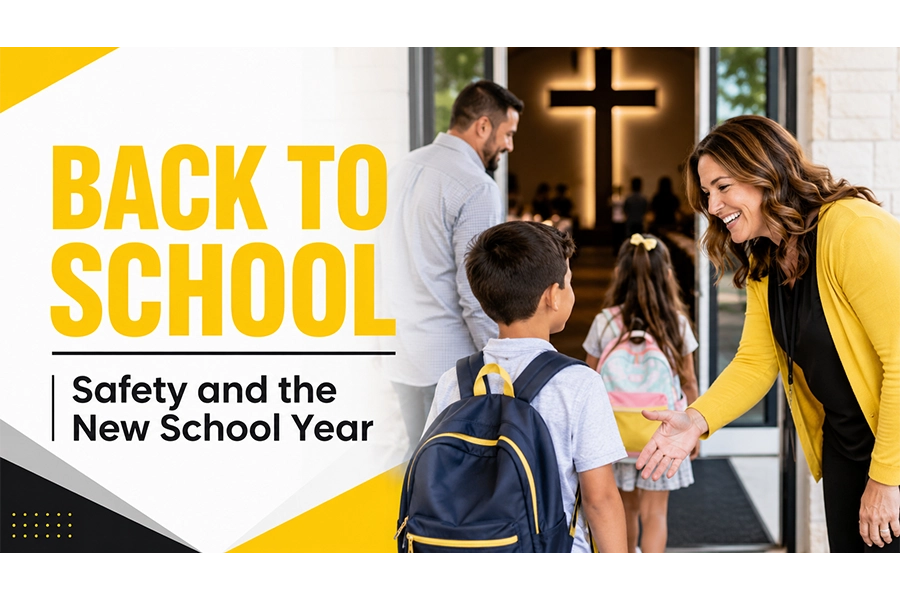
Safety and the New School Year
From the Bible
Come, ye children, hearken unto me: I will teach you the fear of the Lord (Psalm 34:11).
Introduction –
This is the Back-to-School season. The exact beginning of the school year varies by state and locality. The traditional start date was the day after Labor Day. This was set when many youths and children were helping in farm work. Later, many teens had summer jobs in camps and parks. Now most schools in the United States start in August.
Stores began having Back-to-School sections and sales in mid-July. These continue into the opening of the school year. This is when parents get supplies for pupils in their families. Teachers also stock up supplies.
Back-to-School is also a season in churches. Some churches in areas where a large portion of the population are employed elsewhere in the summer suspend Sunday School until Labor Day. In almost all churches, attendance returns to normal following the end of summer vacations, camps, camp meetings, conferences, mission trips, etc.
There are both challenges and opportunities when it’s Back-to-School at church.
On the Web –
Cincinnati, Ohio, 2022 – The Insurance Board of Cincinnati Insurance Companies has published a Risk Insights PDF on preventing injuries from slips, trips, and falls. This paper, “Avoiding Slip, Trip and Fall Liabilities in Religious Organizations,” begins with the statement,
Slips, trips and falls are some of the most common injuries across industry lines, with religious organizations being no exception. … According to the latest industry research, more than 50% of injuries that occur in churches stem from slip, trip and fall incidents. [1].
Children’s Ministry, no date – The Safety & Security page of Children’s Ministry begins with, “You know the saying, “Better safe than sorry!” This is a no-brainer for children’s ministry.” After the introduction, there is a linked list of short articles on aspects of child safety in the church. Here are titles of the first nine:
- In God We Trust: All Others Must Be Screened for Church Safety.
- Addressing Sexual Harassment in Your Children’s Ministry.
- The Top 4 Reasons Parents Avoid Church Nurseries.
- Classroom Environments: Nursery and Preschool Essentials.
- Everything You Need to Know About Church Check-In Solutions.
- 8 Ways to Keep Your Children’s Ministry Healthy During Flu Season.
- How to Minister in the Wake of Tragedy, Violence, and Disaster.
- 7 Safety Tips to Strengthen Your Children’s Ministry This Year.
- What You Need to Know About Bullying. [2].
Children’s Worship Bulletins, April 1, 2025 – Blog contributor Shirley Vaughn wrote “Keeping Kids Safe and Healthy at Church: Best Practices for Protecting Little Ones.” The article begins with Proverbs 1:33 and ends with Psalm 4:8. She presents nine ways for making the church a safe place for children. The first one is “Start by planning and training.” Some of the aspects are safety on the road, bullying, playground safety, and mandatory reporting. The last one links physical safety with spiritual security. [3].
Colorado Springs - Group Publishing, which is now part of David C. Cook, has posted the PDF “Safety and Security in Sunday School” by Alex Smith. This brief paper covers Security as a Priority, Allergy and Medical Issues, Abuse Prevention, Volunteer Screening, and Check-In Systems. [4].
Draper Utah, no date – ProdataKey, a technology provider, has published “Top Strategies for Enhancing Security in Churches.” The introduction to this article says, “In today’s world, security in churches is more critical than ever.” The first and second of three Key Takeaways are, “Churches must prioritize security, engaging congregants to create an effective safety mindset amidst rising threats,” and “Continuous training, collaboration with local law enforcement, and leveraging technology will enhance church security and ensure preparedness for emergencies.” Note the mentions of “creat[ing] an effective safety mindset” in the congregation and “Continuous training” of the safety team. While we are urged to use new technology to enhance our safety posture, the human factor is still the key to effective security. [5].
Safety in Sunday or Sabbath School –
Just as schools in general – elementary, secondary, and higher education – work to keep their students safe, so must Sunday Schools and Sabbath Schools in churches consider the safety of their students. While those in adult classes have a lot to do with their own safety, parents, teachers, and church leaders are the ones keeping younger students safe, especially children. Some of the safety questions we must answer are:
- Are our classrooms healthful?
- Are the classrooms safe from falling furnishings, etc.?
- Are we ready to treat injuries?
- Are there cutting hazards?
- Are there unprotected heat sources?
- Are classrooms free from slipping and tripping hazards?
- Can teachers safely resolve conflicts among students?
- Are rooms free from hazardous substances?
Plan and work for:
Healthful classrooms and activity areas,
While preventing accidental and intentional injuries in classes, it is also important to be sure the facilities are not making students and others ill. One issue often overlooked until it is already a serious problem is mold. It is true that some molds are basically nuisances and more of a threat to infected materials, but some, especially black mold, are health hazards. Higher humidity encourages more mold growth, so fixing and preventing leaks is one key to mold prevention.
Another health hazard is unhealthful chemicals. We like to have the place clean, but some cleaning products are problematic. Keep hazardous products in lockable rooms. Allow enough time to safely dissipate between their use and when classes or activities begin.
Be certain foods and drinks are safe by following safe food-handling standards. “Classroom snack sickens children” is not a headline we want to see.
Room safety,
That four-shelf bookcase is really nice, keeping key materials handy. But is it safe? What if it is bumped really hard, or there’s a medium-level quake? Will it still stand? Find where you really want it to be and anchor it to the studs in the wall. Other furnishings may also be risks for falling.
How do you keep the classroom warm in cold weather? Certain kinds of space heaters can be fire hazards. Have the church’s heating systems checked and maintained before the heating season comes.
If class projects require some cutting, use age-appropriate cutters. For instance, short blunt scissors for preschoolers, but no knives or razor blades.
Are throw rugs safe? They are not recommended in classrooms. Most will slip on a tiled, linoleum, concrete, or hardwood floor. Even if they have a slip-proof bottom side, people could catch their feet on the edge and trip. See that the floors and floor coverings are in good shape with nothing to trip on.
Human factor safety,
Whatever the ages of students, disagreements and snubs happen and can escalate if there is no de-escalation or disengagement. Teachers and activity leaders need to know how to peaceably resolve disputes.
Children, youth, and vulnerable adults may be subject to abuse. Leaders should guard against abuse and know how to respond.
Always be prepared to respond to medical emergencies. It’s not always old people who have them.
Safety Training –
Now that vacations are past and attendance has recovered from summer slump, it's time for Safety Ministries to have classes and meetings on security and safety. This includes not only members of the safety ministry, but also pastors, leaders, ushers, greeters, and members of the congregation. The Back-to-School season is an appropriate time to plan training each group for its role in church safety.
For Safety Ministry Members,
Every member of a church safety ministry needs to be trained and certified through the Safety Member Certification program. It has eight training modules. Five of them are Core Modules essential for team members: Safety Team Fundamentals, Violent Intruder Response, De-Escalating Disruptive Persons, Use of Force for Church Safety Teams, Protecting the Vulnerable. Another three are Standalone Courses: Arson and Fire Safety, Storms and Disasters, Mass Trauma Emergency. [6].
These courses are designed to equip members of a Safety Team to protect the congregation. Each module is an online course. At the end of each there is a test.
For church leaders, staff, and volunteers,
Leaders, staff, and volunteers in the church need training related to their responsibilities. For example, ushers and greeters can be auxiliaries of the safety team. This means their roles contribute to the congregation’s safety and security. Greeters see everyone coming into the church for services and events, and they can be alert to needs for help or signs of concern (such as indications of weapons). A greeter or usher may be the closest person to a medical emergency. Ushers can direct portions of the crowd during an evacuation.
On one hand, certain Standalone Courses can provide this training. Teachers, youth leaders, and children’s activity leaders need to take Protecting the Vulnerable. Department leaders should train them in the church’s procedures for logging children in and out to protect them from abduction. For instance, if the logging is electronic, they learn to use the devices and the program. If it’s on paper, they learn to use the forms.
Office staff need training in safe money handling, financial accountability, and safety from intruders during weekday office hours. They also need to know cybersecurity and how to guard against fraud. The Safety Director should be able to coach them and find relevant training for them.
For Congregants,
We need to “create an effective safety mindset” in members of the congregation. The church will be a safer place if those who are there act safely and are alert to unsafe acts and conditions. This should be a layered approach, with announcements, bulletin notes or inserts, bulletin board postings, casual conversations, drills, demonstrations, etc.
Conclusion –
Just as safety should not take a vacation, it also should come back to school.
References –
- Staff, “Avoiding Slip, Trip and Fall Liabilities in Religious Organizations,” Risk Insights, Insurance Board, Cincinnati Insurance Companies, © 2022 [https://www.insuranceboard.org/wp-content/uploads/2023/11/Slip-and-Fall-Prevention-in-Your-Church.pdf].
- Various authors, “Safety & Security,” Children’s Ministry, no dates [https://childrensministry.com/leader-resources/ministry-basics/safety-security/].
- Shirley Vaughn, “Keeping Kids Safe and Healthy at Church: Best Practices for Protecting Little Ones,” Children’s Worship Bulletins, April 1, 2025 [https://blog.childrensbulletins.com/keeping-kids-safe-and-healthy-at-church-best-practices-for-protecting-little-ones/].
- Alex Smith, “Safety and Security in Sunday School,” Group Publishing, no date [http://cms.group.com/media/4612492/safetyandsecurityinsundayschool.pdf].
- Staff, “Top Strategies for Enhancing Security in Churches,” ProdataKey, no date [https://www.prodatakey.com/single-post/security-in-churches].
- Kris Moloney, Safety Member Certification, Sheepdog Church Security Academy, © 2025 [https://sheepdog-church-security.thinkific.com/courses/safety-member-certification-v5-2025].