




Back-to-School Church Safety
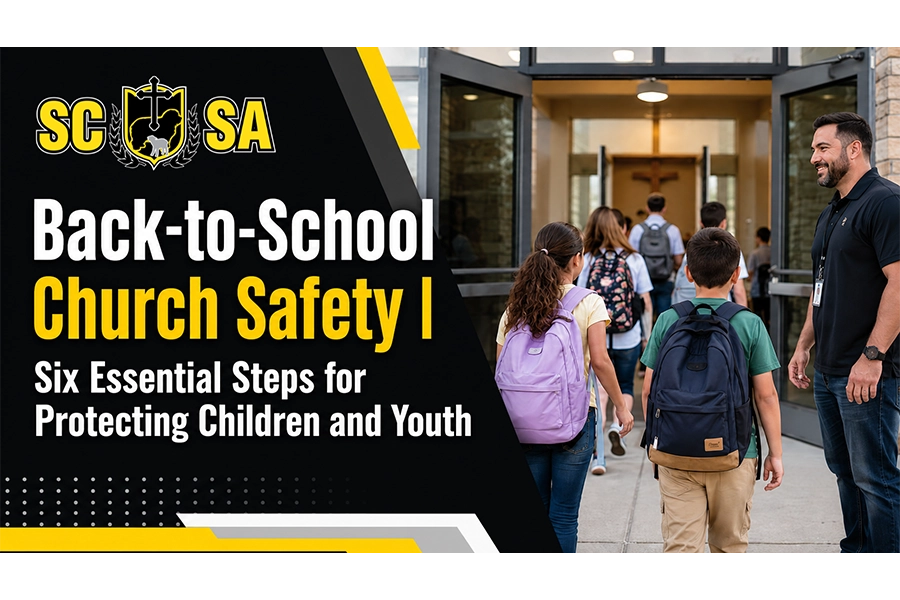
Back-to-school church safety requires more than preparing classrooms and recruiting volunteers. Church Safety Team members, Safety Directors, pastors, and children’s ministry leaders must also review the policies and procedures that protect children throughout the ministry year.
When fall programs restart, churches often experience increased attendance, new families, unfamiliar volunteers, crowded hallways, and changing classroom assignments. Nurseries reopen. Youth groups resume. Wednesday-night programs become busy again. Transportation schedules change. New medical concerns, custody restrictions, and authorized pickup arrangements may also need to be documented.
These transitions create opportunities for ministry, but they can also expose weaknesses in a church’s safety system.
A faithful church does not protect children by relying only on good intentions. It protects them through clear boundaries, trained volunteers, controlled access, documented procedures, and adults who are willing to recognize and report concerns.
“Open your mouth for the speechless, in the cause of all who are appointed to die.” — Proverbs 31:8, NKJV
Protecting children is not separate from the church’s spiritual mission. It is part of that mission.
Why Back-to-School Church Safety Deserves Immediate Attention
The beginning of a new school year is one of the best times to conduct a full review of children and youth safety procedures.
Volunteers may be moving into new roles. Children may advance into different classrooms. Families may return after being absent during the summer. New programs may begin before every worker fully understands the church’s policies.
This is where preventable problems often develop.
A volunteer assumes another adult is watching the hallway. A child is released to someone whose authorization was never verified. A teacher knows that a student has an allergy but does not know where the emergency medication is located. A concerning disclosure is passed to a ministry leader but never reported to the proper authorities.
None of these failures necessarily begin with malicious intent. Many begin with unclear expectations.
Back-to-school church safety should therefore include six essential areas:
- Refreshing the Rule of Two
- Screening and approving volunteers
- Strengthening child check-in and secure release
- Recognizing and reporting suspected abuse
- Preventing children from wandering or leaving unnoticed
- Managing allergies, medications, and medical needs
Each area protects children in a different way. Together, they create layers of accountability and response.
1. What Is the Rule of Two, and Why Should Churches Refresh It?
The Rule of Two means that, whenever reasonably possible, at least two approved and unrelated adults are present when supervising children, youth, or vulnerable individuals.
This practice is designed to reduce isolation, increase accountability, protect children from inappropriate conduct, and protect faithful volunteers from false or misunderstood allegations.
The Rule of Two is not an accusation against volunteers. It is a boundary that serves everyone.
Churches should apply this principle consistently in:
- Nurseries and classrooms
- Youth group meetings
- Church vehicles
- Overnight events
- Counseling or mentoring situations
- Restroom assistance
- Off-site activities
- Digital communication with minors
A policy is only useful when volunteers understand what it means in real situations.
For example, a church may technically assign two adults to a classroom, but one adult frequently leaves to make copies, find supplies, or speak with a parent. During that time, the remaining volunteer is alone with the children. The schedule may satisfy the policy on paper while failing in practice.
How Should the Rule of Two Apply to Small Churches?
Small churches sometimes believe they cannot follow the Rule of Two because they have too few volunteers. Limited staffing is a real challenge, but it should lead to creative planning rather than the abandonment of safeguards.
A smaller church may combine age groups, place classrooms near one another, use open doors or interior windows, position a hall monitor where multiple rooms are visible, or ask ministry leaders to rotate through children’s areas.
Visibility is not a perfect substitute for two approved adults, but it can provide an additional layer of accountability when staffing is temporarily limited.
Churches should also establish a clear escalation procedure. When only one approved worker is available, that worker should notify a ministry leader rather than quietly accepting an unsafe arrangement.
Apply the Rule to Transportation and Counseling
Transportation presents unique risks because isolation can occur quickly.
Whenever possible, one adult should not transport one unrelated child alone. Churches should plan vehicle assignments so that multiple adults or multiple passengers are present. Drivers should use approved routes, avoid unplanned stops, and maintain accurate passenger rosters.
Counseling and mentoring situations also need boundaries. Conversations should occur in observable locations, such as rooms with windows or open doors. Parents or guardians should know when regular mentoring is occurring. Private communication should use ministry-approved channels rather than disappearing messages or secret accounts.
Healthy ministry does not require secrecy.
2. Are Background Checks Enough to Protect Children?
Background checks are important, but background checks alone are not a complete child-protection system.
A background check only reveals information contained in the records searched. It does not measure judgment, maturity, boundary awareness, reliability, or a person’s willingness to follow church policy.
Federal requirements direct states to establish background-check systems for staff in licensed child care settings, but exact requirements and the types of checks used vary by jurisdiction and program. Churches should verify the laws and licensing rules that apply to their specific ministries.
A complete volunteer screening process should include:
- A written application: Collect prior ministry experience, employment information, references, and explanations for gaps or concerns.
- Reference checks: Speak directly with people who have observed the applicant working with children or serving in positions of trust.
- A personal interview: Discuss the church’s policies, expectations, theology of protection, and response to hypothetical situations.
- A criminal background check: Use a reputable service and repeat checks according to church policy and applicable law.
- Sex offender registry searches: Confirm whether additional registry checks are included in the screening package.
- Policy acknowledgment: Require volunteers to read and sign the church’s child-protection and conduct policies.
- Training before service: Do not place someone in a classroom simply because a staffing shortage exists.
Screening should apply to returning volunteers as well as new ones.
A volunteer who served five years ago should not automatically return without an updated review. Personal circumstances, legal records, church policies, and ministry expectations can change.
Do Not Let Familiarity Replace Screening
Churches are relational communities. That is one of their strengths, but familiarity can also produce blind spots.
“He has attended here for years.”
“She comes from a good family.”
“Everyone knows him.”
Those statements may describe meaningful relationships, but they are not screening standards.
The same process should apply to longtime members, relatives of church leaders, ministry employees, and respected volunteers. Exceptions weaken the policy and communicate that some people are above accountability.
A strong system does not depend on deciding who looks trustworthy. It creates appropriate safeguards around every person.
3. How Can Churches Improve Child Check-In and Secure Release?
Child check-in is more than an attendance process. It is an access-control system.
Access control means managing who may enter a protected area, who may interact with children, and who may remove a child from church supervision.
A dependable check-in and release system should answer four questions:
- Which child is in the church’s care?
- Where is that child assigned?
- Who is authorized to pick up the child?
- How will the church verify that authorization?
Churches may use printed tags, electronic systems, numbered stickers, matching security codes, photo identification, or a combination of these methods. The specific technology matters less than consistent use.
What Should Happen When a Pickup Tag Is Lost?
A lost tag should never be treated as a minor inconvenience.
The adult requesting the child should be directed to a designated leader. The leader should verify identity, consult the registration record, and confirm authorization before releasing the child.
Classroom volunteers should not be pressured into making exceptions because a person appears frustrated, is familiar to them, or claims to be in a hurry.
A secure release procedure should state clearly:
- Who may approve an exception
- Which identification is required
- How authorization will be verified
- Where the child will remain during verification
- How the incident will be documented
The goal is not to embarrass a parent or guardian. The goal is to ensure that the child leaves with the correct person.
Custody Restrictions Require Careful Documentation
Custody disputes can become emotionally charged and legally complicated. Children’s ministry volunteers should not be expected to interpret court orders in the classroom doorway.
Church leadership should have a process for receiving, reviewing, securing, and updating relevant legal documentation. Access to sensitive records should be limited to those who need the information to perform their responsibilities.
The child’s check-in record should communicate necessary restrictions without exposing private family details to unnecessary personnel.
When uncertainty exists, the child should remain in a secure location while a designated leader verifies the information.
Safety takes priority over convenience.
4. How Should Church Volunteers Respond to Suspected Child Abuse?
Church volunteers do not need proof before reporting a reasonable suspicion of abuse or neglect. They also should not conduct their own investigation.
An internal investigation can contaminate evidence, alert a suspected offender, influence a child’s account, and delay contact with the authorities responsible for determining what occurred.
Mandatory reporting laws differ by state. Some states require all people to report suspected abuse, while others identify particular professions or roles as mandated reporters. Clergy reporting duties and clergy-penitent privilege also vary by jurisdiction.
Every church should consult qualified local legal counsel and review its state’s current reporting statutes. Church policy should never instruct a volunteer to report only to a pastor or ministry director when the law requires a report to civil authorities.
What Should a Volunteer Do When a Child Discloses Abuse?
When a child makes a disclosure:
- Remain calm. A shocked or emotional reaction may cause the child to stop speaking.
- Listen without interrogating. Allow the child to use his or her own words.
- Do not promise secrecy. Explain that you may need to tell people whose job is to help keep children safe.
- Do not confront the accused person. Protect the child and preserve the integrity of the official investigation.
- Record the child’s exact words. Document what was said, when it was said, where the conversation occurred, and who was present.
- Make the required report promptly. Follow applicable law and the church’s reporting procedure.
- Notify the appropriate church leader. Internal notification should support—not replace—the legally required report.
Anyone may report suspected child abuse or neglect, even when that individual is not specifically classified as a mandated reporter.
Recognize Boundary Violations Before They Escalate
Not every concern begins with a direct disclosure. Churches should train volunteers to recognize grooming and boundary-testing behavior.
Potential warning signs may include an adult who:
- Regularly seeks unnecessary one-on-one access to children
- Gives secret gifts or creates private communication channels
- Ignores physical-contact rules
- Offers transportation outside approved procedures
- Shows unusual favoritism toward one child
- Resists supervision or accountability
- Attempts to separate a child from parents or other adults
- Treats safety policies as insulting or unnecessary
A single behavior may have an innocent explanation. A pattern deserves attention.
Churches should provide a way for volunteers to document and report policy violations before the conduct becomes more serious.
5. How Can Churches Prevent Children From Wandering Away?
A missing child emergency can develop in seconds.
Children may leave a classroom to find a parent, follow another group, enter a restroom, exit through an unsecured door, or wander into a parking lot. Transition times are especially vulnerable because children and adults are moving simultaneously.
Back-to-school church safety inspections should evaluate the entire route a child might take, not just the classroom.
Inspect:
- Classroom doors
- Exterior exits
- Hallways and stairwells
- Restrooms
- Playgrounds
- Fellowship areas
- Parking lots
- Doors used by vendors or staff
- Unoccupied wings of the building
Use Active Supervision
Active supervision means that adults intentionally position themselves, scan the environment, count children, anticipate movement, and communicate changes.
It is different from simply being present.
A volunteer who is organizing supplies, checking a phone, or speaking with another adult may be physically in the room without actively supervising the children.
Churches should require head counts:
- At check-in
- Before leaving a classroom
- After arriving at another location
- Before and after restroom breaks
- Before boarding transportation
- After exiting transportation
- Before release begins
Children should not transition between locations without an assigned adult at the front and another adult monitoring the rear when staffing allows.
Create a Missing Child Response Plan
A missing child response should be written, trained, and practiced.
When a child cannot be located, the church should immediately gather an accurate description, notify the Safety Team, monitor or secure exits, search assigned zones, contact the parent or guardian, and determine when law enforcement should be called.
Do not allow every available adult to search randomly. Uncoordinated searching creates gaps and makes it difficult to know which areas have been checked.
The church should assign search zones in advance, including:
- Children’s ministry areas
- Restrooms
- Worship spaces
- Offices and storage rooms
- Exterior grounds
- Parking lots and vehicles
- Nearby streets or public areas
Once the child is found, leadership should document the incident and determine how the child left supervision. The purpose of the review is not simply to assign blame. It is to close the gap before it happens again.
6. How Should Churches Manage Allergies, Medications, and Medical Needs?
Children’s ministry safety includes medical readiness.
Food allergies can cause severe and potentially life-threatening reactions. The Centers for Disease Control and Prevention recommends that schools, early care programs, and out-of-school programs develop plans to prevent allergic reactions and respond to emergencies, including anaphylaxis.
Anaphylaxis is a severe allergic reaction that may affect breathing, circulation, or multiple body systems. It can progress rapidly and requires immediate action.
Churches should collect current medical information during registration and give responsible volunteers only the information they need to protect the child.
Build an Individual Emergency Action Plan
For a child with a serious allergy or medical condition, the church should have a written emergency action plan developed with the parent or guardian and, when appropriate, the child’s health care provider.
The plan should identify:
- The child’s condition and known triggers
- Early and severe symptoms
- The location of medication or medical equipment
- Who is trained and authorized to assist
- When to call 911
- How parents or guardians will be contacted
- What information should accompany the child if transported
CDC guidance emphasizes training staff according to their responsibilities, including specialized instruction for those expected to respond to allergy emergencies or administer epinephrine.
Churches must also verify state law, insurance requirements, and medical policies concerning medication storage and administration.
Avoid Informal Medication Practices
Medication should not be kept loosely in a child’s bag, transferred in an unlabeled container, or administered based on verbal instructions alone.
Church policy should address:
- Original packaging and labeling
- Written parental authorization
- Secure but accessible storage
- Expiration dates
- Documentation of administration
- Emergency exceptions
- Disposal or return of unused medication
The policy should also clarify whether volunteers may administer medication and what training is required.
For serious reactions, volunteers should activate the child’s emergency plan, call 911, and follow their training and legal authority regarding emergency medication. CDC guidance advises calling emergency medical services immediately after epinephrine is administered.
Communicate Without Violating Privacy
Medical information should be shared carefully, but privacy should not prevent responsible adults from receiving information necessary to protect a child.
A classroom leader may need to know that a child has a severe peanut allergy. The entire congregation does not.
Use discreet alerts within the check-in system, classroom roster, or emergency plan. Train volunteers not to discuss children’s medical conditions casually or publicly.
The Safety Team and Children’s Ministry Must Work Together
Children’s ministry leaders understand classroom routines, family relationships, and volunteer needs. Safety Teams understand access control, emergency response, communication, and incident management.
Neither ministry should operate in isolation.
Before fall programs begin, the Safety Director and children’s ministry leader should walk through the building together. They should test procedures rather than simply reading them.
Ask practical questions:
- Can a visitor reach a classroom without being challenged?
- Does every exterior door latch correctly?
- Can volunteers summon help without leaving children unattended?
- Do Safety Team members know the children’s ministry layout?
- Are emergency contacts current?
- Can substitute teachers quickly identify medical alerts?
- Does everyone know who may authorize a pickup exception?
- What happens when staffing falls below the required minimum?
This walkthrough should produce written corrective actions, assigned responsibilities, and completion dates.
What Does the Bible Teach About Protecting Children?
Jesus treated children as people of great value, not as interruptions to adult ministry.
In Matthew 19:14, Jesus said:
“Let the little children come to Me, and do not forbid them; for of such is the kingdom of heaven.” — Matthew 19:14, NKJV
Welcoming children includes creating a ministry environment in which they can worship, learn, and grow without preventable harm.
Biblical hospitality and responsible security are not opposites. A church can be warm without being careless. It can welcome families while controlling access. It can trust faithful volunteers while maintaining accountability.
Christian love does not ask us to ignore risk. It calls us to act wisely on behalf of those who depend on us.
Back-to-School Church Safety Key Takeaways
As the new ministry year begins, remember these core principles:
- Accountability protects everyone. Refresh the Rule of Two and apply it to classrooms, transportation, mentoring, and digital communication.
- Screening is a process, not a single search. Combine applications, interviews, references, background checks, policy acknowledgment, and training.
- Secure release requires verification. Familiarity, urgency, and inconvenience should never override the pickup procedure.
- Report suspicions according to law. Church leaders should support reporting, not replace civil authorities or conduct unauthorized investigations.
- Active supervision prevents wandering. Count children, monitor transitions, secure exits, and train a coordinated missing child response.
- Medical readiness must be specific. Maintain written plans, accessible emergency information, trained responders, and clear medication procedures.
Take Action Before Fall Programs Begin
Do not wait for an incident to reveal where your church’s child-safety system is weak.
Schedule a back-to-school church safety review with your pastor, Safety Director, children’s ministry leader, youth leader, medical team, and key volunteers. Walk through each procedure. Inspect the building. Update rosters. Verify background checks. Practice the missing child plan. Confirm how suspected abuse is reported in your state.
Most importantly, make sure every volunteer understands that policies are not obstacles to ministry. They are tools of faithful stewardship.
For focused training on protecting children and teens, explore Sheepdog Church Security Academy’s Youth Safety Essentials training. This course helps churches strengthen volunteer screening, supervision, reporting procedures, ministry boundaries, and practical safeguards for children and youth programs.
Churches can also explore the Safety Member Certification for broader training in observation, reporting, emergency response, de-escalation, child protection, and Safety Team operations. Together, these training opportunities can help pastors, ministry leaders, volunteers, and Safety Teams build a more consistent and prepared approach before fall programs begin.
The children entrusted to our churches deserve more than our good intentions. They deserve our preparation, accountability, and watchful care.
In service of God and His people.
Legal notice: This article provides general educational information and is not legal or medical advice. Reporting laws, child care regulations, background-check requirements, and medication rules vary by state and ministry setting. Churches should consult qualified local legal counsel, medical professionals, insurers, and applicable government agencies.
Sources
- Centers for Disease Control and Prevention. “Food Allergies in Schools.” CDC, 15 May 2024, https://www.cdc.gov/school-health-conditions/food-allergies/index.html. Accessed 28 July 2026.
- Centers for Disease Control and Prevention. Managing Food Allergies in Schools: The Role of School Teachers and Paraeducators. U.S. Department of Health and Human Services, https://www.cdc.gov/school-health-conditions/media/pdfs/20_316712-G_FA_teachers_508tagged.pdf. Accessed 28 July 2026.
- ChildCare.gov. “Child Protective Services.” U.S. Department of Health and Human Services, Administration for Children and Families, https://childcare.gov/consumer-education/other-support-and-resources/child-protective-services. Accessed 28 July 2026.
- ChildCare.gov. “Staff Background Checks.” U.S. Department of Health and Human Services, Administration for Children and Families, https://childcare.gov/consumer-education/regulated-child-care/staff-background-checks. Accessed 28 July 2026.
- Child Welfare Information Gateway. “Clergy as Mandatory Reporters of Child Abuse and Neglect.” U.S. Department of Health and Human Services, Administration for Children and Families, https://www.childwelfare.gov/resources/clergy-mandatory-reporters-child-abuse-and-neglect/. Accessed 28 July 2026.
- Holy Bible: New King James Version. Thomas Nelson, 1982.