




A Practical Guide
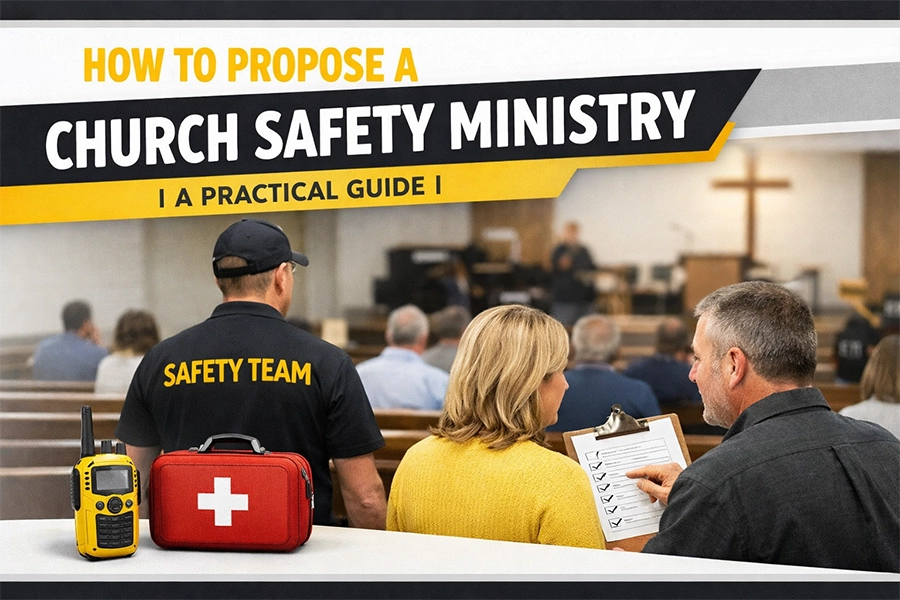
Starting a church safety ministry can feel overwhelming—especially if you are a pastor, board member, or volunteer without a law enforcement background. Yet most churches consider a safety ministry after a specific concern arises. The key is not fear. The key is wise, structured leadership.
This guide will show you how to propose, build, and launch a church safety ministry in a way that is biblical, practical, and aligned with best practices in safety, documentation, and leadership accountability.
Why Start a Church Safety Ministry?
Most churches do not begin with a formal plan. They begin with a concern.
Common safety concerns in churches include:
- Fire safety and evacuation readiness
- Child protection and abuse prevention
- Medical emergencies (cardiac arrest, falls, trauma)
- Disruptive or threatening behavior
- Burglary or vandalism
- Violent intruder or armed attack scenarios
A church safety ministry exists to address these concerns systematically instead of reactively.
A structured safety ministry replaces the “ad hoc hero response” with calm, trained, documented procedures.
What Does the Bible Say About Preparedness?
Scripture does not promote panic—but it does affirm wisdom and planning.
“With patience a ruler may be persuaded…” (Proverbs 25:15)
“This advice pleased the king and the princes, and the king did as Memucan proposed.” (Esther 1:21)
Biblically, persuasion, order, and thoughtful proposal matter. Leaders in Scripture did not act impulsively. They assessed, proposed, and implemented with structure.
A church safety ministry reflects stewardship. It is not a lack of faith—it is faithful leadership.
Start With Felt Needs, Not Fear
One of the most effective ways to propose a church safety ministry is to begin with real, shared concerns.
Instead of saying:
“We need a full security team.”
Start by asking:
- What concerns do staff members have?
- Have there been recent incidents?
- Where do volunteers feel unprepared?
Talk with:
- Pastors
- Office staff
- Custodians
- Children’s ministry leaders
- Nursery workers
- Ushers and greeters
Document their concerns. Put their concerns ahead of your ideas.
This builds trust and credibility.
A Practical Example: Responding to a Break-In
Consider a church that experienced two burglaries in one year. The immediate concerns were:
- Stolen property
- Volunteer safety during weekday cleaning
- Access vulnerabilities
The church responded by:
- Installing secure doors
- Reinforcing entry points
- Replacing vulnerable windows
- Adding surveillance cameras
- Improving access control procedures
The pastor and board initially functioned as an informal security committee. Over time, those improvements naturally evolved into a structured church safety ministry.
The lesson: address one real issue well, then build from there.
Address One Major Safety Concern First
If fire safety is the pressing concern:
- Inspect fire extinguishers
- Test emergency lighting
- Review sprinkler maintenance
- Clear fire hazards
- Map evacuation routes
- Conduct tabletop fire drills (discussion-based planning exercises)
If medical emergencies are the concern:
- Arrange CPR/AED training
- Identify medical responders
- Ensure AED accessibility
- Establish documentation procedures
These focused improvements demonstrate competence. That momentum builds support for a formal church safety ministry.
How Should a Church Structure a Safety Ministry?
A church safety ministry should be structured, accountable, and role-driven.
Key Leadership Components
- Pastoral Sponsor – provides oversight and alignment
- Safety Director or Team Lead – coordinates training and operations
- Safety Team Volunteers – trained responders
- Medical Response Team (if applicable)
Use functional titles such as:
- Greeter
- Usher
- Team Lead
- Medical Lead
- Radio Coordinator
Avoid inflated or “security officer” labels unless counsel and insurance have reviewed them. Titles matter for insurance alignment and liability clarity.
How Do You Gather Support for a Church Safety Ministry?
Support grows through participation.
Look for individuals in your congregation with relevant backgrounds:
- Law enforcement officers
- Firefighters
- EMTs
- Nurses and medical professionals
- Social workers
- Counselors
- Military veterans
But here is an important principle:
A church safety ministry is not built on credentials alone. It is built on consistent training and documented procedures.
Even experienced professionals benefit from church-specific training. Church environments have unique legal, pastoral, and operational considerations.
Preparing the Proposal: What Should Be Included?
When presenting a church safety ministry proposal to your board, include:
1. Purpose Statement
Why are we creating this ministry?
Example:
“To support the mission of the church by improving preparedness, reducing preventable risk, and ensuring calm, coordinated response during foreseeable emergencies.”
2. Specific Concerns Identified
List actual concerns raised by staff or congregation.
3. Actions Already Taken
Show momentum. Example:
- Fire inspection completed
- CPR training scheduled
- Access control review completed
4. Structure and Accountability
- Who leads?
- Who reports to whom?
- What are the limits of authority?
5. Training Plan
Explain how volunteers will be trained and documented.
6. Cost Breakdown
Transparency builds trust. Itemize:
- Radios and earpieces
- Training materials
- AED units
- Basic first aid supplies
- Background checks (if applicable)
Avoid vague numbers. Boards want clarity.
How Should You Present the Proposal?
Present in two forms:
- Written document
- Live presentation
Do not simply read the document. Summarize key points. Maintain eye contact. Be calm.
Expect questions such as:
- Are we creating liability?
- What about insurance?
- Will this scare the congregation?
- Are volunteers armed?
Be prepared with conservative answers.
Avoid guarantees. Use language such as:
- “This is a structured starting point.”
- “We will confirm compliance with our insurer and counsel.”
- “We are emphasizing de-escalation first.”
Legal and Insurance Considerations
When building a church safety ministry, align with:
- Your insurance broker
- Your legal counsel
- State and local laws
If you are discussing policies, Emergency Action Plans (EAPs), or use-of-force considerations, documentation should be:
- Clear
- Role-driven
- Conservative in language
- Reviewed before adoption
Church insurance typically covers operational exposure, but it may not automatically cover every volunteer action without proper alignment and endorsements.
Confirm details directly with your broker.
Educational and general safety information for houses of worship; not legal advice. Confirm compliance with your laws, insurer, and counsel before implementation.
Communication Strategy: How to Introduce It to the Congregation
A church safety ministry should be introduced carefully.
Best practices include:
- Clear announcements explaining purpose
- Emphasis on support, not suspicion
- Invitation for qualified volunteers
- Avoid dramatic or fear-based language
Language matters.
Avoid phrases like:
- “We are under threat.”
- “Danger is everywhere.”
Prefer:
- “We are strengthening preparedness.”
- “We are supporting ministry operations.”
Common Mistakes to Avoid
Many churches make these mistakes when starting a church safety ministry:
- Starting with violent intruder drills before basic training
- Creating a thick policy binder before training anyone
- Using security-style uniforms or titles prematurely
- Failing to document training
- Ignoring medical preparedness
- Surprising the congregation with unannounced drills
A structured approach avoids chaos.
What Does a Healthy Church Safety Ministry Look Like?
By 8–12 weeks into implementation, you should see:
- Defined roles and responsibilities
- Consistent radio language
- De-escalation training completed
- Basic emergency action plans drafted
- One tabletop drill conducted
- Documentation system in place
- Leadership review and approval
This is not about perfection. It is about disciplined progress.
Key Takeaways
- A church safety ministry begins with real concerns, not fear.
- Address one major issue well before expanding.
- Use functional titles and conservative language.
- Present a written proposal with a clear cost breakdown.
- Align with legal counsel and insurance.
- Train before drilling.
- Document everything.
- Emphasize de-escalation first.
- Communicate calmly with the congregation.
Final Encouragement
You do not need law enforcement credentials to build a responsible church safety ministry.
You need:
- Structure
- Training
- Documentation
- Accountability
- Calm leadership
If your church is ready to build a consistent training baseline, you may consider enrolling your team in Safety Member Certification v5 (SMC v5) to establish unified readiness across core safety topics.
If you are building or rebuilding a full ministry structure—including policies and Emergency Action Plans—the Church Safety Program Kit (Basic or Premium) provides a structured roadmap and implementation tools.
Start where you are. Take the next disciplined step. Steward your ministry well.
References
- Cybersecurity and Infrastructure Security Agency. Active Shooter Preparedness Action Guide. 11 June 2025, https://www.cisa.gov/sites/default/files/2025-06/Active-Shooter-Preparedness-Action-Guide_508_20250611.pdf. Accessed 28 Feb. 2026.
- Federal Bureau of Investigation. “Active Shooter Attack Prevention and Preparedness (ASAPP).” FBI, https://www.fbi.gov/how-we-can-help-you/active-shooter-safety-resources/active-shooter-attack-prevention-and-preparedness-asapp. Accessed 28 Feb. 2026.
- National Fire Protection Association. Emergency Evacuation Planning Guide for People with Disabilities. Nov. 2022, https://www.nfpa.org/downloadable-resources/guides/evacuation-guide-pdf. Accessed 28 Feb. 2026.
- Occupational Safety and Health Administration. How to Plan for Workplace Emergencies and Evacuations. OSHA 3088, 2001 (Revised), https://www.osha.gov/sites/default/files/publications/osha3088.pdf. Accessed 28 Feb. 2026.
- U.S. Department of Homeland Security, Federal Protective Service. Active Shooter Event Cards. 5 Dec. 2024, https://www.dhs.gov/sites/default/files/2024-12/24_1205_fps_active-shooter-event-cards-508.pdf. Accessed 28 Feb. 2026