




This article is related to the Safety Member Certification training module “Storms and Disasters v4” and the Church Security Guide “Preparing Your Church for Natural Disasters” [1][2][3][4].
From the Bible –
* Preparing for Winter:
She is not afraid of snow for her household, for all her household are clothed in scarlet (Proverbs 31:21).
* The hazard of Winter weather:
He hurls down his crystals of ice like crumbs; who can stand before his cold? (Psalm 147:17).
… fire and hail, snow and mist, stormy wind fulfilling his word! (Psalm 148:8).
Pray that your flight may not be in winter ... (Matthew 24:20; also see Mark 13:18).
* Shelter from Winter storms:
Be merciful to me, O God, be merciful to me, for in you my soul takes refuge; in the shadow of your wings I will take refuge, till the storms of destruction pass by (Psalm 57:1).
For you have been ... a shelter from the storm ... (Isaiah 25:4).
Introduction –
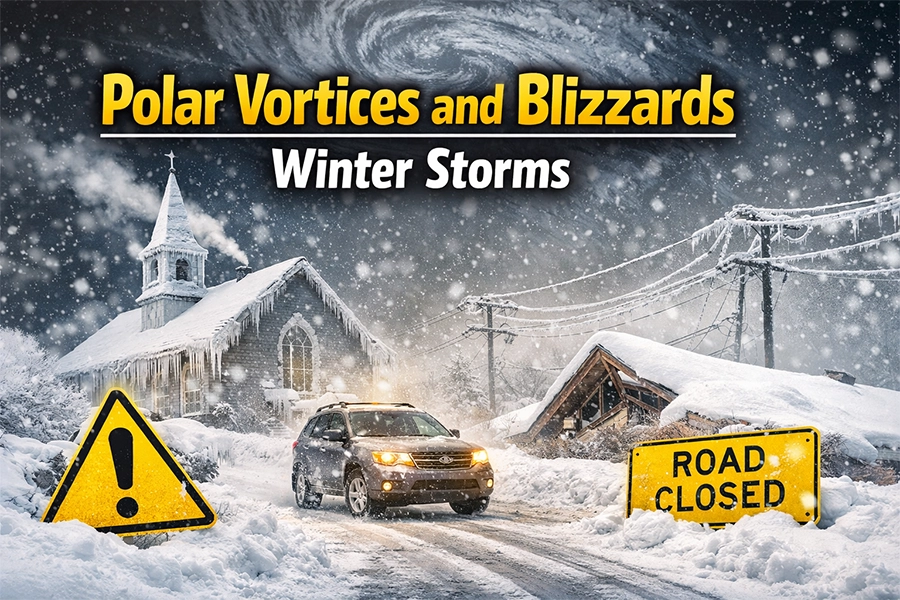
A previous winter weather article referred to Beauty and the Beast [5]. While snow covering the ground, decorating trees, and bushes (as well as feathery frost on windows) is beautiful, winter weather can also be a beast. Especially beasty are severe winter storms, such as some currently hitting parts of the United States and Canada. In addition to walks and driveways needing shoveling and plowing, and driving on slick streets and roads, a severe storm can bring blizzard conditions with excessive snow putting stress on roofs and sinking boats in a marina, high winds damaging property and downing power lines, accumulated ice and snow sliding off roofs and down hillsides injuring anyone caught in the way, and excessive cold.
The winter challenge for a church or synagogue safety team is protecting the congregation – first the people, then the property. We can’t totally separate these two targets of protection, because in many ways protecting the property in a severe winter storm serves to protect the people.
In the News –
* Severe winter storms can come at or near the end of the season and can cover large areas:
Eastern United States and Canada, March 13-14, 1993 – On March 12, two tropical weather system remnants, one from the Pacific and one from the Caribbean, merged near Yucatan, forming a storm which moved toward the US Gulf Coast. Meanwhile, cold air moved in from the northwest. This is known as the Superstorm of 1993 or The Storm of the Century.
The now-enlarged storm covered parts of Alabama and Georgia with snow on Saturday, the 13th. This system raced north by northeast with increasing levels of snowfall. By that night, most of the East Coast states, and as far west as most of Tennessee and Kentucky and much of Ohio, had come to a standstill with roads closed. The death toll was over 300.
With a week of winter left, most church services in that area were cancelled, and power was out in many places [6].
* Winter snow storms can hit farther south than we normally expect:
Oak Cliff, Texas, February 12, 2010 – Record snow fell on Oak Cliff, bordering Dallas on the southwest. The heavy snow pack caused the roof of Central Pointe Church of Christ to collapse. The congregation used space at another church for eight months while their building was cleaned and repaired [7].
* Church schools are also affected by winter storms:
Milo, Oregon, December 13, 2015 – Buildings and trees at the Milo Adventist Academy (a boarding school) were damaged by a winter storm followed by rain. Heavy snow broke roofs on several buildings, including dormitories. The superintendent started Christmas Break the next day, sending students home until January 7. Housing was obtained for international students until their scheduled flight days. Students’ personal items in the dorms were tagged and put into safe storage until repairs were made. Most of the $2 million damage was covered by insurance [8].
* No one was inside – a good reason for cancelling services for a severe winter storm:
Sterling, Illinois, February 4, 2021 – The congregation of the 16th Avenue Church of Christ had finally been meeting in person again for a few weeks after having had services online during the pandemic. Then on a Thursday, a winter storm dumped loads of snow on the roof. Rain that followed added to the weight of the snow. It was too much for the roof, which collapsed. Fortunately, no one was inside [9].
* A late winter storm can hit in early spring:
Upper Michigan, March 28-30, 2025 – Upper Michigan was hit by severe ice storms on the last weekend of March, during the second week of spring. In the Michigan District of the Lutheran Church - Missouri Synod five Upper Michigan pastors reported on how the ice storm affected their congregations and others close to them. For most, the power went out. Most members in Upper have generators, and many of the churches do also. In one local church, boilers and air handlers were damaged, but enough heat was produced by mini-split AC units to prevent water pipe freezing [10].
* A church can be a shelter in the time of storm:
Buffalo, New York, December 25, 2022 – The 2022 Christmas Blizzard brought Buffalo to a standstill. Very few places still had power, and the Spirit of Truth Urban Ministry was one of them. The pastors (husband and wife) saw someone stalled in the street. They went out and brought him in. More were brought in by a friend who went out on a snowmobile to rescue stranded neighbors. The word got around that there was a place to go.
By divine coincidence, the pastors had enough food for a cancelled family reunion. The ministry also had a rehab center scheduled to be replaced, and the mattresses and bedding were in the church. As it was, 154 persons were fed and had a place to sleep [11].
Dealing with Extremes –
Winter has enough normal hazards of its own, but sometimes there are extremes. A polar vortex can bring exceptionally cold temperatures, setting record lows, with vehicles not starting, heating systems overtaxed, water pipes freezing, and the dangers of hypothermia and frostbite. The extreme cold air meeting warmer air masses can also produce severe winter storms – ice storms and blizzards. As seen in the news stories, these are threats to both property and lives.
Severe winter storms can also move into areas not accustomed to real winters, such as the record snow in Oak Cliff, TX, and the Superstorm of 1993. They can also come in late fall and early spring. It’s easy for us to say, “It’s never been like that here before” – that is until a new record is set. I remember when we had record low temperatures. “Never has” does not guarantee “never will.”
What this means for religious organizations is that there’s a wider window, in both time of year and geography, where preparation for severe winter storms is advisable.
Prepare for Ice & Snow, for Wind & Cold –
During this past holiday season, winter weather was a safety concern for Christmas and Hanukkah services and events, as covered in the article “Winter Weather and Christmas Event Safety for Churches” [12]. Just because the holiday season is finished doesn’t mean we’re past the time of severe winter storms. Follow the old advice, “Hope for the best and prepare for the worst” [13].
Forecasts, Watches, and Warnings:
Keep an eye on the weather. We don’t need to be obsessed with it all the time, but we do need to be aware of long-range and medium-range forecasts, such as a storm system moving across the ocean toward the coast. Besides flooding, an atmospheric river can meet a polar vortex and become the mother of blizzards. Be aware of severe winter storms crossing the country. We need to be aware of what’s likely to come our way, and a shift in the jet stream can move it farther south than usual.
More currently, be aware of local weather developments. Have a weather radio with S.A.M.E. technology, such as the Midland - WR300, Deluxe NOAA Emergency Weather Alert Radio in Sheepdog Church Security’s store on Amazon, Recommended Equipment for Safety Ministries [14][15]. A watch means that there’s a possibility of the storm. A warning means it is coming your way – you’re in the bullseye.
Ice & Snow:
Precipitation causes most of the damage done in a severe winter storm. Heavy snow and ice can stress roofs and other above-ground structures to the breaking point. This is why many old buildings in snow-prone areas have steep roofs. When the snow gets heavy enough it slides off. However, for structures with wide expanses, there is a practical limit to how steep a roof can be.
There are roof designs, such as stepped roofs, that spread the stress and allow more snow and ice to safely slide off. Frankly, designing a new building is easier than retrofitting an existing structure. It is possible, though, to increase support to the roof of some older churches by adding rafters or trusses specifically engineered for that building.
Metal roofs can be heated to melt the bottom of a sheet of snow or ice. This lubrication promotes sliding off. The heaters can be turned on when needed.
Now we have the hazard of roof avalanches endangering persons below the eaves. Before a service or event after a heavy snowfall or ice storm, remove or divert the snow or ice from where it can fall on people below. Rope off areas which cannot be made safe. For construction and remodeling, consider Pedestrian Safety Through Environmental Design (PSTED). This could include covered walkways and diversion of precipitation from roofs. Also, snow guards will break up snow so it does not come off the roof in sheets.
Ice from a storm on a gable or eave can produce ice dams under the roof. This creates a moisture hazard when the ice melts, damaging walls and favoring mold growth. Sealed flashing is intended to prevent ice dams.
If a severe winter storm will come in just before or during an event, a service, or classes, it is better to cancel or postpone than to risk the safety of attendees. Consider road safety for those coming. Also factor the time needed to make the church grounds safe.
Wind:
Strong winds can damage buildings and outdoor fixtures, especially when they are hurricane force. Can your church withstand those winds? So far this season, some locations have experienced those very high winds with roofs ripped off. Winds can also pile up high drifts, blocking doors and driveways. It can knock small vehicles off the road and tip over large ones.
Cold:
Extreme cold is more than uncomfortable. It can be unhealthful, dangerous, and damaging. It is dangerous when materials become brittle and break. Some appliances may be damaged if they freeze. Of particular concern are water pipes. If they freeze, the ice in them expands, and the pipes may burst. After thawing, water in the pipes leaks out, causing water damage. When this water is on walking surfaces, it is a hazard. If leaked water refreezes, it creates further damage.
Also, some heating systems may not be able to operate during extreme cold, as happened at one church in Upper Michigan. This was when the power went out, and a boiler was damaged by the cold [10].
An emergency generator can help to prevent most cold damage. Pipe heaters and insulation will keep water pipes in outside walls and crawl spaces from freezing if they get power. Dripping water may keep water in pipes from freezing, but then you need to keep drain pipes from freezing so sinks and basins don’t overflow. Thermostats can be set to keep inside temperatures above freezing.
Preventative Measures:
It is better to be prepared for a storm before it comes. Few churches are in use seven days a week, and almost all are unoccupied overnight. This means a severe winter storm may come in when no one is present to use protective measures. How can we prepare?
Storm Worthiness Assessment,
Assess the church’s readiness for a severe winter storm. This can be part of the annual safety and security assessment:
- Are you equipped to receive weather forecasts, watches, warnings, and updates?
- Can the roof survive loads of snow and ice?
- How can snow and ice on the roof be removed or diverted?
- Are the water pipes protected from freezing?
- Is emergency power available?
- Are walls and the roof leakproof?
- Does sealed flashing guard against ice dams?
- Does the church have a means of notifying the congregation of safety issues and of cancelled or postponed meetings?
You can use information from the weather service and local authorities in assessing the relative risk of severe winter storms for the church’s location. Lean toward more likely in your assessment. Better safe than sorry.
Preventive Action,
Using the findings of the storm worthiness assessment, plan and activate needed structural, maintenance, and procedural measures. Focus on communication, coordination, and organization of tasks. Structural issues will be handled by the church’s governing board.
Some items may need to be procured, such as a S.A.M.E. weather radio [14], snow rakes, and cones or caution ropes for guiding foot and vehicular traffic.
Consultation,
Consult with your insurance provider on winter storm risk abatement. It’s to their benefit, as well as yours, to reduce the risks of damage and liability during a winter storm.
There are outside resources with advice on preparing for winter. As an example, the Voss Law Firm has a blog post, “Five Tips for Protecting Your Church During Cold, Snowy Winter Months.” Here is an outline. You can read it in full online:
- Insulate your pipes.
- Remember your roof.
- Be prepared for power loss.
- Clean your gutters.
- Check on your building daily [16].
Training –
Be sure all your safety team members have completed Safety Member Certification and are certified. In addition to them, church leaders and others should take the class “Storms and Disasters v4” as a standalone course.
Conclusion –
When it comes to severe winter storms, “Hope for the best and prepare for the worst.”
References –
- Kris Moloney, Safety Member Certification, Sheepdog Church Security, 2025 [https://sheepdog-church-security.thinkific.com/courses/safety-member-certification-v5-2025].
- Kris Moloney, “Storms and Disasters v4,” Safety Member Certification, Sheepdog Church Security, 2020 [https://sheepdog-church-security.thinkific.com/courses/severe-weather-and-natural-disasters].
- Kris Moloney, Church Security Guide, Sheepdog Church Security, 2018/2023 [https://sheepdog-church-security.thinkific.com/pages/security-articles?c=church-security-guide] also at [https://sheepdogchurchsecurity.net/church-security-guide/].
- Kris Moloney, “Preparing Your Church for Natural Disasters.” Church Security Guide, Sheepdog Church Security, June 9, 2023 [https://sheepdog-church-security.thinkific.com/pages/security-articles?p=preparing-your-church-for-natural-disasters], also 2018 at [https://sheepdogchurchsecurity.net/severe-weather-preparedness].
- WGV, "On a Frosty Day," Sheepdog Church Security, November 26, 2024 [https://sheepdogchurchsecurity.net/articles/on-a-frosty-day/].
- Ben Gelber, “Remembering the March blizzard 30 years ago,” NBC4i WCMH, Posted: Mar 13, 2023, Updated: Mar 18, 2023 [https://www.nbc4i.com/weather/remembering-a-march-blizzard-30-years-ago/].
- WFAA Staff, “Oak Cliff church reopens after winter storm repairs,” WFAA, September 19, 2010 [https://www.wfaa.com/article/news/local/oak-cliff-church-reopens-after-winter-storm-repairs/287-338217694].
- Kathy Hernandez, “Winter Storm Inflicts $2 Million in Damage on Adventist School,” Adventist Review, December 29, 2015 [https://adventistreview.org/news/winter-storm-inflicts-2-million-in-damage-on-adventist-school/].
- Chellie Ison, “Winter storm causes roof collapse at Illinois church,” The Christian Chronicle, February 9, 2021 [https://christianchronicle.org/winter-storm-causes-roof-collapse/].
- By Newsroom Michigan District, “After the Ice Storm,” Michigan District of the Lutheran Church - Missouri Synod, April 17, 2025 [https://michigandistrict.org/newsroom/after-the-ice-storm/].
- Billy Hallowell, “Superhero Buffalo Pastors Credit God After Saving Lives, Rescuing Over 150 People During Deadly Blizzard,” CBN, January 2, 2023 [https://cbn.com/news/us/superhero-buffalo-pastors-credit-god-after-saving-lives-rescuing-over-150-people-during].
- Rachel M. Moloney, “Winter Weather and Christmas Event Safety for Churches,” Sheepdog Church Security, December 9, 2025 [https://sheepdog-church-security.thinkific.com/pages/security-articles?c=team-briefing].
- According to Book Browse, the first known use of “Hope for the best and prepare for the worst” was by Thomas Norton and Thomas Sackville in the 1561 play "The Tragedie of Gorbuduc." [https://www.bookbrowse.com/expressions/detail/index.cfm/expression_number/479/hope-for-the-best-and-prepare-or-plan-for-the-worst].
- Midland - WR300, Deluxe NOAA Emergency Weather Alert Radio, Sheepdog Church Security - Recommended Equipment for Safety Ministries, Amazon.com [https://www.amazon.com/dp/B00009V2YV?linkCode=ssc&tag=onamzsafetyeq-20&creativeASIN=B00009V2YV&asc_item-id=amzn1.ideas.1ERD68BB0JGWR&ref_=aip_sf_list_spv_ofs_mixed_d_asin].
- Kris Moloney (Instructor), Sheepdog Church Security - Recommended Equipment for Safety Ministries, Amazon [https://www.amazon.com/shop/instructor_moloney?ccs_id=99de48af-9a24-42ee-8a25-fe4b97e87006].
- Roxane Heshmati, “Five Tips for Protecting Your Church During Cold, Snowy Winter Months,” Voss Law Firm, August 5, 2025 [https://www.vosslawfirm.com/library/caring-for-your-church-during-winter-snow-freezing-weather.cfm].