




Safety Team Communications
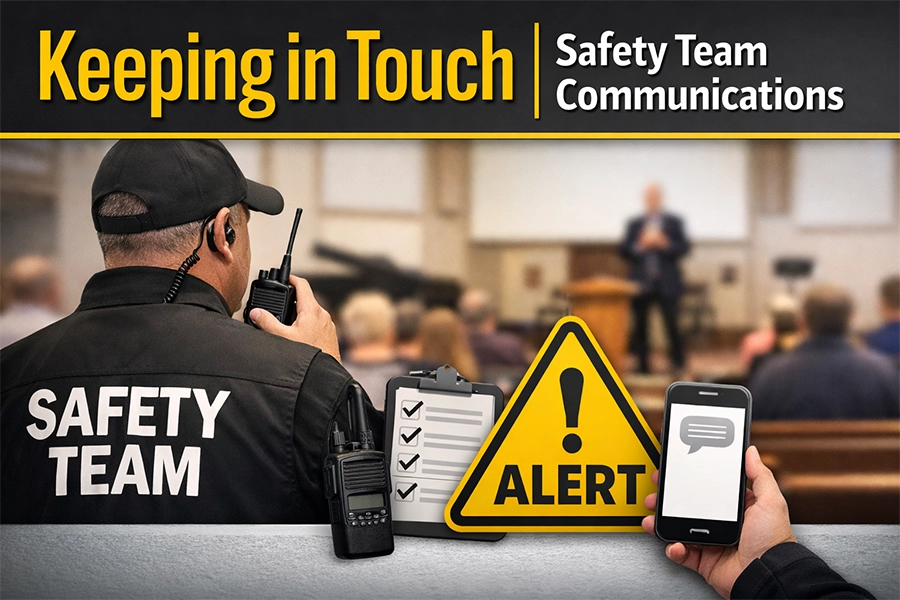
This article is based on the Safety Member Certification training module “Safety Member Fundamentals V5” and the Church Security Guide article “Church Safety Team Basics.” [1][2][3][4].
From the Bible –
And there CAME one that had escaped, AND TOLD Abram the Hebrew; for he dwelt in the plain of Mamre the Amorite, brother of Eshcol, and brother of Aner: and these were confederate with Abram (Genesis 14:13).
And [Gideon] SENT MESSENGERS throughout all Manasseh; who also was gathered after him: and he sent messengers unto Asher, and unto Zebulun, and unto Naphtali; and they came up to meet them (Judges 6:35).
THEN THEY TOLD David, saying, "Behold, the Philistines fight against Keilah, and they rob the threshing floors" (1 Samuel 23:1).
And when Paul's sister's son HEARD of their lying-in-wait, HE WENT and entered into the castle, AND TOLD Paul. Then Paul CALLED ONE of the centurions unto him, AND SAID, "Bring this young man unto the chief captain: for he hath A CERTAIN THING TO TELL HIM" (Acts 23:16-17).
Introduction –
In any organization, communication is a key to coordination. This can be orally in-person, orally over the radio, written logs and notifications, speaking to groups, etc. It may include pre-arranged hand signs. In any case, this is sharing facts, issuing warnings, giving advice and instructions, and making commands when needed. In a church safety ministry, communication is used by members of the safety team in keeping the congregation safe and secure. Ongoing communication is how members of the Safety Ministry keep in touch with each other.
On the Web –
Atlanta, Georgia, January 21, 2026 – On its Facebook page, the Israel Missionary Baptist Church posted a notification that they were monitoring weather reports and forecasts to determine whether or not to cancel services for Sunday, January 25. This notification was in both a post and a reel. Their primary concern is the safety of the congregants. [5].
* Note: Several other churches (especially those without web pages) include Facebook for congregational notifications.
Grand Blanc Township, Michigan, September 28, 2025 – The man who committed the vehicle attack, arson, and shooting at an LDS Ward in Grand Blanc Township called 911 three times reporting attacks on places of worship (a Catholic Church, a Christian Reformed Church, and a Jewish temple) just minutes before driving his pickup into the Mormon church building, opening fire, and igniting the building. These calls were to divert police away from the real threat. [6].
* Note: Sometimes false threats will be made to the church or to 911 about the church. These could be diversionary, as in Grand Blanc, or to disrupt scheduled activities.
Hinesville, Georgia, January 17, 2026 – Someone reported a suspicious person near the St. Stephen’s Church in Hinesville and called 911. When officers arrived, they noted that, “The situation appears to have been handled cautiously,” apparently by persons at the church. [7].
* Note on outgoing communication: Internal communications resulted in a 911 call, as well as effective response by safety personnel.
Saint Augustine, Florida, September 22, 2024 – In an article on the Protect His House website, Tommy Sapp addresses churches’ need to plan for emergency communications. Clear communication is the key to effective coordination during an emergency. This article was shared by Religious Product News on its website.
Mr. Sapp said, “An emergency communication plan allows your church to quickly and efficiently relay important information, coordinate responses, and provide reassurance.”
Here’s how he outlines the topic:
- Developing Your Emergency Communication Plan,
- Develop Clear Messaging,
- Establish Communication Protocols,
- Implementing and Testing Your Plan,
- Leveraging Technology,
- Engaging the Congregation.
In the conclusion, he again stresses the importance of planning a church’s emergency communications:
“By identifying key communication channels, developing clear messaging, and leveraging technology, churches can create a robust communication system that keeps everyone informed and reassured.”
Sending a Message –
The unofficial motto of the United States Postal Service (formerly the U.S. Post Office) has been “Neither snow nor rain nor heat nor gloom of night stays these couriers from the swift completion of their appointed rounds.” When the James Farley Post Office was built in New York City, these words were chiseled into the granite above the entrance. This is a translation from Herodotus’s history account, The Persian Wars. [8]
The quoted sentence was how the Greek historian described the Persian king’s mounted couriers, who carried messages back and forth across the expanse of the empire. This example of messengers in ancient times reminds us of the critical importance of communication, especially when security is at stake.
In church safety and security, messages are not carried on horseback across the country (like the Pony Express), but in the church and among the congregants and other involved parties, beginning in the Church Safety Ministry.
Communication Means –
Before getting into how to communicate, let’s consider with whom we communicate. Broadly, the communication can be with individuals or with groups. Topically, it can be general or situational. For instance, one safety team member can talk with another about security issues or a specific situation. The Church Safety Director can have a conversation with one member of the Safety Committee or address the entire committee, speak to one Safety Team member or the whole team. Some safety notices and announcements will be for the congregation in general or for a certain activity group. The persons involved and the subject matter will have a bearing on the means of communication used.
Besides communication within the church, there are also external communications, such as with emergency agencies (law enforcement, fire department, EMS), governmental departments, insurance providers, medical facilities, utilities, etc.
Oral Communication:
- Face-to-face,
- Addressing a group in-person,
- Public Address System,
- Two-way radios,
- Telephone.
Written Communication:
- Emails,
- Mailed communications (USPS),
- Social media
- Website,
- Newsletters,
- Bulletin board announcements,
- Public announcements in the media,
- Written notices,
- Articles, manuals, guidelines,
- Written policies and procedures,
- Logs and reports.
Mass Notification:
- Phone messages,
- Text messages,
- Email messages,
- Social media.
Radio Communication –
How we communicate influences how the message or conversation is received and how it is understood. The three key areas of concern are etiquette, confidentiality, and clarity. Here they are for radio:
Etiquette:
This simply means considering the other person(s). First, use ear pieces with radios. If you are in a populated area (such as the sanctuary or in a class), you’ll hear an incoming message without disturbing others or disrupting the service or class. If you need to answer, you can step outside for the same reason.
Others on the team may need to use the radio channel, so keep the message short. If you need more time, call the other member on the phone or switch to a one-on-one channel (if so equipped).
Sign in and sign off on the call. Identify yourself when initiating the call and immediately indicate why you’re calling. When done, sign out using your name, such as, “Jimmy out.” This lets the other(s) know you’re done and they can initiate their call(s).
Confidentiality:
Be careful about sharing confidential matters. An open channel on the radio is not the medium for that. A lot of our knowing about certain situations depends on persons feeling secure in sharing their concerns with the Safety Ministry. This comes down to respecting and protecting their privacy. When sharing a confidential security concern, you can say “someone” and the kind of things they need to watch for, such as a non-custodial parent trying to take a child.
Clarity:
Safety communication is not the time to be creative or copy what is used on TV shows. Use plain English, and on the radio use standard phrases and approved codes.
Standard Phrases;
Here are some standard phrases and what they mean:
- “Go ahead” – “Send your message.”
- “Copy” – “I received and understood the message.”
- “Say again” – “Retransmit your message.” You were doing something else or couldn’t hear the message clearly.
- “Stand by” – “I heard your message but please wait.”
- “Affirmative” or “Yes” – “Yes.”
- “Negative” or “No” – “No.”
- “Do you copy?” – “Do you understand?”
- “Unreadable” – you can’t understand the person who transmitted the message (i.e. you don’t know what was said because the message was garbled due to a technological problem).
- “Disregard” – “Don’t pay any attention to the last message.” [9].
Approved Codes;
For police drama fans, “10-4” is not on this list. Also, if an emergency agency is needed, add “9-1-1” to the code:
- Code Red – a fire emergency.
- Code Blue – a medical emergency.
- Code Pink – a missing or lost child.
- Code Orange – an actively disruptive or combative person.
- Code Yellow – a suspicious person.
- Code Green – a cash or offerings escort.
- 911 is an enhancement code. It means, “Respond quickly and call local law enforcement (or the fire department or EMS).” When using this code, you would first give the other code, for example “Code Orange 9-1-1.” [9].
Recommended Radios;
The technology for two-way radios is constantly developing, with changes year-by-year. Since older models leave the market as new ones appear, so our preferences change. Kris says that “for now” he recommends the Black Diamond Radio D452. It has 16 channels, more than enough for most churches. The battery can stay charged for 14 hours (analog) and 20 hours (digital). If you are using analog radios and want to add more units, the D452 is compatible with those. It is available on the Black Diamond Radio website. [10].
Other Means -
It is important for church safety ministry communication to be to-the-point. That way those who hear or read it will know what they need to know.
Oral Communication:
In-person oral communication, whether with an individual or a group, calls for control of posture, facial expressions, and voice. Avoid distractions like fidgeting and swaying. Know what you’ll say before you say it. In a conversation, listening is as important as speaking.
Verbal De-escalation is an important use of oral communication, with the goal of calming a tense situation.
On the telephone, speak clearly enough to be understood at the other end. Connections are not always perfect. Also, most people can better understand what is said when they can see the speaker’s face. Since you can’t be seen, this increases the need for vocal clarity.
The need for vocal clarity also applies to notifications on a public address system or mass telephone notifications.
Written Communications:
The worst excuse for bad writing I’ve heard is, “Spelling don’t [sic] matter. They gets [sic] it anyway.” Well, there are enough cases of a misspelling being a different word that changes the meaning of the message to say that it does make a difference. It is important to not be misunderstood when the message is very important or critical. Also, misspelling or wrong word use makes the writer look bad, especially when it is in polices, instructions, newsletters, etc.
Logs and reports need to have the relevant information. Include the date, time, location, and your name. Most reports also need to be signed. A church safety ministry should have forms for logs and reports. What kinds are needed?
Logs:
- Patrol Log – A patrol log lets other team members know what concerns were found on patrol.
- Radio Check-out Log – At the beginning of a shift, a safety team member gets a two-way radio. The member signs it out, then signs it back in at the end of the shift. Note any problems with the radio.
- Report for Duty Log,
- Child check-in and check-out form,
- Training Log.
Reports:
- Incident Report – These are needed when there will be a legal investigation, an insurance claim, or the possibility of a lawsuit. At the least, they can inform assessments of safety team actions.
- Child Abuse Report – Report known or suspected abuse or neglect of a child, a youth, or other vulnerable person.
Notifications:
There are times we need to notify congregants of prayer requests, announcements, safety concerns, cancellations, and postponements using:
- Phone messages – There are services for recording a message and calling congregants to play the message when they answer. If someone doesn’t answer the phone, the message can be recorded on voicemail.
- Text messages - Notifications can be sent in mass to congregants who have mobile phones. Those with landlines or VOIP but no mobile can still be on the phone message list.
- Email messages – Members who have email can be notified that way. It may take longer than by phone or text, but can be used for longer messages and have more time to respond.
- Social media – Most churches now have social media accounts, especially on Facebook. When changes are made two or more days earlier, this is a good route, especially if the notice is a bit long. One church put its winter storm advisory into a reel [5].
Training and Drills –
Church Safety Teams should have all their members trained and certified. The Safety Member Certification program begins with “Safety Member Fundamentals V5,” which includes several points about communication. Communication is also considered in the Church Security Guide article “Church Safety Team Basics.” [1-4].
It will help for members to review the subject of communications, especially when it has been a problem. Team members can hold each other accountable, with more experienced members mentoring others. The best practice is to practice good communication skill in everyday use.
By the way, Sheepdog Church Security has some forms available to Safety Member Certification students.
Conclusion –
Keeping in touch requires good communication practices.
References –
- Kris Moloney, Safety Member Certification, Sheepdog Church Security, 2025 [https://sheepdog-church-security.thinkific.com/courses/safety-member-certification-v5-2025].
- Kris Moloney, Safety Member Fundamentals V5, Sheepdog Church Security, 2025 [https://sheepdog-church-security.thinkific.com/courses/Safety-Member-Fundamentals-V5].
- Kris P. Moloney, Church Security Guide, Sheepdog Church Security, [https://sheepdog-church-security.thinkific.com/pages/security-articles?c=church-security-guide].
- Kris P. Moloney, “Church Safety Team Basics,” Sheepdog Church Security, June 9th, 2023 [https://sheepdog-church-security.thinkific.com/pages/security-articles?p=church-safety-team-basics].
- Church Leadership, “Sunday Worship Winter Storm Advisory,” Israel Missionary Baptist Church, Atlanta, January 21, 2026, Post: [https://www.facebook.com/IMBCAtlanta], Reel: [https://www.facebook.com/reel/907951178838179],
- David K. Li and Alexandra Chaidez, “Man behind deadly attack on Mormon church in Michigan called in other threats to 'divert' police,” NBC News, January 20, 2026 [https://www.nbcnews.com/news/us-news/man-deadly-attack-mormon-church-michigan-called-threats-divert-police-rcna254965].
- AI generated transcript and summary from 911 call, “Possible suspicious person near St. Stephen's Church,” Liberty County Emergency Call Center posted by CrimeRadar, January 17, 2026 [https://www.crimeradar.us/hinesville-ga/42570\_1768689369\_dkhphvju-possible-suspicious-person-near-st-stephen-s-church].
- Herodotus, “The Persian Wars, Book 8, Paragraph 98,” 5th Century, BC.
- Kris Moloney, Instructor’s Guide, “Church Safety / Security Volunteer Academy V2,” Sheepdog Church Security, © 2016, 2017.
- Black Diamond Radio D452, Black Diamond Radio, 2025 [https://blackdiamondradio.com/d452/].