




Tornado Season Safety
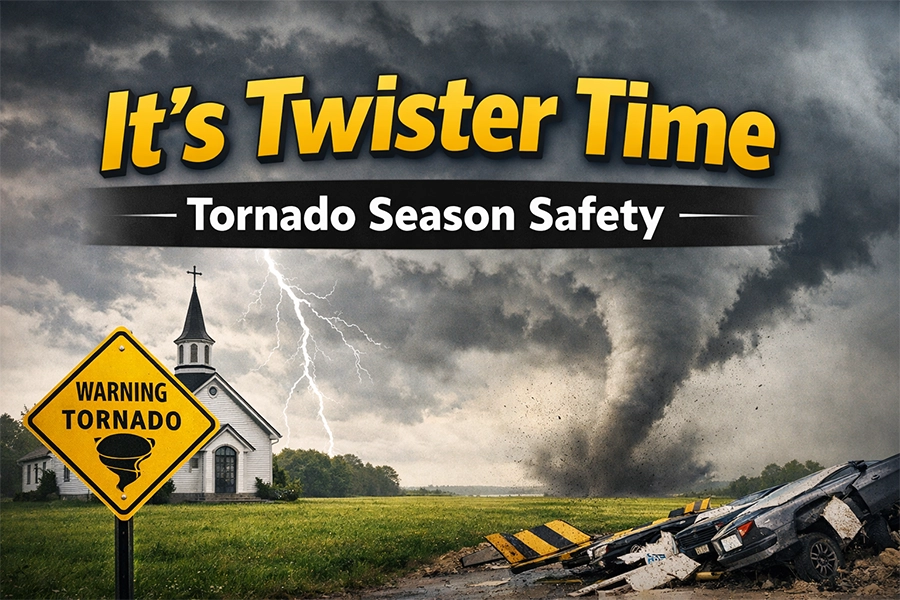
An article based on the Safety Member Certification training module “Storms and Disasters v4” and the Church Security Guide article “Preparing Your Church for Natural Disasters.” [1][2][3][4].
From the Bible –
As the whirlwind passeth, so is the wicked no more: but the righteous is an everlasting foundation (Proverbs 10:25).
The voice of thy thunder was in the heaven: the lightnings lightened the world: the earth trembled and shook (Psalm 77:18).
Fire, and hail; snow, and vapours; stormy wind fulfilling his word (Psalm 148:8).
Introduction –
We are already in the Tornado Season, which is usually most severe March through May. Even though the Weather Service forecasts fewer tornadoes this year (January and February have had fewer than normal) due to the ending of La Niña, they do expect severe thunderstorms with lightning, hail, strong winds, and flash flooding. [5][6].
It sounds more like the Tornado Plus Season. For us, this means preparing for church safety in all these weather events.
In the News –
There have been 18 tornadoes from March 5 to 7, ranging from EF0 to EF3. On March 6, six people died, two in Oklahoma and four in Michigan. [7].
Major County, Oklahoma, March 5, 2026 – An EF2 tornado traveled 7+ miles. It hit a vehicle on a U.S. highway, killing two persons, a mother and her daughter. [8].
Cass County and Branch County, Michigan, March 6-7, 2026 – Two tornadoes claimed the lives of four persons in southern Michigan. An EF1 twister killed one person in a home in Cass County. In Branch County, an EF3 tornado hit Union City and Union Lake. One person in a mobile home was killed, as well as two more people near the lake. [9].
Seasonal Weather and Church Safety –
Winter, with its snow, ice, and extreme cold, is now past, and the heat of summer is months away. The weather hazards we face are now those of spring.
History tells us that places of worship are not exempt from tornadoes, strong winds, lightning strikes, hail, and flooding. Preparations are needed for these seasonal weather hazards. As this is being written, Indiana, Michigan, Ohio, and Pennsylvania are cleaning up the damage from over 24 hours of high winds. This includes restoring power to hundreds of thousands of users. A repeat is predicted for Sunday and Monday with the possibility of a bomb cyclone. Currently, some churches are using mass notification to advise alternate routes due to downed trees and power lines. [10][11].
Forecasts and Advisories:
Forewarned is forearmed. We need to be aware of seasonal risks in our area. Since climate does change, there is a chance that new records could be set. For instance, many localities in North America had record snowfalls this winter, and several more had levels not seen for many decades. The same goes for windspeeds and rainfall. “Has not been,” does not mean, “Never will.”
Stay up-to-date on forecasts from the Weather Service. You may see them on the Weather Channel, AccuWeather, Weather Nation, Fox Weather, and local media. Every safety & security ministry should have a reliable weather radio, such as the Midland-WR300, Deluxe NOAA Emergency Weather Alert Radio. [12].
Just a reminder: a Watch means that conditions make a weather event possible or likely. A Warning means that it is coming.
Severe Weather Preparation:
One piece of age-old farm advice is, “Fix the fence before the cattle get out.” Also, a folk song says, “Oh no, don’t let the rain come down. My roof’s got a hole in it and I might drown.” The time to prepare for severe windstorms or catastrophic downpours is before they develop. Don’t wait until you get a watch or warning. By then it will likely be too late. [13].
The stages of preparation are Risk Assessment, Physical, Organizational and Procedural, Communication, and Training.
Risk Assessment,
Weather-related risks should be part of the church’s annual risk assessment. Since weather events are changeable, long-range and short-range forecasts need to be considered more often, such as monthly or quarterly.
Physical,
The church’s buildings and property need to be weather-worthy, able to withstand windstorms and torrential rain (yes, even in Phoenix). Inspect the roof after severe weather events so any damage can be identified and repaired. That also goes for walls, windows, and doors. If “my roof has a hole in it,” then fix the hole before it rains.
- Will door sills and basement windows keep high water out?
- Will the door latches and hinges hold for the next extreme wind?
- How about the edges of the roof?
- A very small leak around a window frame may not be so small the next time.
Physical preparation also includes having supplies needed for a weather response. Plan for and procure them. Keep them where they could be found and deployed without undue delay.
Organizational and Procedural,
It is important to already know what to do for each type of weather emergency.
Outline what will be done in case of severe weather and who carries out which tasks. For example:
- If weather alerts come while services or events are in progress, what will you do for the current threat?
- Do you have time for everyone to evacuate and safely get home?
- Will people be safe where they are, or do they need to seek shelter?
- How will we set up for an extended stay?
- Who, if anyone, goes to the church when it is unoccupied?
- Who boards windows and doors or loads the sandbags?
Communication,
Communication is essential for coordination and safety.
Keep members of the safety team in communication with each other while they are at church. Also, some may need to be called during off hours when needed. Two-way radios serve the first purpose. Team leaders need a call list to quickly contact team members. One means may be to set up a group text message. Type once and send to all. You can also send a voice message as an audio text.
Does your church have a reliable mass notification system? On Saturday, my church sent out a notification that one route to church was blocked by downed power lines. That is an example of using mass communication for the safety of church members.
Last Minute News –
A report has come in that a massive winter storm will hit the east half of the United States, affecting over 200 million people. A bomb cyclone formed over the Midwest Sunday afternoon and will bring blizzards to the East Coast on Monday. There may be long-track tornadoes. This will be followed by extreme cold, lasting several days and setting record lows in many places. [13].
This news underscores the need of churches to be current on weather forecasts so they can be ready for rough storms.
Training,
Train safety team members and auxiliaries (ushers, greeters, on-call medical professionals) in preparing for and responding to weather emergencies. This includes drills as well as the training module “Storms and Disasters,” which can be used as a standalone course. [2]. The goal is efficient coordination during a severe weather event.
Conclusion –
Spring is Twister Time and more. Be ready for whatever this season’s weather brings.
References –
- Kris P. Moloney, Safety Member Certification, Sheepdog Church Security, 2025 [https://sheepdog-church-security.thinkific.com/courses/safety-member-certification-v5-2025].
- Kris P. Moloney, “Storms and Disasters v4,” Safety Member Certification, Sheepdog Church Security, 2025 [https://sheepdog-church-security.thinkific.com/courses/severe-weather-and-natural-disasters].
- Kris P. Moloney, Church Security Guide, Sheepdog Church Security, 2025 [https://sheepdog-church-security.thinkific.com/pages/security-articles?c=church-security-guide].
- Kris P. Moloney, “Preparing Your Church for Natural Disasters,” Church Security Guide, Sheepdog Church Security, June 9, 2023 [https://sheepdog-church-security.thinkific.com/pages/security-articles?p=preparing-your-church-for-natural-disasters].
- Brian Lada, “Tornado season: What forecasters expect for severe weather in 2026,” AccuWeather, accessed on Yahoo!News, February 25, 2026 [https://www.yahoo.com/news/articles/tornado-season-forecasters-expect-severe-120041041.html].
- “List of United States tornadoes from January to March 2026,” Wikipedia, [https://en.wikipedia.org/wiki/List_of_United_States_tornadoes_from_January_to_March_2026].
- Anon, “At least 6 dead after tornadoes rips through Michigan and storms hit central U.S,” CBS News, Updated on: March 7, 2026 [https://www.cbsnews.com/news/michigan-tornado-storms-oklahoma-severe-weather-fatalities/].
- Doyle Rice, “Mother, daughter killed in Oklahoma tornado; more severe storms expected,” USA TODAY, March 6, 2026 [https://www.usatoday.com/story/news/weather/2026/03/06/oklahoma-tornado-kills-two-with-more-storms-possible/89022541007/].
- Anon, “At least 6 dead after tornadoes rips through Michigan and storms hit central U.S.”, CBS News, Updated on March 7, 2026 [https://www.cbsnews.com/news/michigan-tornado-storms-oklahoma-severe-weather-fatalities/].
- News Staff, “Severe Winds Lash Northwest Ohio and Southeast Michigan, Causing Widespread Damage and Outages,” WTVG -13ABC, posted on USA Today, March 13, 2026 [https://news-usa.today/toledo-wind-damage-power-outages-school-damage-traffic-issues-march-2026/#google_vignette].
- Alex Sosnowski, "March megastorm: Blizzard, dangerous winds to threaten nearly 200 million," AccuWeather, Mar 12, 2026; Updated Mar 14, 2026 [https://www.accuweather.com/en/winter-weather/march-megastorm-blizzard-dangerous-winds-to-threaten-nearly-200-million/1872500].
- "Don't Let the Rain Come Down (Crooked Little Man)," Wikipedia [https://en.wikipedia.org/wiki/Don%27t_Let_the_Rain_Come_Down_(Crooked_Little_Man)].
- Midland - WR300, Deluxe NOAA Emergency Weather Alert Radio, Sheepdog Church Security - Recommended Equipment for Safety Ministries, Amazon.com [https://www.amazon.com/dp/B00009V2YV?linkCode=ssc&tag=onamzsafetyeq-20&creativeASIN=B00009V2YV&asc_item-id=amzn1.ideas.1ERD68BB0JGWR&ref_=aip_sf_list_spv_ofs_mixed_d_asin].
- Angela Fortuna, "Bitter Arctic cold blast to impact over 200 million Americans immediately after monstrous bomb cyclone," Fox Weather, accessed on Yahoo!News, March 15, 2026 [https://www.yahoo.com/news/articles/bitter-arctic-cold-blast-impact-192804032.html]