



November and December Church Safety Guide
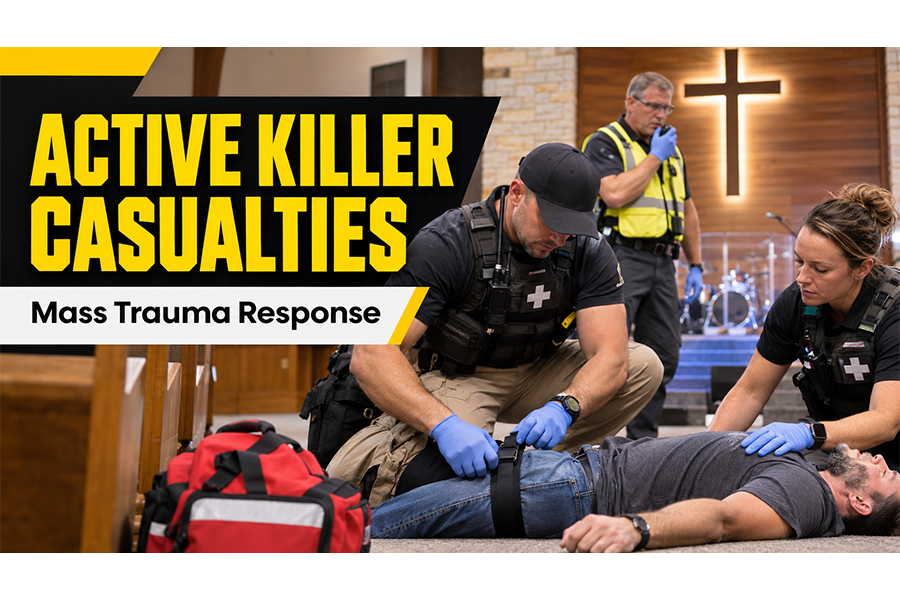
Holiday church safety hazards change quickly in November and December. For church Safety Teams and Safety Directors, the challenge is not simply preparing for violence. It is recognizing the ordinary hazards that become more likely when weather changes, attendance increases, decorations go up, kitchens get busy, and ministry schedules become crowded.
Those risks deserve our attention.
According to the U.S. Fire Administration, fire departments responded to an estimated average of 1,300 fires in places of worship each year from 2020 through 2022, resulting in an estimated $74.6 million in annual property loss. Cooking was the leading cause, accounting for 33% of those fires.
At the same time, churches are entering the season of Thanksgiving meals, Christmas programs, candlelight services, outreach events, children's rehearsals, evening activities, and visitors who may have never walked through our doors before.
That combination makes November and December an important time for a seasonal church safety assessment.
The goal is not to make Christmas feel like a security operation. Our calling remains ministry. People should be welcomed, children should be able to celebrate, families should worship together, and guests should encounter the love of Christ.
Good safety supports that mission.
Why November and December Require a Different Church Safety Assessment
A risk assessment is simply a deliberate process of identifying what could reasonably go wrong, evaluating how serious the consequences could be, and deciding what actions can reduce that risk.
For a volunteer church Safety Team, that does not require complicated software or a law enforcement background.
It requires paying attention.
CISA's guidance for houses of worship emphasizes understanding risk, understanding the facility, developing and practicing a plan, educating greeters, and building relationships with community partners. CISA also notes that house-of-worship safety teams are commonly made up of volunteers and that members do not have to come from law enforcement, fire service, emergency medicine, or emergency management backgrounds to serve effectively when they receive appropriate training.
During November and December, I recommend walking through your church with one question in mind:
What has changed since an ordinary Sunday in September?
You may discover more changes than you expect.
There may be Christmas trees in the lobby, electrical cords across areas normally kept clear, rehearsal equipment on the platform, extra chairs in the sanctuary, food being prepared in multiple rooms, more children on campus, unfamiliar volunteers helping with events, dark parking lots during evening services, or icy sidewalks after a weather event.
None of those things automatically represents a crisis.
Together, however, they change your risk environment.
What should a holiday church safety walkthrough include?
Do not limit the walkthrough to the sanctuary. Begin at the property line and move toward the places where people gather.
A practical November or December inspection should examine:
- Parking lots, sidewalks, stairs, and entrances. Look for inadequate lighting, ice, snow, standing water, damaged pavement, loose rugs, and other fall hazards. OSHA recommends clearing snow and ice from walking surfaces and applying deicer as soon as practical after winter weather.
- Exits, aisles, and gathering spaces. Make sure decorations, additional seating, equipment, tables, gift boxes, and temporary displays have not reduced access to evacuation routes. NFPA emphasizes maintaining access and egress routes so occupants and emergency personnel can move through assembly spaces during an emergency.
- Kitchens and fellowship halls. Check cooking equipment, food service areas, fire extinguishers, extension cords, traffic flow, and who is responsible for the kitchen during an event.
- Children's areas. Confirm that check-in, pickup, supervision, and restricted-access procedures still work when attendance is unusually high.
- Electrical and decorative installations. Look for damaged cords, overloaded power arrangements, decorations near heat sources, and temporary equipment placed where it creates trip or fire hazards. NFPA specifically warns against unsafe extension-cord and power-strip arrangements and recommends attention to damaged or improperly routed cords.
- Emergency equipment. Verify that first-aid kits, AEDs, radios, flashlights, fire extinguishers, emergency lighting, and other assigned equipment are accessible and ready for use. CISA recommends clearly locating lifesaving equipment and regularly checking and testing it.
A walkthrough is not successful because someone filled out a form. It is successful when an identified problem gets assigned to a person and corrected.
Fire, Electrical, Cooking, and Candle Hazards Increase During the Holidays
Fire deserves particular attention during the holiday season because churches often combine several risk factors at once: decorations, temporary electrical equipment, candles, cooking, additional people, and altered room layouts.
NFPA reports that candle fires in U.S. homes peak in December and January, with Christmas being the peak day for candle fires. Its 2020–2024 data also show that more than half of home candle fires began when combustible material was too close to the flame. Although residential statistics should not be presented as church-fire statistics, they demonstrate why open flames deserve disciplined handling during Christmas activities.
How should churches prepare for Advent and Christmas candlelight services?
A candle is an open flame. Treat it as one.
Before a candlelight service, identify who is responsible for distributing candles, lighting them, supervising their use, responding to dropped candles or ignited material, and confirming that all flames are extinguished afterward.
Keep combustible decorations away from open flames and heat sources. Consider whether battery-operated flameless candles can accomplish the purpose of a particular activity without introducing an unnecessary ignition source. NFPA specifically recommends keeping candles away from anything that can burn and identifies flameless candles as an alternative.
Christmas trees and lighting also deserve inspection. NFPA reports that electrical distribution or lighting equipment was involved in about 40% of home Christmas tree fires in its current holiday fire data. Again, that is residential data, not church-specific data, but the underlying electrical and ignition hazards are relevant wherever trees and decorative lighting are used.
Do not allow the beauty of a display to override basic fire protection.
What about Thanksgiving dinners and church kitchens?
Church meals combine ministry and hospitality beautifully, but busy kitchens introduce heat, grease, knives, crowded workspaces, electrical equipment, and foodborne-illness risks.
The USFA finding that cooking was the leading cause of reported fires in places of worship from 2020–2022 should get our attention.
Food safety matters too. FDA guidance recommends four basic practices: clean, separate, cook, and chill. Turkey and stuffing should reach a safe internal temperature of 165°F, and foods requiring refrigeration should generally be refrigerated within two hours.
For buffet service, FDA guidance calls for keeping hot foods at 140°F or above and cold foods at 40°F or below, with perishable foods generally discarded after two hours at room temperature unless they are being maintained at safe temperatures.
Local health-department rules may impose additional requirements, particularly when churches regularly prepare or serve food to the public. USDA specifically advises food-service operations to consult applicable FDA Food Code provisions and local health regulations.
That distinction is important throughout church safety: national best-practice guidance does not replace your locally adopted fire, building, electrical, health, or occupancy codes.
Your local fire marshal, building official, health department, insurer, and other appropriate authorities can help you determine which requirements apply to your facility.
Winter Weather, Darkness, and Power Loss Change the Safety Environment
November and December bring another change that is easy to underestimate: people arrive and leave church in darkness.
A Wednesday evening children's program that felt routine in August may now end after sunset. Christmas concerts create additional vehicle and pedestrian traffic. Snow and ice can make familiar sidewalks hazardous.
OSHA's winter-weather guidance identifies snow- and ice-covered walking surfaces as slip-and-fall hazards and recommends prompt clearing and deicing.
For churches, the practical application is simple: someone should own the condition of the property before people arrive.
Do not assume another ministry has checked the sidewalk.
Assign it.
Parking areas deserve the same attention. USFA recommends illuminating building exteriors and entrances, while CISA recommends appropriate perimeter lighting, clear parking and pedestrian pathways, and properly identified personnel for traffic management where appropriate.
A Safety Team member walking a dark parking lot should be looking for more than suspicious activity. Look for burned-out lights, icy areas, fallen branches, poorly marked curbs, stranded vehicles, people who need assistance, and pedestrian conflicts with traffic.
That is safety ministry too.
How should a church prepare for a winter storm or power outage?
Decisions about cancellation, delayed services, or early dismissal should be made through an established process rather than improvised while weather deteriorates.
Determine in advance who monitors conditions, who has authority to change the schedule, and how that decision will be communicated to staff, volunteers, parents, and congregants.
Also ask what happens if the electricity fails while the building is occupied.
Can people safely see their way out? Who checks children's rooms? Who communicates with the congregation? Does your communication equipment still function? Are electrically controlled doors affected? Can emergency responders easily access the property?
Winter preparedness should also include awareness of generator risks. NFPA and USFA warn that improperly used portable generators can cause carbon-monoxide poisoning, electrocution, and fire.
Never improvise electrical or generator arrangements during an outage. Use properly installed equipment and qualified professionals consistent with applicable codes and manufacturer instructions.
Holiday Crowds, Children, Visitors, and Outreach Require Clear Assignments
Christmas Eve may bring people who have not attended church in years. Children's programs may fill rooms with grandparents and extended family. Community dinners and gift distributions can attract families who have never been on your campus.
That is a ministry opportunity.
It is also a reason to plan.
How do we welcome unfamiliar people without profiling them?
A person's appearance, clothing, ethnicity, disability, economic condition, or unfamiliarity with church culture does not make that person a threat.
Safety awareness should be behavior-based.
CISA's Power of Hello guidance encourages greeters to engage visitors respectfully while paying attention to behavior and context. The approach is summarized as observing, initiating a greeting, navigating the risk, and obtaining help when warranted. CISA identifies behaviors such as communicated threats, threatening abusive language, statements about harming others, or other conduct that reasonably raises concern—not someone's demographic characteristics—as reasons for further attention or reporting.
That model fits church ministry well.
A genuine greeting accomplishes two things at the same time: hospitality and awareness.
We do not have to choose between being welcoming and being watchful.
Jesus taught His disciples to be "wise as serpents and innocent as doves" in Matthew 10:16. The immediate context concerns disciples being sent into a hostile world; it is not a church-security manual. But the principle reminds us that Christian service does not require naivety. Wisdom and innocence can exist together.
How should churches handle children's Christmas programs?
Large children's events can disrupt normal routines, and disrupted routines create opportunities for mistakes.
Do not abandon established child-protection procedures because the Christmas program is crowded or because "everyone knows everyone."
Maintain your church's procedures for check-in, controlled access, authorized pickup, volunteer identification, supervision, and responding when someone attempts to bypass the process.
Before the event, determine who handles doors, who helps lost children, who responds when a parent has an identification or custody issue, and who communicates with leadership during an emergency.
Safety Teams should support children's ministry leadership rather than unnecessarily taking it over. Clear roles prevent confusion.
What about donations, benevolence events, and holiday outreach?
Food boxes, toys, gift cards, special offerings, and benevolence distributions may create temporary storage, traffic, crowd-management, and accountability concerns.
Establish who controls access to storage areas, who manages distribution flow, and who has responsibility for money or other high-value items. Use your church's established financial-control procedures rather than inventing a looser system because an event is temporary.
Proverbs 27:23 says, "Know well the condition of your flocks." In context, the passage is about responsible stewardship. It offers a fitting leadership principle here: what God entrusts to us deserves attentive care.
Medical Emergencies and Seasonal Illness Belong in Holiday Planning
Not every emergency begins with a threat.
Someone may fall on an icy sidewalk. A guest may choke during a meal. An older member may experience chest pain. A child may have an allergic reaction. Someone in a packed Christmas service may suffer cardiac arrest.
Church Safety Teams should know who calls 911, who retrieves the first-aid kit or AED, who meets EMS at the entrance, and who keeps access routes clear.
An AED, or automated external defibrillator, is a device that can analyze a person's heart rhythm during cardiac arrest and, when appropriate, deliver a shock.
The American Heart Association states that cardiac arrest requires immediate action involving CPR and use of an AED. It also reports that immediate CPR can double or triple a person's chance of surviving an out-of-hospital cardiac arrest.
CISA recommends first-aid, CPR, and appropriate emergency training for house-of-worship personnel and clearly marked, regularly checked lifesaving equipment.
Do not merely own an AED.
Know where it is, inspect it according to the manufacturer's requirements, and make sure trained volunteers can reach it quickly.
Should churches think about flu, RSV, and other respiratory illnesses?
Yes, without turning worship into a medical screening operation.
CDC says influenza typically circulates during fall and winter and most often peaks nationally between December and February. For the 2026–2027 respiratory-virus season, CDC expects COVID-19, influenza, and RSV to continue contributing to winter hospitalizations, although the precise timing and severity of each virus cannot be predicted with certainty.
Practical church measures include encouraging ill volunteers to stay home, maintaining hand-hygiene supplies, cleaning commonly touched areas, and maintaining effective indoor ventilation where feasible. CDC identifies hygiene, staying home when sick, immunization, and cleaner indoor air as core respiratory-virus prevention strategies.
This is also a staffing issue.
If three key volunteers become sick the week of Christmas Eve, who fills their roles?
Redundancy—having another trained person who can perform an essential responsibility—is part of preparedness.
Turn Holiday Risks Into a Written Church Safety Plan
Safety is strongest when expectations are decided before an emergency.
CISA recommends that houses of worship develop emergency procedures, establish reporting and notification responsibilities, train personnel, and practice their plans. Its house-of-worship assessment guidance specifically highlights safety leadership, ushers and greeters, emergency operations plans, exercises, first-responder partnerships, and crisis communications.
Your November and December plan does not need to become a hundred-page manual.
For each major holiday event, answer several practical questions:
Who is in charge? What hazards are unique to this event? Which volunteers are assigned to entrances, children's areas, parking, medical response, and other essential positions? How will the team communicate? How will emergency services be contacted and directed to the correct location? How will people evacuate or shelter if necessary?
Then practice.
A drill is a planned exercise used to practice a specific emergency response. It does not have to be dramatic. A Safety Team can walk through a scenario before people arrive.
For example: Halfway through the Christmas Eve service, the power fails. What happens next?
Or: A guest collapses in the rear of the sanctuary during a full service. Who calls 911? Who gets the AED? Who meets EMS? Who maintains space around the patient?
Or: Freezing rain begins during an evening children's program. Who evaluates the property, communicates with parents, and manages dismissal?
You learn far more by walking through those questions than by assuming everyone will "know what to do."
Ecclesiastes 4:9–10 reminds us that two are better than one because each can help the other when one falls. Although the passage speaks broadly about companionship and mutual support, that principle is reflected in a healthy Safety Ministry: preparedness is shared work.
No single volunteer should be expected to notice everything, remember everything, and handle everything.
Key Takeaways for Church Safety Teams This Holiday Season
November and December church safety is not primarily about preparing for the worst imaginable event. It is about faithfully preparing for the most reasonable risks created by the season.
Your priorities should be clear.
Assess winter walking surfaces and exterior lighting. Inspect candles, decorations, kitchens, electrical equipment, aisles, and exits. Review children's procedures before special programs. Prepare for larger crowds and unfamiliar visitors without profiling. Confirm medical-response roles and AED readiness. Establish winter-weather and power-outage procedures. Protect accountability during outreach and donation activities. Plan for seasonal illness affecting volunteers. And assign responsibility rather than assuming someone else will handle it.
Most importantly, practice your plan.
Our goal is not to make people afraid when they come to church.
Our goal is to create an environment where pastors can pastor, teachers can teach, children can learn, visitors can be welcomed, families can worship, and the Safety Team quietly stands ready to serve.
That is the heart of the Sheepdog mission.
As 1 Peter 4:10 teaches, believers are called to use what they have received to serve one another as faithful stewards of God's grace. For those entrusted with church safety, preparedness is one expression of that stewardship.
Before your next Thanksgiving outreach, Christmas program, or Christmas Eve service, review your church safety plan and conduct a holiday-specific walkthrough with your team. Identify the seasonal hazards, assign responsibilities, correct what you can, and practice the scenarios most relevant to your congregation.
And if your volunteers need a stronger foundation for serving effectively, explore Sheepdog Church Security Academy's Safety Member Certification as part of your team's continuing training.
Preparedness does not replace faith.
It helps us serve faithfully with what has been entrusted to our care.
Sources
- American Heart Association. "Treatment of Cardiac Arrest." American Heart Association, https://www.heart.org/en/health-topics/cardiac-arrest/emergency-treatment-of-cardiac-arrest. Accessed 13 Nov. 2026.
- Centers for Disease Control and Prevention. "2026–2027 Respiratory Disease Season Outlook." CDC, 23 Sept. 2026, https://www.cdc.gov/cfa-qualitative-assessments/php/data-research/season-outlook26-27.html.
- Centers for Disease Control and Prevention. "Flu Season." CDC, 26 Sept. 2025, https://www.cdc.gov/flu/about/season.html.
- Centers for Disease Control and Prevention. "Preventing Respiratory Illnesses." CDC, 18 Aug. 2025, https://www.cdc.gov/respiratory-viruses/prevention/.
- Centers for Disease Control and Prevention. "Taking Steps for Cleaner Air for Respiratory Virus Prevention." CDC, 18 Aug. 2025, https://www.cdc.gov/respiratory-viruses/prevention/air-quality.html.
- Cybersecurity and Infrastructure Security Agency. Houses of Worship Security Self-Assessment Survey. U.S. Department of Homeland Security, 2020, https://www.cisa.gov/sites/default/files/publications/DHS%20CISA%20HoW%20Self-Assessment%20Survey_508_05.04.2020.pdf.
- Cybersecurity and Infrastructure Security Agency. The Power of Hello: A Guide for Houses of Worship. U.S. Department of Homeland Security, May 2025, https://www.cisa.gov/sites/default/files/2025-05/CISA_Power-of-Hello-Guide-for-Houses-of-Worship_508_20250528.pdf.
- Cybersecurity and Infrastructure Security Agency. Protecting Houses of Worship: Perimeter Security. U.S. Department of Homeland Security, 2023, https://www.cisa.gov/sites/default/files/2023-09/CISA_Protecting_HoW_Perimeter_Security_508_Compliant.pdf.
- The Holy Bible, English Standard Version. Crossway, 2016, https://www.esv.org/.
- National Fire Protection Association. "Electrical Home Fire Safety." NFPA, https://www.nfpa.org/education-and-research/home-fire-safety/electrical-safety-in-the-home. Accessed 13 Nov. 2026.
- National Fire Protection Association. "Put a Freeze on Winter Fires." NFPA, https://www.nfpa.org/education-and-research/home-fire-safety/put-a-freeze-on-winter-fires. Accessed 13 Nov. 2026.
- National Fire Protection Association. "Safety with Candles." NFPA, https://www.nfpa.org/education-and-research/home-fire-safety/candles. Accessed 13 Nov. 2026.
- National Fire Protection Association. "Strategies for Crowd Management Safety." NFPA, 1 Nov. 2022, https://www.nfpa.org/news-blogs-and-articles/blogs/2022/11/01/strategies-for-crowd-management-safety.
- National Fire Protection Association. "Winter Holidays." NFPA, https://www.nfpa.org/education-and-research/home-fire-safety/winter-holidays. Accessed 13 Nov. 2026.
- Occupational Safety and Health Administration. "Winter Weather: Hazards/Precautions." U.S. Department of Labor, https://www.osha.gov/winter-weather/hazards. Accessed 13 Nov. 2026.
- U.S. Department of Agriculture, Food Safety and Inspection Service. "How Do I Keep Foods Safe at a Buffet?" USDA, https://ask.fsis.usda.gov/article/How-do-I-keep-foods-safe-at-a-buffet. Accessed 13 Nov. 2026.
- U.S. Fire Administration. "Protecting Houses of Worship Against Arson." Federal Emergency Management Agency, https://www.usfa.fema.gov/prevention/arson/houses-of-worship/. Accessed 13 Nov. 2026.
- U.S. Food and Drug Administration. "Food Safety Tips for Healthy Holidays." FDA, 31 Jan. 2025, https://www.fda.gov/consumers/consumer-updates/food-safety-tips-healthy-holidays.
- U.S. Food and Drug Administration. "Serving Up Safe Buffets." FDA, 25 Feb. 2025, https://www.fda.gov/food/buy-store-serve-safe-food/serving-safe-buffets.
- Bigda, Kristin. "Electrical Fire Safety and Relocatable Power Taps." National Fire Protection Association, 20 Apr. 2018, https://www.nfpa.org/news-blogs-and-articles/blogs/2018/04/20/nfpa-1-electrical-fire-safety-and-relocatable-power-taps-power-strips-firecodefridays.