




Maximizing Your Time
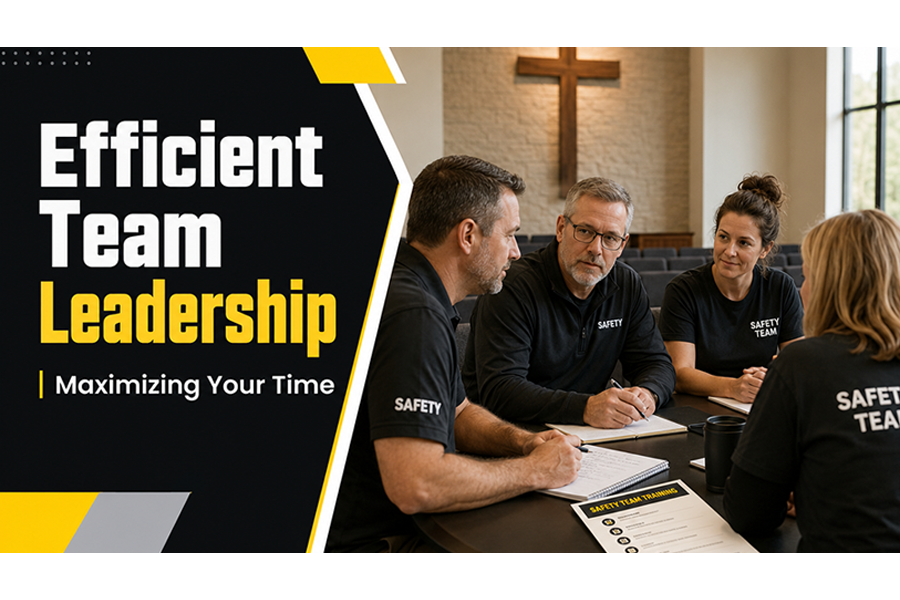
Efficient team leadership is one of the biggest challenges for church safety directors, ministry leaders, and pastors who are trying to keep their teams prepared without adding more meetings, more pressure, or more confusion.
Most church leaders I talk to are not struggling because they do not care about safety. They are struggling because they are already carrying a lot.
Sunday is coming every week. Volunteers need direction. Families need care. The building needs attention. Ministries need support. People need prayer. And somewhere in the middle of all that, the safety team still needs to train.
That can feel overwhelming.
But here is the good news. Effective safety training does not always require a long classroom session, a full Saturday event, or a complicated training calendar. Sometimes the most consistent growth happens in small, focused moments that are already built into your rhythm.
Ten minutes at a time can make a real difference.
This guide is about helping church leaders maximize the time they already have. It is for the safety director who wants to keep the team sharp but does not want to burn them out. It is for the pastor who wants a safer church but knows volunteers are already giving generously. It is for the ministry leader who wants training to feel practical, doable, and connected to real church life.
When we steward time well, we honor both the mission and the people serving in it.
Why Church Safety Training Often Gets Pushed Aside
Church safety training is important, but it is also easy to postpone.
Not because leaders are careless. Usually, it is because the schedule is full.
A safety director may think, “We need to review medical response soon,” but then Sunday arrives, a volunteer calls out, a door issue comes up, and a family needs help. The moment passes.
A pastor may know the church needs better evacuation planning, but there are sermons to prepare, counseling needs, staff meetings, facility concerns, and ministry decisions that cannot wait.
Volunteers may want to be better prepared, but many of them are serving in between work, family, school activities, and other church commitments.
So safety training gets treated like something that has to wait until there is “enough time.”
The problem is that enough time rarely appears on its own.
That is why short, focused training sessions are so valuable. They do not require you to stop everything. They help you build readiness into what you are already doing.
Instead of waiting for a perfect training day, you use the next team meeting. Instead of trying to cover everything at once, you cover one topic clearly. Instead of overwhelming volunteers, you give them one practical thing they can remember and apply.
That is efficient leadership.
The Power of 10-Minute Safety Training
A 10-minute training focus may sound too simple at first. But in a church setting, simple is often what works.
Short training sessions help your team stay engaged. They are easier to schedule, easier to repeat, and easier for volunteers to absorb. They also allow you to build consistency over time.
Think about what happens when your team reviews one safety scenario at every meeting. One month, you talk through fire evacuation routes. The next month, you review how to respond to a disruptive individual. Then you walk through medical emergencies and AED use. Over time, your team is not just hearing safety concepts once. They are regularly practicing how to think.
That matters.
Church safety is not only about having a binder full of policies. It is about helping people respond calmly when something unexpected happens. Calm response usually comes from repeated exposure, clear expectations, and role clarity.
Ten minutes gives you enough time to ask:
- What is the concern?
- Who needs to know?
- What should our team do first?
- What should our team not do?
- Where do we need better clarity?
Those questions can reveal a lot.
A short discussion may show that half the team does not know where the AED is located. It may show that greeters are unsure who to notify if someone becomes disruptive. It may show that ushers know the evacuation routes but do not know who checks the restrooms. It may show that youth volunteers have a good child check-in process but are unsure what to do if a parent becomes upset.
That is not failure. That is useful information.
Training is not just about proving what your team knows. It is about discovering what still needs to be strengthened.
Start With Scenarios That Fit Your Church
One of the most important parts of efficient team leadership is choosing training topics that match your actual environment.
Your church does not need to train from fear. It needs to train from wisdom.
Start with realistic scenarios. Think about the things your team may actually face on a Sunday morning, during a midweek service, at a youth event, or during a special gathering.
For many churches, a good starting point includes:
- Fire evacuation routes
- Responding to disruptive individuals
- Medical emergencies and AED use
- Severe weather procedures
- Child check-in concerns
- Lost child response
- Suspicious behavior reporting
- Parking lot concerns
- Communication during service
- Assisting elderly members or guests with mobility needs
You do not need to cover all of these at once. In fact, you should not try to.
Pick one.
Keep the discussion focused.
For example, if the topic is fire evacuation routes, do not try to review every emergency plan your church has ever created. Use the 10 minutes to answer a few practical questions.
- Where are the nearest exits from the sanctuary?
- Who helps direct people out?
- Who checks classrooms?
- Where do families reunite?
- What should volunteers avoid doing?
That last question is important. Volunteers need to know what their role is, but they also need to know what is outside their role.
A greeter does not need to act like a firefighter. An usher does not need to make independent decisions in the middle of an emergency. A youth worker does not need to leave children unattended to investigate a noise.
Role clarity protects people.
It also keeps your team from freelancing under pressure.
Train for Calm, Not Control
One of the best things a church safety leader can teach is calm.
Your team does not need to control every situation. They need to respond appropriately, communicate clearly, and support the plan.
That is especially important when training volunteers who are not formal safety team members.
Greeters, ushers, children’s workers, parking volunteers, hospitality teams, and ministry leaders all play a role in church safety, but most of them are not there to confront people, investigate concerns, or physically intervene.
They are there to notice, report, and support.
That can be part of your 10-minute training rhythm.
For example, if you are reviewing how to respond to a disruptive individual, you might ask:
- What behavior are we noticing?
- Who should be notified?
- Where is the person located?
- Is there an immediate risk?
- What support does the room need right now?
Then make the boundaries clear.
Volunteers should not argue, threaten, chase, restrain, search, or try to prove a point. Their job is to stay calm, create space when possible, notify the right leader or safety team member, and help protect the overall environment.
In a church, the goal is not to win an argument. The goal is to preserve peace, protect people, and respond with wisdom.
That is a deeply biblical posture.
Proverbs 15:1 reminds us that “a soft answer turns away wrath.” That does not mean we ignore danger. It means our first posture should not be pride, panic, or escalation. It should be wisdom, self-control, and readiness.
A well-trained team does not become harsh. It becomes steady.
Engage the Team Instead of Lecturing the Team
One mistake leaders sometimes make is treating training like a one-way announcement.
The safety director talks. Everyone listens. The meeting moves on.
There is a place for instruction, but short training works best when the team participates.
Ask questions. Invite observations. Let volunteers talk through what they would do. Give people a chance to identify what feels unclear.
This does two things.
First, it keeps people engaged. Most volunteers learn better when they are part of the discussion.
Second, it shows you what your team actually understands.
A nodding room does not always mean people are ready. Sometimes people nod because they do not want to slow the meeting down. But when you ask, “What would you do first?” or “Who would you call?” you get a clearer picture.
You may discover that your team is sharper than you realized. You may also discover gaps that need attention.
Both are helpful.
The goal is not to embarrass anyone. The goal is to strengthen the team together.
You can make this simple by assigning roles during the scenario.
For example:
- “Sarah, you are the greeter at the front door.”
- “Mike, you are the usher near the back row.”
- “David, you are the safety team member on duty.”
- “Lisa, you are helping in the children’s area.”
Then walk through the situation.
A guest becomes upset in the lobby. What does the greeter do? Who gets notified? What does the usher need to watch for in the sanctuary? What should the children’s area know, if anything? Who speaks to the guest? Who documents what happened?
This kind of discussion helps each person understand their lane.
It also builds respect between roles.
When people understand what others are responsible for, they are less likely to overstep and more likely to support one another.
Use Training to Identify Knowledge Gaps
A knowledge gap is not a weakness. It is an opportunity to lead.
If your team does not know where the AED is located, that is something you can fix.
If people are confused about which door should be used during an evacuation, that is something you can clarify.
If volunteers do not know who is on the safety team each Sunday, that is something you can communicate better.
Short training sessions are excellent for revealing these gaps because they put practical questions in front of the team.
For example, during a 10-minute medical emergency discussion, you might learn that several volunteers know CPR, but no one knows whether the AED pads are adult-only or if pediatric pads are available. You might learn that ushers know to call 911, but they do not know who should meet emergency responders at the door. You might learn that children’s workers are unsure whether to move children or keep them in place during a medical situation nearby.
That information helps you plan your next step.
You do not have to solve every issue in the moment. Write it down. Assign follow-up. Revisit it later.
Efficient leadership does not mean doing everything immediately. It means noticing what matters and moving it forward with discipline.
Keep a Record of What You Covered
If you want short training sessions to become truly effective, keep a record.
This does not need to be complicated. A simple spreadsheet, binder page, shared document, or meeting log can work.
Track:
- Date of the meeting
- Scenario discussed
- Key points covered
- Team members present
- Questions raised
- Follow-up items
- Topics that need to be revisited
This helps in several ways.
First, it prevents random training. Without a record, leaders may repeat the same few topics and miss other important areas. A record helps you rotate through scenarios with intention.
Second, it helps with consistency. If a team member misses a meeting, you can see what they missed and follow up.
Third, it helps you document progress. That matters for leadership accountability. It also helps your pastor, elders, or board see that safety preparation is happening in a structured way.
Fourth, it helps you plan future sessions. If the team struggled with a topic, put it back on the schedule. If a question came up that needs more time, plan a longer training later.
A record turns 10-minute conversations into a training pathway.
That is the difference between “we talked about safety once” and “we are steadily preparing our team.”
Rotate Topics Over Time
A good training rhythm should not stay stuck in one area.
Some churches talk about disruptive people often but rarely discuss medical response. Others focus on active threat concerns but have not practiced evacuation. Some have strong children’s ministry procedures but weak communication between ministries. Some have great parking lot awareness but no clear plan for severe weather.
Rotating topics keeps your team well-rounded.
You might create a simple rotation like this:
- Month 1: Fire evacuation
- Month 2: Medical emergency and AED location
- Month 3: Disruptive individual response
- Month 4: Severe weather shelter plan
- Month 5: Lost child response
- Month 6: Communication and reporting
Then repeat the cycle with deeper questions.
The first time you discuss fire evacuation, you may focus on exit routes. The next time, you may focus on who checks classrooms. The next time, you may focus on how to assist elderly members or guests with mobility needs.
This keeps training fresh without constantly inventing new material.
It also helps people retain what they learn. Repetition builds readiness.
As leaders, we sometimes want training to feel exciting or new every time. But in safety, repeated clarity is a gift. People do not rise to a binder they barely remember. They respond from what has been practiced, reviewed, and reinforced.
Celebrate Small Wins
Leadership is not only about correcting problems. It is also about noticing progress.
When your team handles a scenario discussion well, say so.
When someone asks a good question, thank them.
When a volunteer remembers the correct reporting process, acknowledge it.
When the team identifies a gap before it becomes a real problem, celebrate that.
Small wins build momentum.
This matters because church safety can feel heavy. If every conversation is only about danger, failure, or what could go wrong, people may start to feel discouraged. They may also begin to associate training with fear.
That is not the goal.
The goal is faithful preparation.
When you celebrate progress, you remind your team that their service matters. You remind them that readiness is built one step at a time. You help them see that every conversation, every clarification, and every improvement contributes to the safety and peace of the church.
A trained team is not built overnight. It is built through steady leadership.
How to Plan Your Next 10-Minute Training Focus
If you are ready to start, keep it simple.
Before your next team meeting, choose one scenario. Write down three to five questions you want the team to discuss. Decide what main point you want everyone to remember.
Here is a simple structure you can use.
Minute 1: Introduce the Scenario
Briefly describe the situation.
For example:
“During Sunday service, a guest in the lobby becomes loud, upset, and refuses to move away from the children’s check-in area.”
Keep it realistic. Do not make it dramatic just to get attention. Use something your church could actually face.
Minutes 2 to 5: Ask What the Team Notices
Invite discussion.
What is happening?
Where is it happening?
Who could be affected?
Is there an immediate risk?
Who needs to be notified?
This helps the team practice observation before action.
Minutes 6 to 8: Clarify Roles
Ask what each role should do.
What does the greeter do?
What does the usher do?
What does the safety team member do?
What does the children’s worker do?
What does the ministry leader do?
This is where you prevent confusion and overstepping.
Minute 9: Identify Gaps
Ask one simple question.
“What do we need to clarify before this happens in real life?”
Write down the answers.
Minute 10: Close With the Key Takeaway
End with one clear reminder.
For example:
“Our first job is to notice early, report clearly, and support the plan. We do not argue, chase, or physically intervene. We stay calm and get the right help involved.”
That is training your team can remember.
A Sample 10-Minute Training Scenario: Medical Emergency During Service
Here is an example you can use with your team.
Scenario:
During worship, an elderly member appears weak and sits down suddenly. A family member nearby looks concerned and waves for help.
Questions to ask:
- Who notices first?
- Who alerts the safety team or medical volunteer?
- Who calls 911, if needed?
- Who retrieves the AED?
- Who meets emergency responders?
- How do ushers keep the aisle clear?
- How do we protect the person’s dignity?
- What should volunteers avoid doing?
Key teaching point:
In a medical emergency, the team should respond calmly, call for appropriate help, keep pathways clear, and avoid crowding the person. Volunteers should not guess at a diagnosis or move the person unless there is an immediate danger.
This is practical, simple, and ministry-minded.
It reminds the team that safety is not just about procedures. It is also about caring for people with dignity.
A Sample 10-Minute Training Scenario: Fire Evacuation
Scenario:
A fire alarm sounds during service. People are unsure whether to leave immediately or wait for instructions.
Questions to ask:
- Who gives direction?
- Which exits should be used?
- Who assists children’s ministry?
- Who checks restrooms or classrooms, if assigned?
- Where do people gather outside?
- How do we help guests who do not know the building?
- What should volunteers avoid doing?
Key teaching point:
During an evacuation, volunteers should help move people calmly toward the nearest safe exit, keep pathways clear, and follow the church’s established plan. No one should go back inside unless authorized by emergency responders.
This kind of short review can make a real difference.
People may think they know what to do during a fire alarm, but unless the process has been discussed, confusion can spread quickly.
Clarity saves time.
A Sample 10-Minute Training Scenario: Disruptive Individual in the Lobby
Scenario:
A person enters the lobby visibly upset, speaking loudly, and refusing to calm down. Guests are beginning to move away.
Questions to ask:
- Who notices the behavior?
- Who contacts the safety team?
- Where should greeters stand?
- How do we create space without escalating?
- Who communicates with church leadership?
- What should ushers watch for inside the sanctuary?
- What should volunteers avoid doing?
Key teaching point:
The team should respond early, stay calm, notify the right people, and avoid confrontation. Volunteers should not argue, block, threaten, touch, restrain, or chase the person. The goal is to preserve safety and peace while getting appropriate help involved.
This is where role clarity really matters.
In tense situations, people often feel the urge to “do something.” Training helps them understand what the right something is.
Efficient Leadership Is Faithful Stewardship
Church safety leadership is not just about procedures. It is about stewardship.
You are stewarding the people God has entrusted to your church. You are stewarding the volunteers who serve faithfully. You are stewarding the time, energy, and attention of your team.
That means training should be serious, but it should also be sustainable.
If your training plan depends on everyone having unlimited time, it will probably fail. But if your training plan uses the time you already have with wisdom, it can grow stronger month by month.
Ten minutes may not seem like much, but ten minutes repeated faithfully can build a culture.
A culture where volunteers know their role.
A culture where people report concerns early.
A culture where safety is not treated as fear-based or separate from ministry.
A culture where the church remains welcoming and watchful.
That is the goal.
We are not trying to turn every volunteer into a security officer. We are helping every volunteer serve with awareness, humility, and care. We are helping leaders build teams that are prepared without being overwhelmed.
That is servant-hearted safety.
Practical Takeaways for Church Safety Leaders
If you want to start using short training sessions right away, here are a few practical steps.
Choose one scenario for your next meeting.
Keep the discussion to 10 minutes.
Ask questions instead of only giving instructions.
Clarify what each role should do.
Clarify what each role should not do.
Write down the topic, attendance, questions, and follow-up items.
Rotate scenarios over time.
Celebrate progress along the way.
The key is consistency. Do not wait until you can build the perfect training program. Start with the next meeting. Start with one scenario. Start with the team you have.
Preparedness grows through faithful repetition.
Next Steps: Build a Simple Training Rhythm
At your next team meeting, set aside 10 minutes for one focused safety discussion.
Pick a scenario that matters for your church right now. Maybe it is fire evacuation. Maybe it is AED use. Maybe it is how to respond when someone becomes disruptive. Walk through it slowly. Let people ask questions. Write down what comes up.
Then do it again at the next meeting with a different topic.
Over time, those short conversations will help your team become more confident, more unified, and more prepared.
You do not need to add more pressure to your schedule to lead well. You need a clear rhythm, practical topics, and a commitment to steady improvement.
Small training moments can produce strong teams.
And strong teams help churches remain both safe and welcoming.
Ready to Lead Your Church Safety Team With More Confidence?
Strong church safety leadership does not happen by accident. It grows through clear direction, practical training, and steady support. Whether you are just getting started or working to strengthen an existing safety ministry, you do not have to build it alone.
At Sheepdog Church Security Academy, we provide training and resources designed specifically for Safety Directors, church leaders, and volunteers who want to protect their congregation with wisdom, confidence, and care.
Our Church Safety Program Kit gives you a practical system to launch, organize, and sustain your church safety ministry. Inside, you will find step-by-step guidance, training resources, editable documents, planning tools, workshops, and support to help you move from good intentions to a structured and prepared safety program.
And if this article helped you see the value of short, focused training sessions, we invite you to take the next step.
When you sign up for our newsletter, you can download our free Efficient Team Leadership Guide: Maximizing Your Time. This practical guide will help you streamline your team training, use 10-minute safety discussions more effectively, engage your volunteers, and keep your church safety ministry moving forward without adding more meetings to your schedule.
Your team does not need more pressure. They need a clear path, practical tools, and faithful leadership.
Explore our training for Safety Directors, learn more about the Church Safety Program Kit, and download your free Efficient Team Leadership Guide today.