




Protecting Marriages And Families
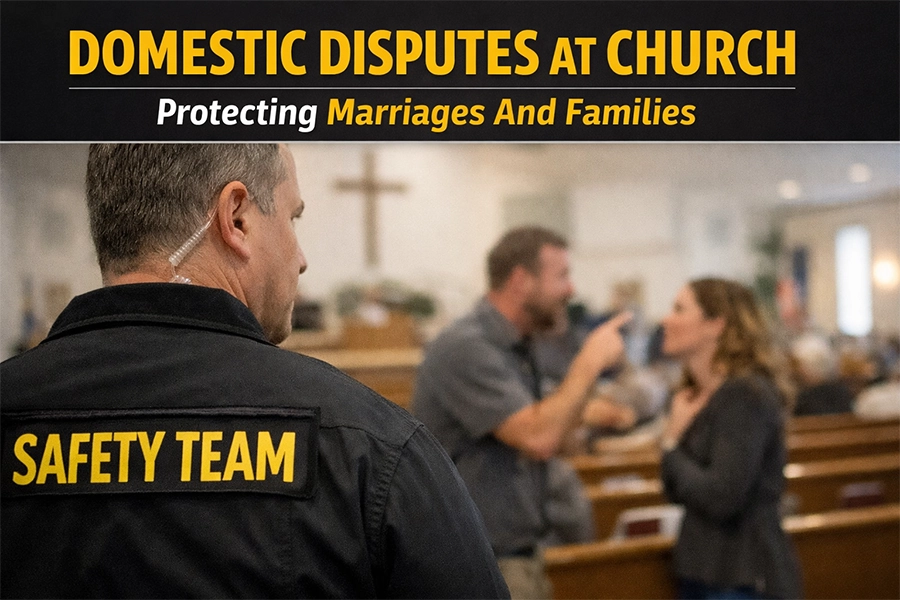
Domestic disputes are one of the most common—and most misunderstood—drivers of serious violence at churches, and they often unfold with little warning in places meant for worship, healing, and community. For church Safety Team members and Safety Directors, understanding domestic disputes is not about becoming law enforcement or investigators. It is about readiness: recognizing warning signs early, responding within clear role boundaries, and protecting people while activating the right help at the right time.
Domestic disputes that spill into churches rarely look dramatic at first. They often arrive quietly, attached to familiar faces, family dynamics, custody tensions, restraining orders, or unresolved conflict. Yet history shows that many of the most tragic church incidents began as domestic or personal disputes that escalated in sacred spaces. That is why domestic disputes deserve focused attention in every church safety and emergency planning effort.
What Is a Domestic Dispute in a Church Context?
A domestic dispute is a conflict between people with a close personal relationship—such as spouses, former partners, family members, or co-parents—that involves emotional volatility, threats, intimidation, or violence. In a church setting, these disputes may appear during services, children’s programs, counseling meetings, or special events.
Unlike random disruptions, domestic disputes often come with history. The people involved may know the building, the schedule, the staff, and the routines. They may have strong emotions tied to faith, forgiveness, reconciliation, or perceived injustice. This combination makes churches uniquely vulnerable when domestic conflict shows up on campus.
Churches must remember a critical reality: many shootings and violent incidents at houses of worship have roots in domestic violence or personal conflict that spilled into the church environment. This is not speculation; it is a documented pattern across decades.
Why Domestic Disputes Are a High-Risk Issue for Churches
Domestic disputes are dangerous because they blur boundaries. The person causing concern may not look like a “threat” in the traditional sense. They may be a member, a former member, a spouse, or a parent picking up a child. Familiarity can lower vigilance, delay escalation, and create hesitation to act.
Church culture can unintentionally add risk. Pastors and volunteers are trained to show grace, patience, and hospitality. While these values are biblical and essential, they must be paired with wisdom and discernment. Scripture repeatedly affirms both compassion and prudence. Proverbs reminds us that “the prudent see danger and take refuge” (Proverbs 22:3), a principle that applies directly to safety readiness.
From a safety perspective, domestic disputes often escalate quickly because emotions are already high. The presence of children, former partners, or perceived rivals can trigger impulsive behavior. Churches must plan for these realities without assuming malicious intent or assigning guilt.
Common Warning Signs of a Domestic Dispute Escalating at Church
Domestic disputes rarely begin with physical violence. They usually show up as behavioral cues that something is not right. Safety leaders should train staff and volunteers to notice patterns, not to diagnose people.
Some common indicators include:
- Heightened emotional intensity, such as crying, yelling, pacing, or agitation that seems disproportionate to the situation.
- Boundary violations, including refusing to leave someone alone, following them through the building, or insisting on access to restricted areas.
- Control behaviors, such as demanding to see children, pressuring staff to release a child, or attempting to override established procedures.
- Fixation, where one person seems obsessed with another individual, a meeting, or a perceived grievance.
- History clues, including references to court orders, custody disputes, restraining orders, or “ongoing issues at home.”
None of these signs automatically mean violence will occur. They do mean the situation deserves attention, communication, and escalation through the proper channels.
How Should a Church Respond to a Domestic Dispute in Progress?
The church response to a domestic dispute should be calm, structured, and consistent with emergency action planning. The goal is not to solve the dispute or take sides. The goal is to protect people, prevent escalation, and activate help when thresholds are met.
In most cases, a domestic dispute inside a church begins as a Hold situation under the Standard Response Protocol. Hold is used when there is an internal issue that requires people to stay in their rooms or areas while leaders address the problem. This posture reduces chaos, keeps hallways clear, and prevents a tense situation from becoming a public spectacle.
Early communication is critical. Leaders should be notified promptly, with clear and factual language. The emphasis is on what is observed, not assumptions about motives. Calm, respectful engagement—when role-appropriate—can often slow things down and create space for resolution.
Equally important is knowing when to stop trying to manage the situation internally. If threats are made, weapons are suspected, physical aggression occurs, or children are at immediate risk, the church must escalate without delay by calling 911. Calling for emergency help is not a failure of ministry; it is an act of stewardship and care.
Protecting Children During Domestic Disputes
Children are often the most vulnerable people in domestic disputes that surface at church. Custody disagreements, estranged parents, and emotional confrontations frequently center on access to children.
Churches must treat children’s ministry boundaries as non-negotiable safety measures, not customer service preferences. Controlled check-in and check-out procedures exist precisely because emotions can override good judgment during conflict.
When a domestic dispute involves children, the priority is to **keep children inside secure spaces, maintain normal routines as much as possible, and prevent unauthorized access**. Staff should not attempt to mediate custody issues or interpret legal documents on the spot. Instead, they should follow established procedures and escalate to leadership and, when necessary, law enforcement.
This approach protects children, protects staff, and protects the church from being pulled into disputes it is not equipped or authorized to resolve.
What Does the Bible Say About Domestic Violence and Church Responsibility?
Scripture is clear that violence, intimidation, and abuse are incompatible with God’s design for relationships. The Bible consistently condemns oppression and calls God’s people to protect the vulnerable.
Psalm 82:3 instructs leaders to “defend the weak and the fatherless; uphold the cause of the poor and the oppressed.” This mandate applies not only to spiritual care but also to physical safety. Grace does not require exposure to harm. Forgiveness does not require ignoring danger.
Jesus Himself demonstrated the wisdom of boundaries. While He welcomed sinners and healed the broken, He also withdrew from hostile situations when violence was imminent. Churches honor Christ not by enabling destructive behavior, but by responding with truth, love, and appropriate safeguards.
Legal and Ethical Considerations Churches Must Understand
Domestic disputes often intersect with legal realities such as restraining orders, custody agreements, and prior police involvement. Churches should avoid giving legal advice or interpreting court documents unless they have qualified counsel involved.
From a readiness standpoint, the safest posture is to focus on observable behavior and immediate risk, not legal arguments. If someone claims a right to access a person or child and staff are unsure, that uncertainty alone is a reason to pause, involve leadership, and potentially contact law enforcement.
Documentation matters. After any domestic dispute incident, leaders should record what was observed, what actions were taken, who was notified, and how the situation resolved. This factual record supports follow-up, pastoral care, and any future coordination with authorities.
Practical Action Steps for Church Safety Leaders
Churches of all sizes can take meaningful steps to reduce risk related to domestic disputes without turning ministry volunteers into enforcers.
Key readiness actions include:
- Train staff and volunteers to recognize early warning signs and to communicate concerns promptly and clearly.
- Reinforce children’s ministry boundaries and ensure everyone understands that exceptions are not made under pressure.
- Clarify escalation thresholds, including when to involve leadership and when to call 911 without delay.
- Practice Hold scenarios so people know how to reduce movement and maintain calm during internal disruptions.
- Document incidents consistently, focusing on facts rather than interpretations.
These steps align safety practices with ministry values by prioritizing protection, dignity, and wise decision-making.
Key Takeaways: Domestic Disputes and Church Safety
- Domestic disputes are a leading driver of serious violence at houses of worship.
- Early recognition and communication are more effective than delayed intervention.
- Churches are not responsible for resolving domestic conflicts, but they are responsible for protecting people.
- Clear boundaries, especially around children, reduce risk and confusion.
- Calling 911 when thresholds are met is an act of stewardship, not fear.
A Call to Action for Church Leaders
Domestic disputes will continue to touch churches because churches serve real people with real struggles. The question is not whether your church might encounter a domestic dispute, but whether your leaders are prepared to respond wisely when it happens.
Now is the time to review your emergency action plan, evaluate your children’s ministry procedures, and ensure your staff and volunteers understand their role in recognizing and escalating risk. Consider equipping your team through the Sheepdog Church Security Academy Safety Member Certification, where readiness, clarity, and ministry-aligned safety principles are taught in a practical, accessible way.
Preparedness is not about expecting the worst. It is about loving people well by being ready to protect them when it matters most.