



Know When to Talk—and When to Act
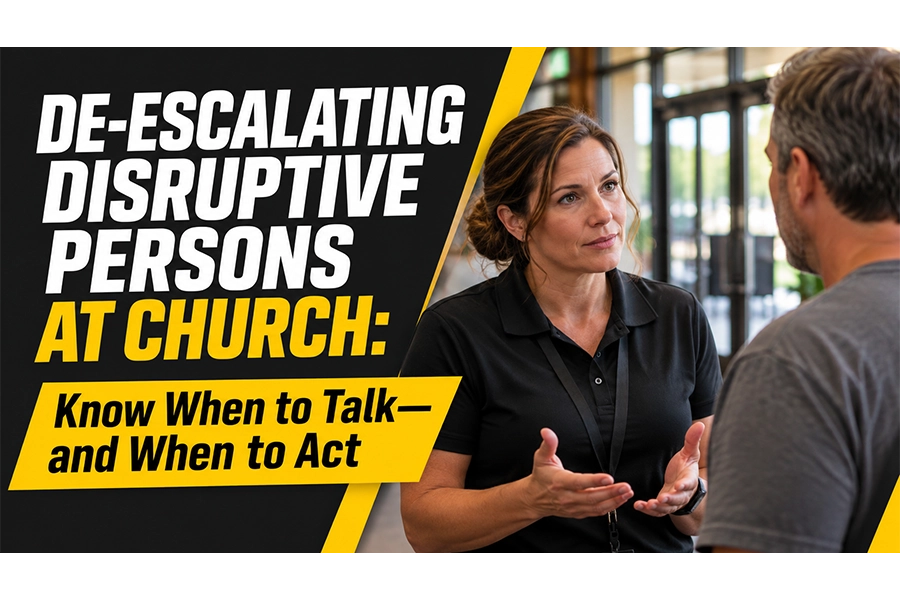
The loudest voice in the lobby is not always the greatest danger. De-escalating disruptive persons at church begins with recognizing what someone is doing—not guessing why—and knowing when a calm conversation is still useful. For greeters, Safety Team members, and Safety Directors, that distinction can shape everything that happens next.
Imagine an upset parent arriving at children's check-in. They have been told they cannot pick up a child without following the church's established release process. Their voice rises. Other families begin watching. One volunteer tries to explain every detail of the policy while another steps closer to help. Soon, three people are speaking at once.
This is a hypothetical situation, but the decisions it raises are familiar: Who should speak? What boundary must remain in place? When does the church call for support? And how does everyone protect the children without turning a tense moment into a public confrontation?
Good de-escalation is not about finding magic words. It is about sound judgment, respectful communication, clear boundaries, and knowing when the situation requires a different response.
Not Every Upset Person Is Dangerous
Churches welcome people carrying all kinds of burdens. Someone may be grieving, anxious, angry about a decision, confused about a procedure, or frightened for a family member. An emotional reaction can disrupt a service without creating an immediate threat to life.
That distinction matters. A person who is crying loudly but accepting guidance is presenting a different safety picture from someone quietly testing locked doors or repeatedly moving toward a person they have threatened.
SCSA's volunteer instruction distinguishes distress, which describes need; disruption, which describes the effect on ministry or access; escalation, which describes meaningful deterioration; and danger, where delay could permit serious harm. These are observations about a situation, not diagnoses of the person involved.
A Safety Team member does not need to decide whether someone has a mental health condition, is intoxicated, or has bad intentions. Instead, describe the observable behavior: “The visitor has asked to enter the children's hallway three times after being redirected,” rather than “The visitor is unstable.”
Specific observations lead to better decisions. Labels often lead to assumptions.
Start With Your Own Composure
When someone is angry, we naturally feel pressure to match their energy, defend a rule, or prove that we are in charge. Yet the church's objective is not to win a disagreement. It is to protect people, preserve appropriate boundaries, and move the encounter toward the safest reasonable outcome.
Before speaking, take stock of your own tone, expression, posture, and movement. Are you growing louder? Moving closer out of frustration? Interrupting? Taking the person's words personally?
A steady voice, visible hands, deliberate movements, and simple sentences can reduce unnecessary pressure. Give the person enough room to communicate while preserving your own ability to step away if circumstances change. There is no single “safe distance” for every location; a crowded lobby, narrow hallway, or busy parking lot each creates different considerations.
You do not have to appear intimidating to be effective. In many cases, the calmer you become, the clearer your next decision becomes.
How Do You De-escalate a Disruptive Person at Church?
SCSA teaches a practical sequence for situations where conversation remains safe and useful: Regulate → Open → Listen → Acknowledge → Boundary → Bounded Choice → Watch → Close or Change Action. It is a memory aid, not a script that must be completed during an emergency.
- Regulate. Settle your own voice and movements before trying to influence the encounter. Your frustration should not become another problem.
- Open. Begin with ordinary human contact: “I'm with the church. How can I help you?” Identify the immediate request without making accusations.
- Listen. Give the person a reasonable opportunity to explain. Ask what they need rather than demanding to know why they are behaving that way.
- Acknowledge. Reflect what you can honestly recognize: “I can see this is frustrating.” Acknowledgment does not mean agreeing with every claim.
- Boundary. State the behavior or access limit clearly. “This hallway is limited to children's ministry. Please wait here while I contact the leader.”
- Bounded Choice. Offer two realistic options when appropriate, such as waiting in the lobby or contacting the church office later. Never offer an exception you lack authority to grant.
- Watch. Notice whether the person is accepting direction, moving toward a restricted area, making threats, or becoming more agitated. Watch the surroundings as well.
- Close or Change Action. End the encounter respectfully when the issue is resolved, or bring in the right leader or emergency resource when talking is no longer helping.
Not every encounter needs all eight steps. Sometimes ordinary hospitality resolves the concern. Sometimes a serious threat is present from the first moment and there is no time for a conversation.
Use words while words are helping.
Boundaries Are Not the Opposite of Compassion
One common misunderstanding is that being compassionate means keeping every request open for negotiation. In a church, that can create serious problems. A child-release procedure does not disappear because someone becomes emotional. Restricted access does not become available because a visitor insists. An unavailable pastor cannot be made immediately accessible through a louder argument.
A useful response can acknowledge the concern while keeping the limit intact: “I understand you want to speak with the pastor. I can pass along your request, but you cannot go through that door.”
When a person has trouble responding, do not automatically assume defiance. They may not have heard the instruction, understood the words, processed the request, or found an accessible way to respond. Simplify the message, allow a reasonable moment to process it, or involve appropriate communication support.
Once a clear direction has been understood, however, repeated refusal or continued movement against the boundary changes the operational picture. Endless explanation does not make the boundary safer.
Compassion can be firm. In fact, clear boundaries often make compassionate care possible.
Recognize the Three Changes in Response
SCSA uses a common decision frame: Normal → Escalating → Immediate Protection. These are operating conditions, not a mandatory sequence that every incident passes through.
Normal: Hospitality and Ordinary Help Still Work
A visitor is frustrated about a seating decision but accepts an usher's offer to speak with a ministry leader. A grieving person is visibly distressed but remains cooperative. In these situations, ordinary assistance and respectful communication may be the right response.
Stay aware of the surroundings, but do not turn emotion alone into an emergency.
Escalating: Bring in the Right Support
The situation shifts when a person repeatedly refuses a clear boundary, pressures access to a protected area, follows someone, makes threatening statements, or otherwise creates growing risk. The concern may also exceed the volunteer's authority or the time and attention they can safely devote to it.
A greeter or usher should not try to manage an escalating encounter alone to prove competence. Report what changed and bring in the designated Safety or ministry leader. The receiving leader should decide what additional capability or response is needed.
Immediate Protection: Life Safety Comes First
An active assault, dangerous forced entry, serious weapon threat, credible imminent violence, attempted forced child removal, or serious medical emergency may require Immediate Protection immediately. A situation can begin here without any earlier warning.
At that point, stop treating conversation as the primary task. Call or confirm 911, follow the applicable Emergency Action Plan, and move or protect people within your assigned role when safe. Prepare useful information for arriving responders.
De-escalation is valuable. It is not a reason to delay emergency help when serious harm may be imminent.
One Person Speaks While Another Watches
When staffing and assignments permit, SCSA recommends one Primary Contact and one Safety Support for an escalating encounter.
The Primary Contact handles the conversation, explains the boundary, and evaluates whether talking is still useful. Safety Support maintains awareness of movement, bystanders, children, exits, and other developing risks while coordinating assistance.
This is not permission for two people to corner someone. Nor does the support person become a second negotiator. Several volunteers speaking at once can make the encounter harder to understand and leave the wider environment unattended.
Small churches may not have two trained Safety Team members available at every service. That is precisely why leadership should decide in advance who receives escalation, who serves as backup, and how front-line volunteers can disengage safely. If the church lacks enough people to manage the situation, seeking outside assistance earlier may be the responsible choice.
A well-timed handoff is not a defeat. It is good teamwork.
Protect the Surroundings Without Isolating the Person
De-escalation involves more than words. Where people stand, who is watching, whether an exit is blocked, and whether children are nearby all matter.
If safe, reduce unnecessary spectators, keep ordinary movement routes usable, and avoid having multiple volunteers gather around one person. Protect children's and other restricted ministry areas according to church procedures. Move bystanders away from the conflict rather than creating a crowd around it.
Privacy may lower embarrassment, but that does not mean moving an escalating person deep into a closed office or secluded hallway. Preserve visibility, nearby support, and a usable way to disengage.
The goal is to improve the safety of the environment, not gain physical control of the person. Physical intervention is a separate, consequential matter governed by law, church policy, training, evaluation, and explicit authorization; online de-escalation instruction does not confer those capabilities.
When Should a Safety Team Stop Talking?
There is a point when another carefully worded sentence will not solve the problem. If threats are becoming immediate, the person is moving toward a protected target, safe routes are disappearing, violence begins, or a weapon enters a threatening confrontation, the church must change its response.
Ask a practical question: Is this conversation still providing useful information or a safer path forward—or is it now delaying protection?
That question also helps distinguish the right outside resource. A person in emotional crisis who is not creating an immediate physical danger may benefit from pastoral care, local crisis resources, or the 988 Suicide & Crisis Lifeline. But 988 is not a replacement for 911 during an immediate physical safety threat or serious medical emergency; the Lifeline itself advises calling 911 in those situations.
When someone needs an authorized decision about access or leaving the property, involve the leader assigned to make it. A volunteer should not invent a permanent ban or threaten enforcement they are not authorized to request.
Knowing when to stop talking is part of knowing how to de-escalate.
What Should a Safety Director Prepare Before Sunday?
Safety Directors have a different responsibility from front-line volunteers. Rather than relying on one gifted communicator, they need to help leadership establish a simple, repeatable contact-and-escalation system.
At a minimum, the church should know who receives a report and who is the backup, who may set or enforce an access boundary, who may direct someone to leave for the day, how emergency calls are made, and what happens after a significant encounter. Formal exclusions or restricted-return decisions require their own authorized leadership process and may involve local legal requirements.
The director should also determine how staff share active restrictions on a need-to-know basis without creating gossip, how significant contacts are documented factually, and how the church selects pastoral, medical, crisis, or law-enforcement resources when appropriate.
Keep instructions plain enough for an ordinary volunteer to remember. A useful report explains Who / What / Where / Risk / Action: who is involved, what occurred, where it is happening, what risk is developing, and what action is underway or needed.
A policy that exists only in a binder cannot help the greeter who does not know whom to call.
Practice One Realistic Scenario Together
Return to the hypothetical parent at children's check-in. The person's frustration deserves to be heard. The children's release process still applies. An assigned worker should keep responsibility for the children while the appropriate leader addresses the adult's concern; the child-care worker should not abandon the group to join the confrontation.
During your next team discussion, consider:
- Who owns the next decision? Identify the primary contact, the support role, and the leader authorized to resolve the release-process question.
- What would make the situation change lanes? Discuss the observable signs that would call for escalation, emergency help, or a safe disengagement rather than further conversation.
- How does the situation end? Practice a respectful, clear closing and determine what factual follow-up is needed if the encounter is significant.
The point of practice is not to find the volunteer with the most persuasive voice. It is to build shared judgment so ordinary people can recognize the same warning signs and respond within the same boundaries.
Faith, Patience, and Protective Responsibility
James 1:19 encourages believers to be quick to listen and slow to speak and become angry. Proverbs 15:1 reminds us that a gentle response can turn away wrath. These principles fit naturally with the discipline of listening before judging and keeping our own reactions under control.
But gentleness is not the same as ignoring danger. Church safety is part of serving people well, including the person in distress and everyone else depending on the ministry to protect its spaces and responsibilities.
We cannot guarantee that every difficult encounter will end peacefully. We can prepare ourselves to respond with greater clarity, compassion, and sound judgment.
The next time tension rises in your church, remember the objective: not to win the exchange, but to protect people and make the next good decision.
Continue Learning With SCSA
De-escalation is an essential skill for every church Safety Team member, but it's just one part of being prepared to protect your congregation. Sheepdog Church Security Academy's Safety Member Certification v5 brings together five core training areas: Safety Team Fundamentals, De-escalating Disruptive Persons, Violent Intruder Response, Use of Force for Safety Teams, and Protecting the Vulnerable.
This comprehensive, church-specific program helps Safety Team members develop the knowledge, judgment, and confidence to respond appropriately to everyday challenges and serious emergencies while serving with compassion and professionalism.
Ready to strengthen your Safety Team's preparedness? Explore Safety Member Certification v5 and discover how a shared foundation of training can help your team serve and protect your church more effectively.