




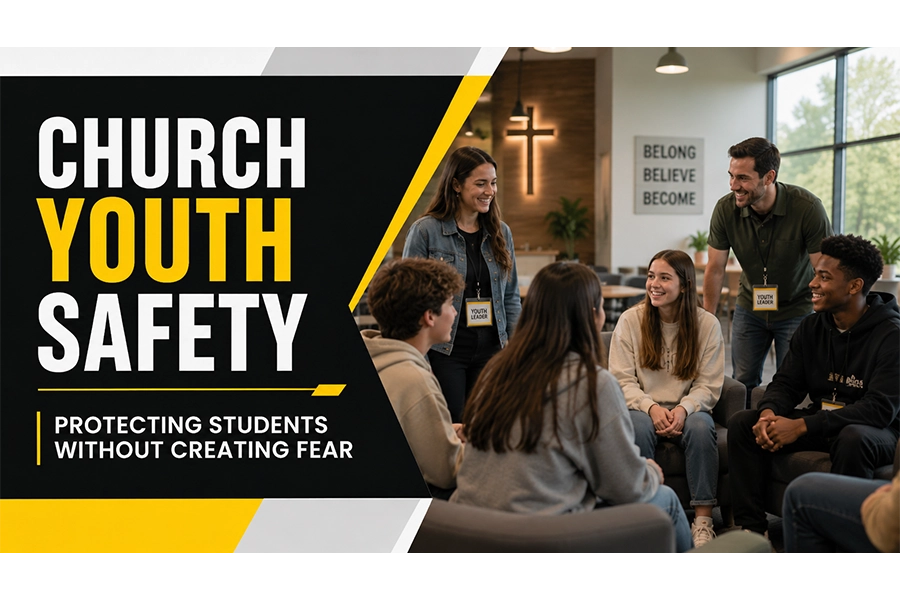
Protecting Students Without Creating Fear
From the Bible
Come, ye children, hearken unto me: I will teach you the fear of the Lord (Psalm 34:11).
Church youth safety does not have to make children, teenagers, parents, or volunteers feel afraid. In fact, some of the best safety practices are the ones that quietly create consistency, accountability, and calm without drawing attention to themselves.
Pastor, safety director, children’s ministry leader, or youth director, this is where I want to start:
Your youth and children’s ministry volunteers do not need to become security officers to help keep students safe.
They should not investigate suspicious people.
They should not chase someone through the building.
They should not physically restrain an adult.
They should not decide custody disputes at the classroom door.
They should not leave their group to search the building unless directed.
Their most important responsibility is much simpler.
They need to know who is in their care, where those students are supposed to be, and what their group needs next.
That may not sound dramatic.
It is not supposed to.
Good church youth safety is usually built on simple things done consistently: check-in procedures, clear boundaries, accurate attendance, calm communication, controlled release, and volunteers who know when to call for help.
The goal is not to make children nervous about danger.
The goal is to create an environment where children can learn about Jesus, teenagers can build healthy relationships, parents can worship with confidence, and volunteers can serve knowing what is expected of them.
That is what protecting students should look like.
Why Church Youth Safety Is Different
Every area of the church deserves thoughtful safety planning, but children’s and youth ministries carry a unique responsibility.
Adults can often make their own decisions during a confusing situation.
Children cannot.
Young students depend on the adults around them to provide direction, maintain order, and make good decisions when circumstances change.
That is why youth safety has to begin with accountability.
Who is present?
Who is responsible for them?
Where should they be?
Who is authorized to pick them up?
What happens if the building needs to evacuate?
What happens if everyone needs to stay inside?
What happens if a student is missing?
Those questions need answers before an emergency happens.
When a stressful situation starts, that is the worst time to invent a process.
I have seen firsthand how much difference organization can make when circumstances become chaotic. A united team that knows its responsibilities can bring calm to a situation very quickly. A group of well-intentioned people all trying to solve the same problem on their own can create more confusion.
Children’s ministry is no different.
The strongest youth safety plan is not built around having a hero nearby.
It is built around volunteers who know their students, understand the process, communicate clearly, and stay where they are needed.
The Youth Worker’s Main Question: What Does My Group Need Now?
For greeters, the question is:
“What does the door need next?”
For ushers:
“What does the room need next?”
For youth and children’s ministry workers, the question becomes:
What does my group need now?
I love this question because it keeps the volunteer focused on the people God has placed directly in their care.
If something unusual happens in the hallway, a volunteer may feel the urge to go investigate.
But what does the group need?
The group may need that volunteer to stay.
If a child is reported missing, a volunteer may want to join the search immediately.
But what does the rest of the group need?
They may need that volunteer to remain with them, verify attendance, and make sure another student does not become unaccounted for.
If there is an emergency elsewhere in the building, volunteers may become distracted by radios, noise, alarms, or people moving quickly.
But what does the group need?
They need calm leadership.
They need clear instructions.
They need an adult who is paying attention to them.
This question keeps youth volunteers from freelancing.
It reminds them that their first responsibility is not to go toward every problem.
It is to care for the students already entrusted to them.
Church Youth Volunteers Are Not Security Officers
Youth workers play a critical safety role, but that role needs boundaries.
They are not investigators.
They are not security officers.
They should not search a person, bag, or vehicle. They should not physically detain someone. They should not chase a person who leaves a restricted area. They should not argue with an adult who refuses a rule. They should not decide whether someone’s explanation sounds believable enough to make an exception.
Their role is ministry-facing and practical.
They supervise.
They account for students.
They follow established procedures.
They report concerns.
They support the church’s response.
Those boundaries are especially important in youth ministry because children’s safety processes must be consistent.
If a volunteer starts making exceptions based on who they know, who seems trustworthy, or who is in a hurry, the process stops being a process.
It becomes personal judgment.
That is a dangerous place for a church to operate.
Church Youth Safety Begins With Consistent Check-In
One of the easiest ways to improve church youth safety is also one of the least exciting:
Follow the check-in process every time.
That includes familiar families.
It includes longtime members.
It includes ministry leaders.
It includes someone who says, “Everybody knows me.”
Child safety procedures work because they are consistent, not because they are convenient.
Imagine a parent is running late and asks a volunteer if they can just slip through the children’s hallway without checking in.
The volunteer may recognize them.
The easy answer would be:
“Sure, go ahead.”
But now that volunteer has created an exception.
The next person may see it happen.
Another volunteer may make a different decision.
Soon the process depends on who is standing at the door instead of what the church has established.
A better response is simple:
“For child safety, everyone checks in before going back.”
That sentence does several things.
It is respectful.
It explains the reason.
It removes personal judgment.
It protects the volunteer.
Most importantly, it protects the process.
Why Restricted Areas Matter in Children’s Ministry
Churches often have spaces that should only be accessible to certain people.
Children’s hallways are one of the clearest examples.
Restricted does not mean unfriendly.
It means there is a reason the area is controlled.
Children’s spaces may include classrooms, nursery areas, check-in stations, youth rooms, storage areas, offices, or pickup zones.
Volunteers should understand which areas require authorization and what to do when someone tries to enter without following the process.
The first step is calm redirection.
“For child safety, everyone checks in before going back.”
Or:
“This hallway is limited to checked-in families and approved volunteers. I can help you get where you need to go.”
Most situations will end there.
But what happens if they do not?
If someone ignores the volunteer and keeps walking, the volunteer should not grab them.
They should not chase them.
They should not start shouting unless immediate danger requires an urgent warning.
They should report immediately.
A good report might sound like this:
“Adult male in a gray shirt just walked past check-in toward the elementary hallway after being asked to stop. He is moving toward Room 104. I need leadership and safety support.”
Short.
Factual.
Useful.
That is how volunteers help a coordinated response.
Notice Behavior, Not Labels
Church youth safety requires awareness, but awareness must be grounded in observable facts.
This is an important distinction.
We do not want volunteers labeling people based on appearance, personality, clothing, or a feeling they cannot explain.
We want them noticing behavior.
For example:
An adult repeatedly tries to enter a children’s hallway without checking in.
A person refuses to follow release procedures.
Someone is pulling on locked classroom doors.
An unfamiliar adult is asking detailed questions about when children are released or which entrances stay open.
A student appears frightened and is trying to avoid leaving with someone.
A person becomes increasingly loud or aggressive when asked to follow the process.
Those are things we can describe.
Instead of saying:
“That person seems dangerous.”
Say:
“The adult has tried three times to enter the hallway after being redirected.”
Instead of:
“That parent is acting suspicious.”
Say:
“The adult is raising their voice, refusing the release process, and demanding that the child be brought out immediately.”
Facts help leadership make decisions.
Labels do not.
The Youth Safety Pattern: Notice, Report, Support
The same simple framework that applies to other church volunteers works beautifully in youth ministry:
Notice. Report. Support.
Notice
Know your group.
Know what normal looks like.
Know where students are supposed to be.
Know which adults belong in the ministry area.
Pay attention when something changes.
The goal is not to make volunteers nervous.
It is to help them become familiar enough with their environment that they recognize when something does not fit.
Report
Report concerns early and factually.
A useful report answers:
Who?
What?
Where?
Risk?
Action?
For example:
“Ten-year-old Sarah Johnson is missing from the fifth-grade room. She is wearing a yellow shirt and jeans. She was last seen near the girls’ restroom about five minutes ago. We have checked attendance and confirmed she is not with the group. I need leadership notified.”
That report is much more useful than:
“We cannot find one of the kids!”
Clear information creates a better response.
Support
Youth volunteers support the response by maintaining accountability for everyone else.
That means keeping the rest of the group together.
It means preventing children from wandering off to “help.”
It means staying calm.
It means continuing attendance checks when directed.
It means preparing the group to move if necessary.
Support may feel less active than running through the building searching for answers.
But often it is the safer and more important job.
What Normal Looks Like in Church Youth Safety
Most church youth safety happens during normal conditions.
That is where strong habits are built.
Normal conditions may include:
Checking students in.
Confirming attendance.
Helping new families understand procedures.
Keeping unauthorized adults outside restricted areas.
Monitoring transitions between rooms.
Maintaining appropriate volunteer supervision.
Following release procedures.
Keeping hallways and exits usable.
These things may feel routine.
That is good.
Safety should become part of the routine.
When volunteers consistently practice accountability on an ordinary Sunday, they are much more prepared when something unusual happens.
What Escalating Looks Like in Youth Ministry
A situation becomes escalating when normal direction stops working.
Examples include:
An adult refuses to complete check-in.
Someone insists on entering a restricted hallway.
A parent becomes increasingly angry about the release process.
An individual repeatedly tries locked doors.
Someone refuses to leave an area after being redirected.
A student becomes severely agitated and the normal ministry response is no longer enough.
A person’s behavior is causing children or volunteers to move away.
In these moments, youth workers should resist the temptation to argue.
Give one clear direction.
Then report.
A volunteer might say:
“For child safety, we have to follow the release process. I am going to get the ministry leader to help you.”
That is enough.
The volunteer does not need to win the disagreement.
They need to maintain the boundary and get leadership involved.
Immediate Protection in Children’s and Youth Ministry
Immediate Protection means there is urgent danger or active harm.
This could include:
Fire.
Violence.
A weapon.
Serious medical distress.
Attempted abduction.
Another immediate threat to life.
When Immediate Protection is required, the priorities become very simple:
Alert.
Call 911 when safe.
Move students away from danger when possible.
Maintain accountability.
Follow the church’s emergency plan.
This is where training matters.
Youth volunteers should already know the difference between Evacuate, Shelter, and Lockdown before they hear those instructions in a real emergency.
How Youth Workers Support an Evacuation
Evacuation means moving out of the building and away from danger.
For youth workers, accountability must move with the group.
This is not just:
“Everybody go outside.”
The volunteer needs to know which students are with them.
Children should move together under adult supervision toward the designated evacuation area.
Once outside, the volunteer should account for the group again.
One of the greatest challenges during an evacuation is parents trying to reunite with children immediately.
I understand why.
If I were a parent and something serious happened, I would want my child in my arms as quickly as possible.
But unplanned reunification can create confusion.
Children should not simply be released at an exit or passed through a crowd.
They should remain with assigned adults until the church begins its established reunification process.
That protects everyone.
How Youth Workers Support Shelter
Shelter means staying inside because the danger is outside.
This could involve severe weather, police activity nearby, or another external threat.
Youth workers may need to move students away from windows, exterior walls, or glass and toward interior rooms or hallways.
Again, the group needs to stay together.
A volunteer who knows the plan can keep the tone simple:
“We are moving to another room for a little while. Stay with your group and follow me.”
Children do not need every detail.
They need clear direction and a calm adult.
That is one of the most important ways we can prevent fear.
How Youth Workers Support Lockdown
Lockdown means there is an immediate threat inside or very near the building.
This response requires quiet, quick action.
Youth workers should follow church procedures for securing their room if it can be done safely.
Move students out of sight.
Stay low when appropriate.
Stay quiet.
Silence phones and devices.
Do not open the door until a verified all-clear has been received.
Again, the goal is not to explain frightening details to children.
The goal is to give them simple instructions.
Depending on age, something as basic as:
“We need everyone quiet right now. Stay close and listen to your leaders.”
may be enough.
Adults set the emotional temperature of the room.
If volunteers panic, students will feel it.
If volunteers remain calm and clear, students are more likely to follow direction.
What Should Happen When a Child Is Missing?
A missing child or student should be reported immediately.
Youth volunteers should not wait several minutes hoping the child returns.
They should begin with facts.
Name.
Description.
Last known location.
Time last seen.
Any other useful information.
Leadership should be notified immediately.
The youth worker’s next responsibility is often misunderstood.
They should keep the rest of the group stable and accounted for.
Unless directed otherwise, they should not abandon their group to search.
Why?
Because one missing student is already an emergency.
The last thing the church needs is for three other students to wander away while every adult is searching for the first.
Other volunteers may be assigned to monitor exits or search specific areas according to the church’s plan.
Greeters and ushers may be asked to watch for an adult leaving with a child matching the description.
Everyone has a role.
That is what coordinated response looks like.
What Should Youth Volunteers Do During a Medical Emergency?
Medical emergencies happen in youth ministry.
Children fall.
Teenagers experience allergic reactions.
Someone may faint.
A child may have difficulty breathing.
A student may have a seizure.
A volunteer may suddenly become ill.
Youth workers do not need to diagnose the problem.
They need to recognize when help is needed and get help moving.
If someone is unresponsive, bleeding heavily, struggling to breathe, or showing another sign of serious distress, call 911.
Keep the other students back.
Create space.
Bring trained responders to the person.
Keep the group calm.
Do not make medical claims you are not qualified to make.
A simple statement works:
“Give them some room. Help is coming.”
Again, calm leadership matters.
What Youth Volunteers Should Never Do
Church leaders should be very clear about role limitations.
Youth workers should not:
Search a person, bag, or vehicle.
Investigate someone’s motives.
Chase someone through the building.
Grab, restrain, tackle, or detain anyone.
Argue with someone to prove a point.
Touch, move, open, or smell a suspicious item.
Diagnose medical problems.
Solve custody issues on their own.
Bypass check-in or release procedures because someone seems trustworthy.
Leave their student group without a handoff unless immediate safety requires it.
These are not limitations meant to make volunteers powerless.
They make volunteers safer and more effective.
Church Youth Safety Without Creating Fear
This is where I think churches sometimes struggle.
We recognize real danger exists.
We understand that churches are not immune to emergencies, violence, abuse, medical events, or people making harmful choices.
We live in a sinful world.
But we also refuse to let fear become the atmosphere of the church.
Children should not walk into Sunday school feeling like they are entering a fortress.
Teenagers should not be taught to view every unfamiliar person as a threat.
Parents should not feel like safety procedures are designed to frighten them.
The goal is quiet preparedness.
Clear procedures.
Trained adults.
Consistent boundaries.
Calm communication.
Accountability.
That is how we protect students without building fear into the ministry.
We prepare the adults so the children do not have to carry the weight.
What the Bible Teaches Us About Protecting Children
Jesus consistently demonstrated care for children.
In Matthew 19:14, Jesus welcomed children and made it clear that they mattered.
Protecting children is part of honoring that trust.
As church leaders and volunteers, we are caring for sons and daughters who have been entrusted to us for a period of time.
That responsibility deserves humility.
It deserves preparation.
It deserves consistency.
The Sheepdog Creed reminds us that our calling is to support shepherds and protect the flock with excellence, self-control, hospitality, and care for others.
Children are part of that flock.
Protecting them does not require us to become fearful.
It requires us to become faithful.
Plain Language Scripts for Youth Volunteers
Giving volunteers simple words ahead of time can prevent a lot of confusion.
For children’s ministry access:
“For child safety, everyone checks in before going back.”
For someone requesting an exception:
“I understand, but we need to follow the same process for everyone.”
For a release concern:
“I cannot change the release process, but I can get the ministry leader to help.”
For someone entering a restricted hallway:
“This area is for checked-in families and approved volunteers. Check-in is right over here.”
For an escalating disagreement:
“I am going to get someone who can help you.”
For an evacuation:
“Stay with your group and follow me.”
For shelter:
“We are moving to our safe area. Stay together.”
For lockdown:
“Everyone stay quiet, stay close, and listen to your leaders.”
Simple language works.
DIY Checklist: Church Youth Safety Basics
Use this checklist with your children’s and youth ministry leaders and volunteers.
* Do volunteers know exactly who is assigned to their group?
* Is attendance recorded consistently?
* Do volunteers know the check-in and release procedures?
* Are children’s and youth ministry restricted areas clearly identified?
* Do volunteers know how to redirect someone who tries to bypass check-in?
* Do volunteers know who to contact when a concern develops?
* Can volunteers make a factual report using Who, What, Where, Risk, and Action?
* Do volunteers know what to do if a child is missing?
* Do volunteers know they should keep the rest of the group together during a missing-child response?
* Do volunteers know the church’s evacuation procedure?
* Do volunteers know the designated shelter area?
* Do volunteers know how to respond during lockdown?
* Do volunteers know when 911 should be called for a medical emergency?
* Do volunteers understand that they should not chase, restrain, search, or investigate?
* Do volunteers know the answer to their main question: “What does my group need now?”
If several answers are no, that does not mean the ministry is failing.
It means you have identified where training needs to begin.
Key Takeaways for Church Youth Safety
Church youth safety starts with accountability, clear procedures, and volunteers who understand their role.
Youth workers do not need to become security officers.
Their job is to supervise students, maintain group stability, follow check-in and release procedures, notice changes, report concerns, and support the church’s emergency plan.
Their focus question is:
What does my group need now?
That question keeps volunteers centered on the students already entrusted to them.
During normal conditions, the group needs consistent procedures.
During escalating situations, the group needs calm boundaries and early reporting.
During immediate danger, the group needs clear direction, accountability, and protection.
Youth ministry safety should never be about making children afraid.
It should be about making adults prepared.
Final Encouragement
Pastor, safety director, or youth ministry leader, you do not need to turn your children’s ministry into a fortress to protect students.
You need good people with clear roles.
You need check-in procedures that mean something.
You need consistent boundaries.
You need volunteers who know their students.
You need an emergency plan that has been practiced before it is needed.
Most importantly, you need adults who understand that their job is not to run toward every problem.
Their job is to care for the group God has placed in front of them.
Teach them to ask:
“What does my group need now?”
Teach them to Notice, Report, and Support.
Teach them to hold boundaries kindly.
Teach them to follow the process even when it would be easier to make an exception.
Teach them to remain calm when circumstances change.
We cannot remove every danger from this world.
But we can prepare faithfully.
And when we do, children and teenagers are free to experience what church should be: a place where they are known, welcomed, taught, loved, and protected.
Ready to Equip Your Youth Workers With Clear, Practical Safety Training?
If this article helped you see how much your youth volunteers contribute to student safety, the next step is giving them practical training built specifically for the role they already serve.
Youth Safety Essentials from Sheepdog Church Security Academy helps youth workers and classroom leaders protect students without asking them to become security officers. The course focuses on student accountability, movement control, clear reporting, and knowing what to do when normal conditions change.
Your volunteers will learn how to recognize concerns early, report using Who, What, Where, Risk, and Action, keep students together and accounted for, and support Evacuate, Shelter, and Lockdown procedures without freelancing or abandoning their group.
The course is self-paced, designed for volunteer completion, and includes 60 days of access with weekly Zoom support, Lessons Learned discussions, and Office Hours for additional guidance.
Give your youth workers the confidence to protect students with calm, clarity, and consistency.
Enroll in Youth Safety Essentials Today: Get Immediate Access for $30