




How to Strengthen Confidence
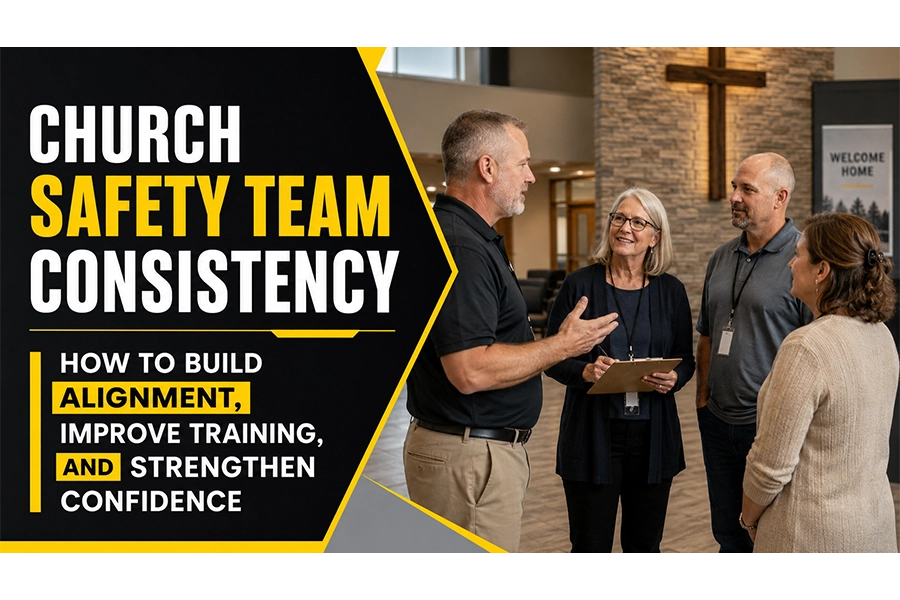
Church safety team consistency is essential for volunteer Safety Teams that want to respond with confidence, communicate clearly, and serve the congregation with steady, Christlike readiness.
Many churches have faithful volunteers who care deeply about protecting the flock. They show up early. They watch the doors. They help guests. They check the parking lot. They respond when something seems off. But even committed volunteers can drift out of alignment if they do not regularly talk through what they are seeing, what they are unsure about, and how the team should respond.
That is why consistency matters.
A Safety Team does not become effective only by creating a policy manual or holding one annual training session. A strong team grows through repeated conversations, clear roles, honest feedback, and small improvements made over time.
The Team Consistency Guide: Strengthening Your Church Safety Efforts helps churches build alignment through short post-service discussions, identification of training gaps, role reinforcement, and steady encouragement. These practices are simple, but they can make a major difference in how prepared your team feels and how well they serve.
For churches of all sizes, especially those with volunteer-based Safety Teams, consistency is one of the strongest foundations for long-term readiness.
Key Takeaways for Church Safety Team Consistency
Church safety team consistency helps volunteers stay aligned, confident, and ready to respond effectively. The goal is not perfection. The goal is steady improvement.
A consistent Safety Team should:
- Hold short post-service discussions. Ten minutes after service can help the team reflect on what happened, what was noticed, and what should be improved.
- Ask open-ended scenario questions. Questions such as “What would we do if this happened?” help volunteers think clearly before pressure arrives.
- Identify training gaps. Confusion, hesitation, or repeated questions often reveal where more practice or clarification is needed.
- Reinforce team roles. Each volunteer should understand their part in the safety plan during common scenarios.
- Celebrate small wins. Encouragement builds morale and reminds the team that faithful preparation matters.
Consistency turns isolated volunteers into a unified team.
Why Does Team Alignment Matter in Church Safety?
Team alignment matters because emergencies create pressure, and pressure exposes confusion. If team members do not understand the plan, their roles, or how to communicate, even a simple situation can become harder than necessary.
Alignment means the team is working from the same understanding. It does not mean every person has the same personality, background, or skill level. It means everyone knows the mission, the plan, and their part in it.
For a church Safety Team, alignment includes knowing:
- Who communicates with church leadership
- Who calls 911 when needed
- Who checks children’s ministry areas
- Who assists vulnerable individuals
- Who guides guests or members during an evacuation
- Who responds to a medical concern
- Who observes and reports a disruptive situation
- Who documents an incident after it happens
A church may have former law enforcement officers, medical professionals, ushers, greeters, parents, retirees, business leaders, and brand-new volunteers all serving together. That variety can be a strength, but only if the team is trained to operate with unity.
Without alignment, team members may make different assumptions. One volunteer may think they should step in immediately. Another may think they should wait. One may know the communication plan. Another may not. One may be confident during a medical emergency but unsure during severe weather.
Consistency helps close those gaps before they matter.
What Are Post-Service Discussions?
Post-service discussions are short, structured conversations held after worship services or church events to review safety observations, team performance, and possible improvements.
These discussions do not need to be long. In many churches, ten minutes is enough. The key is to make them regular, focused, and useful.
A post-service discussion is not a complaint session. It is not a place to embarrass volunteers. It is not a place to criticize the pastor, staff, congregation, or other ministries.
It is a disciplined check-in that helps the Safety Team learn.
The team can gather in a quiet area after service and ask simple questions:
“What did we notice today?”
“What went well?”
“Was anything unclear?”
“What should we review before next Sunday?”
“What would we do if that situation had escalated?”
These brief conversations help keep the team alert and connected. They also give leaders insight into what volunteers are seeing from their posts.
How Should Churches Hold Effective Post-Service Discussions?
Churches should hold post-service discussions with structure, humility, and a clear time limit. Ten minutes after service can be enough when the discussion stays focused.
The Safety Director or team leader should guide the conversation. Start with prayer or a brief word of thanks if appropriate. Then review what happened during the service, ask for observations, identify any concerns, and close with one action step.
A simple post-service discussion can follow this pattern:
- Start with what went well. This builds encouragement and reminds the team that progress matters.
- Ask what was noticed. Volunteers may have seen parking lot issues, children’s ministry concerns, guest confusion, blocked exits, or communication challenges.
- Discuss one scenario. Choose one practical question, such as, “What would we do if someone collapsed in the lobby?”
- Identify one training gap. Look for uncertainty, unclear roles, or procedures that need practice.
- End with one next step. Decide what should be reviewed, practiced, communicated, or improved before the next service.
This format keeps the conversation useful and prevents it from becoming too broad.
What Questions Should a Church Safety Team Ask After Service?
Open-ended questions help team members think and participate. An open-ended question is a question that cannot be answered with only “yes” or “no.” These questions encourage observation, discussion, and problem-solving.
Good post-service questions include:
- “What did you notice today that we should be aware of?” This invites observations from greeters, ushers, parking lot volunteers, children’s workers, and Safety Team members.
- “What would we do if a medical emergency happened in that area?” This helps the team test its response plan in a specific location.
- “How can we improve our response to the situation we saw today?” This turns real observations into learning opportunities.
- “Was there any part of the plan that felt unclear?” This gives volunteers permission to admit confusion before it becomes a problem.
- “Who would take the lead if this happened during service?” This reinforces roles and reduces hesitation.
- “What should we practice next?” This helps training respond to actual team needs.
These questions are practical, simple, and repeatable. They help build church safety team consistency by making reflection part of the team’s normal rhythm.
Identifying Training Gaps Before They Become Problems
A training gap is an area where team members lack the knowledge, skill, clarity, or confidence needed to perform a task well. Training gaps are not failures. They are opportunities to improve.
In church safety, training gaps often appear in small comments:
“I’m not sure who calls 911.”
“I don’t know where the AED is.”
“What do we do if a child is missing?”
“Who talks to a disruptive person?”
“How do we communicate if the radios stop working?”
“I don’t know which doors should be checked after service starts.”
These comments are valuable. They show leaders what needs attention.
A Safety Director should listen closely during post-service discussions. If several team members seem unsure about a procedure, that topic should become a training priority. If one volunteer repeatedly asks about their role, they may need coaching or clearer instructions. If everyone has a different answer to the same scenario, the plan is not aligned.
The goal is not to make volunteers feel unprepared. The goal is to help them become prepared.
How Can Safety Teams Prioritize Training Needs?
Safety Teams can prioritize training needs by focusing first on the areas that are most likely, most confusing, or most important to the congregation’s safety.
A team does not need to train on everything at once. In fact, trying to cover every possible topic can overwhelm volunteers. A better approach is to choose one or two training gaps and address them well.
For many churches, common training priorities include:
- Medical response
- Fire evacuation
- Severe weather sheltering
- Missing child procedures
- De-escalation
- Emergency communication
- Radio use
- Parking lot awareness
- Children’s ministry support
- Incident reporting
The Safety Director can use post-service discussion notes to decide which topic comes next. For example, if multiple team members are unsure about how to respond to a medical emergency, the next training session should focus on who calls 911, who retrieves the AED, who guides emergency responders, and how the team creates space around the person in need.
Training should respond to real needs, not just a calendar.
Reinforcing Team Roles and Responsibilities
Role clarity is one of the most important parts of church safety team consistency. When people know their roles, they are more confident. When roles are unclear, hesitation grows.
A role is a defined responsibility within the safety plan. Roles may change depending on the size of the church, the number of volunteers present, and the situation being addressed.
For example, during a medical emergency, one team member may call 911. Another may retrieve the AED or first aid kit. Another may guide emergency responders. Another may help move bystanders back to create space. Another may communicate with church leadership.
During severe weather, one team member may help move the sanctuary. Another may check children’s ministry. Another may assist elderly members or people with limited mobility. Another may monitor communication with leadership.
During a fire evacuation, one person may guide people toward exits. Another may check a hallway. Another may prevent re-entry. Another may meet emergency responders.
The team should discuss these roles before the emergency. Role clarity helps volunteers act calmly instead of waiting for someone else to decide.
What Should Every Church Safety Team Member Understand?
Every church Safety Team member should understand the mission, the communication plan, the basic emergency procedures, and their personal responsibilities during common scenarios.
At a minimum, team members should know:
- Where they are assigned during service
- Who they report concerns to
- How to communicate quickly
- When to call 911
- Where first aid kits and AEDs are located
- What to do during fire evacuation
- Where severe weather shelter areas are located
- How to support children’s ministry during an emergency
- What information should be documented after an incident
- What actions they should not take without proper authority or training
That last point matters. Church volunteers are not automatically law enforcement officers, medical providers, or security professionals. Even when they serve on a Safety Team, they should understand the boundaries of their role. In many situations, the volunteer’s job is to notice, report, support, communicate, and help preserve order until the right help arrives.
Good training does not simply tell people what to do. It also tells them what not to do.
Providing Constructive Feedback Without Discouraging Volunteers
Constructive feedback is guidance that helps someone improve without tearing them down. Safety Teams need feedback, but it must be handled wisely.
Volunteers are giving their time. Many are already serving in demanding roles. A harsh or critical tone can damage morale and make people hesitant to participate. But avoiding feedback altogether can leave problems unresolved.
The best feedback is specific, calm, and connected to the mission.
Instead of saying, “You handled that wrong,” a leader might say, “Next time, let’s make sure the radio call is shorter and includes the location first.”
Instead of saying, “Nobody knew what to do,” a leader might say, “We found a training gap today. Let’s review who calls 911 and who retrieves the AED before next Sunday.”
Instead of saying, “You missed that,” a leader might say, “Let’s all work on scanning that hallway more intentionally after service starts.”
This kind of feedback helps the whole team improve without shaming one person.
Positive reinforcement is also important. When someone communicates clearly, handles a concern calmly, notices a hazard, helps a guest, or follows the plan well, say so. Encouragement strengthens confidence.
Celebrating Small Wins Builds Team Confidence
Small wins are signs of progress. They may not be dramatic, but they matter.
A small win might be a team member noticing a blocked exit and correcting it before service. It might be a volunteer calmly helping a parent find the children’s check-in area. It might be a successful radio check. It might be a short post-service discussion where every member contributed. It might be a team realizing they need more practice on medical response and scheduling the next training.
Celebrating small wins helps volunteers see that their service matters.
Safety ministry can sometimes feel invisible. When nothing happens, the team may wonder whether their preparation is making a difference. But quiet faithfulness is still faithfulness.
Galatians 6:9 says, “And let us not grow weary while doing good, for in due season we shall reap if we do not lose heart.” That verse is a strong encouragement for Safety Team members. Much of their work is preventative. Much of it happens behind the scenes. But God sees faithful service, and the church benefits from steady preparation.
What Does the Bible Say About Teamwork and Readiness?
The Bible gives strong principles for teamwork, order, watchfulness, and mutual responsibility.
First Corinthians 12 teaches that the body has many members, and each part has a role. A church Safety Team reflects this principle when different members serve in different ways for the good of the whole congregation. One person may be strong in observation. Another may be calm in conversation. Another may be skilled in medical response. Another may be good at training or administration. Each role matters.
Ecclesiastes 4:9 says, “Two are better than one, because they have a good reward for their labor.” Safety ministry should not be isolated. A team grows stronger when members communicate, support one another, and work together.
Nehemiah 4:9 reminds us that God’s people prayed and set a watch. That balance still matters. Safety Teams should serve prayerfully and practically. They do not prepare because they lack faith. They prepare because they are called to steward the people entrusted to their care.
Team consistency should always be rooted in humility. The goal is not control. The goal is faithful service.
How Can Small Churches Build Safety Team Consistency?
Small churches can build church safety team consistency by keeping the process simple and repeatable. A small church may not have a large Safety Team, but it can still hold short check-ins, review roles, identify training gaps, and practice basic responses.
In a smaller congregation, the Safety Team may include ushers, greeters, deacons, ministry leaders, or a few trusted volunteers. They may not wear uniforms or have formal posts. That is okay. Consistency is still possible.
A small church can begin by asking three questions after service:
“What did we notice?”
“What was unclear?”
“What should we practice next?”
Those three questions can reveal enough to guide future training.
Small churches should avoid comparing themselves to larger churches with more staff, equipment, or specialized volunteers. The goal is not to copy another church’s structure. The goal is to become more prepared with the people and resources God has provided.
How Can Larger Churches Keep Multiple Teams Aligned?
Larger churches often have more complexity. They may have multiple services, multiple buildings, large children’s ministry areas, parking teams, medical volunteers, weekday events, and different Safety Team members serving at different times.
In that environment, consistency requires intentional communication.
Team leaders should make sure post-service discussion notes are captured and shared when needed. If one service team identifies a concern, the next service team should know about it. If a procedure changes, all relevant volunteers should receive the update. If a training gap appears across several teams, leadership should address it in a formal training session.
Larger churches may benefit from written role cards, shared digital notes, regular team briefings, and scheduled drills. But the principle remains the same: keep people aligned through repeated communication.
A large team can still become inconsistent if communication is poor. A small team can still become strong if communication is steady.
Legal and Policy Considerations for Church Safety Teams
Church Safety Teams should operate under church leadership, approved policies, and applicable laws. Volunteers need to understand their role and the limits of their authority.
This is especially important in areas such as use of force, medical response, child protection, emergency communication, incident documentation, weapons policies, and interactions with disruptive individuals. Laws vary by state and local jurisdiction, and churches should seek guidance from qualified legal counsel, insurance representatives, and local emergency professionals when needed.
Team consistency should include policy consistency. Volunteers should not be left to invent responses in the moment. If a church has a policy, the team should know it. If the policy is unclear, leadership should review it. If training does not match the policy, the training should be corrected.
A Safety Team protects the church best when it serves within clear boundaries.
Next Steps: Make Post-Service Discussions a Habit
The Team Consistency Guide: Strengthening Your Church Safety Efforts gives churches a practical path forward. Start with brief post-service discussions. Keep them focused. Ask good questions. Listen for uncertainty. Identify training gaps. Reinforce roles. Encourage the team.
Do not overcomplicate the process.
A ten-minute discussion can reveal what a one-hour meeting might miss. It happens while observations are fresh. It gives every team member a voice. It helps leaders see what volunteers need. It creates a rhythm of learning.
The next step is simple: schedule your first post-service discussion. Put it on the calendar. Tell the team what to expect. Keep it brief. Ask one scenario question. Choose one improvement. Then repeat the process next week.
Consistency grows through repetition.
Call to Action: Strengthen Your Church Safety Team One Check-In at a Time
A confident Safety Team is not built by accident. It is built through alignment, training, feedback, and steady encouragement.
This week, gather your team for a ten-minute post-service discussion. Ask what they noticed. Ask what felt unclear. Ask what scenario should be practiced next. Then use that feedback to strengthen your next training session or drill.
For churches ready to build stronger volunteer readiness, explore the Safety Member Certification from Sheepdog Church Security Academy. It equips church Safety Team members with practical knowledge, clear role expectations, and confidence to serve well, even without a law enforcement background.
Make post-service discussions a habit. Small check-ins build strong teams. Strong teams serve with confidence. Confident teams help create safer churches.