




Broaden Your Readiness
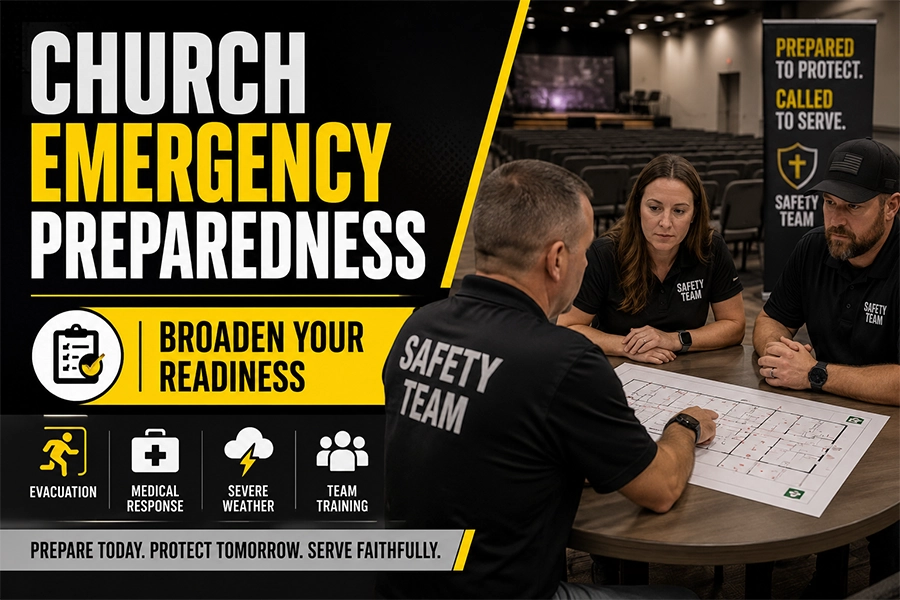
Church emergency preparedness is not only about active threats. Volunteer Safety Teams must be ready for fire evacuations, medical crises, severe weather, facility hazards, and other emergencies that can interrupt worship and endanger the congregation.
Many churches begin their safety planning with the most frightening scenarios in mind. That is understandable. Active violence is serious, and churches should prepare wisely. But a mature church safety ministry cannot stop there. Most Safety Teams are far more likely to face a medical emergency, fire alarm, severe storm, missing child, power outage, disruptive person, or facility issue before they ever face an armed attacker.
That is why broad readiness matters.
The Broaden Your Readiness Guide: Preparing for All Emergencies helps churches expand their preparedness one scenario at a time. The goal is not to overwhelm volunteers. The goal is to build calm, confident, practical readiness for a wide range of emergencies.
A church Safety Team does not need to master every scenario in one month. But it does need to start expanding beyond one narrow category of response. A prepared church learns, practices, observes, adjusts, and keeps growing.
Key Takeaways for Church Emergency Preparedness
Church emergency preparedness should be broad, practical, and realistic for volunteer teams. The most effective churches train for multiple types of emergencies, not just the ones that receive the most attention.
A well-rounded Safety Team should be prepared to:
- Guide a fire evacuation. Team members should know the exits, understand basic evacuation routes, and help move people calmly out of the building.
- Respond to medical crises. Volunteers should know where first aid kits and AEDs are located, who will call 911, and how to manage the scene until help arrives.
- Shelter during severe weather. Churches should identify safe areas, communicate instructions clearly, and keep basic emergency supplies accessible.
- Practice one scenario at a time. Readiness grows when teams walk through realistic situations, identify challenges, and improve their plans.
- Serve vulnerable individuals. Children, elderly members, people with disabilities, guests, and anyone with limited mobility should be included in planning.
Preparedness is not panic. Preparedness is stewardship.
Why Should Church Safety Teams Prepare for All Emergencies?
Church Safety Teams should prepare for all emergencies because the congregation depends on calm leadership when something unexpected happens. Emergencies do not wait for trained staff to be available. They often begin in ordinary moments: during worship, between services, in a hallway, in the nursery, in the parking lot, or during a weekday ministry event.
If the Safety Team has only trained for one type of emergency, it may struggle when a different crisis occurs.
For example, a team that has discussed active threats but never practiced fire evacuation may not know who should check classrooms, who should guide people away from blocked exits, or where the congregation should gather outside.
A team that has talked about severe weather but never identified safe shelter areas may lose valuable time when a tornado warning is issued.
A team that has AED equipment but has never reviewed its location may delay care during a cardiac emergency.
Preparation creates clarity before pressure arrives.
Church emergency preparedness is not about predicting every possible event. It is about building flexible habits. A team that knows how to communicate, assign roles, observe conditions, and move people calmly will be better prepared across many scenarios.
What Does the Bible Say About Preparedness?
The Bible consistently honors wisdom, watchfulness, and faithful stewardship. Church safety should be rooted in those principles, not fear.
Nehemiah 4:9 gives a strong picture of balanced readiness: “Nevertheless we made our prayer to our God, and because of them we set a watch against them day and night.” God’s people prayed, and they also prepared. They trusted the Lord, and they took responsible action.
Proverbs 21:5 says, “The plans of the diligent lead surely to plenty, but those of everyone who is hasty, surely to poverty.” Planning matters. Diligence matters. A church that thinks ahead is better positioned to care for people well.
First Corinthians 14:40 says, “Let all things be done decently and in order.” While this passage speaks to order in worship, the principle applies clearly during emergencies. Confusion can increase risk. Order helps people respond with greater peace.
Church emergency preparedness should reflect a Christlike heart. The Safety Team is not preparing to look important. It is preparing to serve. It is protecting fellowship, guarding the vulnerable, and helping the church remain steady when circumstances become difficult.
Fire Evacuation Planning for Churches
Fire evacuation planning is one of the most basic and important parts of church emergency preparedness. Every church should know how people will leave the building quickly and safely if there is a fire, smoke, gas smell, alarm, or other condition requiring evacuation.
An evacuation is the organized movement of people away from danger. In a church setting, evacuation planning must account for sanctuaries, classrooms, nurseries, fellowship halls, offices, kitchens, restrooms, parking lots, and guests who may not know the building.
How Should a Church Plan Fire Evacuation Routes?
A church should begin by identifying every available exit. This includes main doors, side doors, classroom exits, emergency exits, and other approved exit paths. Once exits are identified, the team should confirm that they are accessible, clearly marked, and not blocked by storage, furniture, decorations, seasonal displays, or equipment.
A fire evacuation route is the path people will use to leave the building. Each ministry area should have a primary route and, when possible, an alternate route. This matters because fire, smoke, crowd movement, or blocked doors may make the preferred path unusable.
Safety Team members should walk these routes in real time. A plan that looks good on paper may reveal problems during a walkthrough. A hallway may be too narrow. A door may be difficult to open. A classroom volunteer may not know where to go. A gathering point outside may be too close to the building or emergency vehicle access.
Fire evacuation planning should also include the needs of vulnerable individuals. This may include young children, elderly members, people using walkers or wheelchairs, individuals with hearing or vision limitations, and guests who may be unfamiliar with the church.
The Safety Team should never assume that everyone will automatically know what to do.
Assigning Roles During a Church Evacuation
A strong evacuation plan includes assigned roles. When no one knows who is responsible, people may hesitate or duplicate efforts. Assigned roles reduce confusion.
In a volunteer church setting, roles should be simple and practical. One person may guide people toward exits. Another may check a hallway or classroom area. Another may help communicate with children’s ministry. Another may meet emergency responders outside and direct them to the right entrance.
Some churches may have a formal Safety Team. Others may rely on ushers, greeters, deacons, staff members, or ministry leaders. Either way, the principle is the same: people should know their responsibilities before an emergency.
Evacuation roles should answer basic questions. Who calls 911? Who confirms that children’s areas are moving? Who helps individuals with limited mobility? Who prevents people from re-entering the building? Who communicates with the pastor or service leader? Who meets the fire department?
These are not complicated questions, but they should be answered before the alarm sounds.
Medical Crisis Response in the Church
Medical emergencies are among the most likely incidents a church will face. A person may faint, fall, experience chest pain, have a seizure, suffer a diabetic emergency, struggle to breathe, or go into cardiac arrest. These situations can happen during worship, in a hallway, in a classroom, at a church meal, or in the parking lot.
Medical crisis response is the organized way a church identifies a medical emergency, calls for help, provides basic care within the team’s training level, and manages the surrounding area until emergency medical services arrive.
The Safety Team should know the location of first aid kits and AEDs. An AED, or Automated External Defibrillator, is a device that can help during sudden cardiac arrest by analyzing the heart rhythm and, if needed, delivering a shock. Churches that have an AED should make sure volunteers know where it is, how to retrieve it quickly, and who is trained to use it.
How Should a Church Respond to a Medical Emergency?
A church should respond to a medical emergency with calm, clear action. The first priority is recognizing that someone needs help and calling 911 when the situation is serious or uncertain. Volunteers should not delay emergency medical care because they are unsure whether the situation is “bad enough.”
The team should assign someone to call 911, someone to retrieve the first aid kit or AED, someone to guide emergency responders to the location, and someone to help manage the immediate area.
Crowd control is often misunderstood. In this context, crowd control simply means keeping people from crowding around the person in need, preserving space for care, and reducing confusion. It does not mean being harsh or forceful. It means calmly saying, “Please give them space,” or “Let’s keep this walkway clear for medical responders.”
A Safety Team member may also need to help protect the person’s privacy. Not everyone needs to watch. Not everyone needs to record. A church should treat medical emergencies with dignity.
Volunteers should only provide care within their training and comfort level. CPR, first aid, and AED training are valuable because they give volunteers practical skills before the emergency happens. Churches should consider encouraging Safety Team members, ushers, greeters, children’s workers, and key ministry leaders to receive basic medical response training.
Severe Weather Procedures for Churches
Severe weather planning is another essential part of church emergency preparedness. Many churches gather during seasons when thunderstorms, tornadoes, high winds, flooding, winter storms, or extreme heat may affect services and events.
A severe weather procedure explains how the church will monitor weather, decide when to act, communicate instructions, and move people to safer areas.
One of the most important severe weather concepts is shelter-in-place. Shelter-in-place means staying inside the building and moving to a safer interior area rather than evacuating outside. During a tornado warning or dangerous storm, leaving the building may place people at greater risk. In those cases, the church should know where people will shelter.
Where Should a Church Shelter During Severe Weather?
Churches should identify interior areas away from windows, large glass doors, exterior walls, and wide-span rooms when possible. Wide-span rooms are large open rooms, such as sanctuaries, gyms, and fellowship halls, where the roof structure may be more vulnerable during certain severe weather events.
Better shelter areas may include interior hallways, lower-level rooms, restrooms, classrooms without windows, or designated storm shelter areas if the building has them. The best location depends on the church building. Safety Teams should consult local emergency management guidance when evaluating shelter locations.
Once shelter areas are identified, the team should plan how to move people there. This includes children in classrooms, nursery volunteers, elderly members, guests, musicians, staff, and people in restrooms or hallways.
Communication is critical. The congregation needs clear instructions. A confusing announcement can create hesitation. A calm announcement might say, “For everyone’s safety, we are moving to our severe weather shelter areas now. Please follow the ushers and Safety Team members to the interior hallway.”
The tone should be steady. The instruction should be simple.
Emergency Supplies Churches Should Keep Accessible
Emergency supplies do not need to be complicated, but they should be accessible. A locked supply closet is not helpful if no one can reach it during an emergency.
Churches should consider supplies that support common non-violent emergencies, such as fire evacuation, medical response, severe weather sheltering, and power outages.
Useful emergency supplies may include:
- First aid kits and AEDs. These should be easy to locate, maintained regularly, and known to trained volunteers.
- Flashlights and extra batteries. Power outages can create confusion in hallways, stairwells, and classrooms.
- Two-way radios or communication tools. Teams need a way to communicate when phone calls or shouting are not practical.
- Bottled water. Water may be helpful during sheltering, heat-related concerns, or extended incidents.
- Basic emergency contact information. Leaders should know how to contact key staff, emergency services, facility personnel, and ministry leaders.
- Printed emergency procedures. A simple printed guide can help volunteers remember steps under stress.
The point is not to buy equipment for the sake of equipment. The point is to support the church’s response plan.
Observation and Practice: Walking Through Each Scenario
Plans become stronger when teams walk through them. A walkthrough is a slow, practical review of how a response would happen in the actual building. It is not a full-speed drill. It is a learning exercise.
For example, the Safety Team might walk through a fire evacuation scenario. They begin in the sanctuary, then move toward the planned exit routes. They check doors, hallways, signs, stairwells, gathering points, and communication needs. They ask, “What would make this difficult?” and “Who needs help here?”
The same approach can be used for a medical emergency. Choose a realistic location, such as the sanctuary, lobby, nursery hallway, or parking lot. Then walk through who would call 911, who would retrieve the AED, who would create space, and who would guide responders.
Severe weather can also be practiced this way. Walk from the sanctuary to the shelter area. Walk from children’s classrooms to the shelter area. Consider what happens if the hallway is crowded, if the power goes out, or if a guest does not understand where to go.
Observation helps teams find problems before the emergency reveals them.
How Can a Church Train Without Overwhelming Volunteers?
A church can train without overwhelming volunteers by focusing on one new scenario at a time. Many Safety Teams become discouraged because they try to fix everything at once. That is not necessary.
Start with one non-violent scenario. Fire evacuation is a strong first choice for many churches because every building needs an evacuation plan. Medical response is also a practical starting point because medical issues are common. Severe weather may be the best place to begin if the church is in a region with frequent storms or tornadoes.
Once the team selects a scenario, keep the training simple:
- Explain the concern.
- Walk through the building.
- Identify roles.
- Practice communication.
- Discuss what worked.
- Adjust the plan.
That process builds confidence. It also helps volunteers feel equipped rather than intimidated.
Building Confidence Through Repetition
Confidence does not come from one conversation. It comes from repeated, practical preparation.
A Safety Team that practices one scenario each month will grow steadily. One month might focus on medical response. Another month might focus on fire evacuation. Another month might focus on severe weather. Another might focus on a missing child procedure or communication during a service disruption.
Over time, the team develops habits. Members learn the building. They understand how to communicate. They become more aware of vulnerable areas. They learn who is calm under pressure. They identify equipment gaps. They build trust with ministry leaders.
This is how broad readiness grows.
The church should also revisit and refine plans based on feedback. A plan is not a trophy to place in a binder and forget. It is a working tool. If a drill reveals confusion, that is not failure. That is useful information. If a volunteer notices that a shelter area is too small, that is helpful. If a radio does not work in a certain hallway, that is something to fix.
Prepared teams learn before the crisis.
Legal and Leadership Considerations for Emergency Preparedness
Church emergency preparedness should be aligned with local requirements, insurance expectations, and wise leadership oversight. Fire codes, building occupancy rules, childcare requirements, emergency medical policies, and severe weather guidance may vary by location.
Church leaders should not guess on legal or regulatory issues. They should consult appropriate local authorities, insurance representatives, qualified legal counsel, and emergency management professionals when needed.
This is especially important when planning fire evacuation routes, emergency exits, building access, children’s ministry procedures, medical response expectations, and volunteer responsibilities. Safety Teams should not create policies in isolation. They should work under church leadership and within the church’s approved structure.
Clear leadership alignment protects the team and the congregation. It also helps volunteers understand their role. A church Safety Team should support ministry, not operate independently from it.
Next Steps: Expand Readiness One Scenario at a Time
The Broaden Your Readiness Guide: Preparing for All Emergencies gives churches a practical way to grow. The next step is not to create a massive emergency manual overnight. The next step is to choose one scenario and begin.
Select a non-violent emergency for your next training session. Fire evacuation, medical response, and severe weather are strong starting points. Walk through the scenario as a team. Identify available resources. Assign basic roles. Practice communication. Note challenges. Then adjust the plan.
After that, choose the next scenario.
This approach keeps the work manageable and sustainable. It also helps churches of every size make progress. A small rural church, a mid-sized congregation, a mobile church plant, and a large multi-service campus can all build readiness by taking one faithful step at a time.
Call to Action: Prepare for More Than One Emergency
A church that prepares for a wide range of emergencies is better equipped to protect its congregation with wisdom and confidence. Fire evacuation, medical crisis response, severe weather procedures, and scenario walkthroughs are not extra tasks. They are part of faithful care.
This week, choose one emergency scenario your team has not practiced recently. Walk through it. Ask what would happen. Identify what needs to improve. Then take one practical step.
For churches ready to strengthen their volunteer Safety Team, explore the Safety Member Certification from Sheepdog Church Security Academy. It helps church Safety Team members build practical readiness, communicate clearly, and serve with confidence, even without a law enforcement background.
Preparedness is not fear. It is love with a plan.
Start with one scenario. Practice it well. Learn from it. Then broaden your readiness for the next one.