




Desecration of a House of Worship
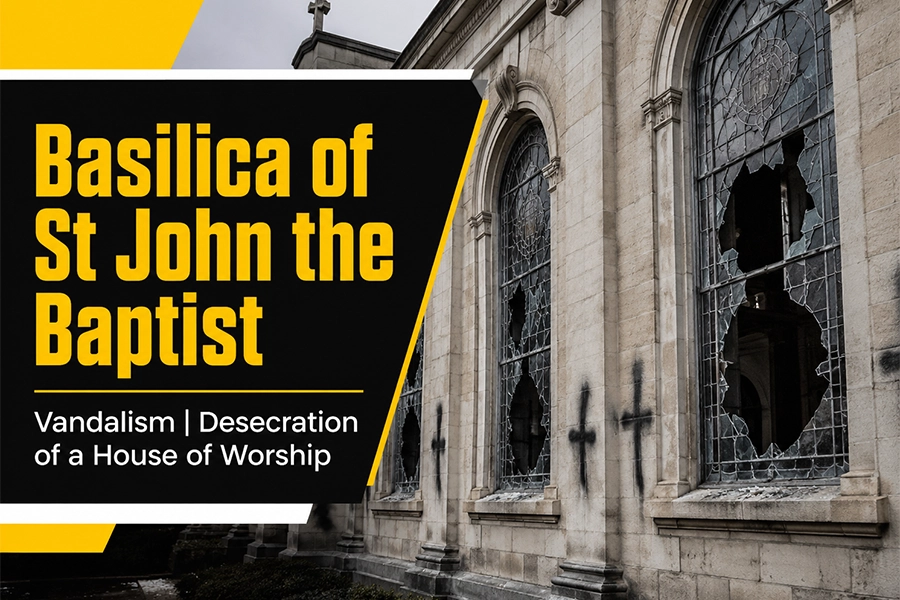
This is a lesson learned from a vandalism incident. Houses of worship have been targets of intentional damage throughout history. A recent one is the breaking of windows at an historical Catholic Church in Canton, Ohio.
In the Bible
Three kings of Judah – Ahaz, Manasseh, and Amon – desecrated and damaged the Temple of the Lord in Jerusalem. Kings Hezekiah and Josiah cleansed and repaired the Temple.
And [Manasseh] built altars in the house of the Lord, of which the Lord said, In Jerusalem will I put my name. And he built altars for all the host of heaven in the two courts of the house of the Lord (2 Kings 21:4-5).
Done in the Dark –
Sometime between 1:00 and 2:30 am on Friday, June 5, 2026, a man pulled landscaping lights from the ground around the Basilica of St. John the Baptist in Canton, Ohio. He threw these lamps through six of the church’s historic stained-glass windows. The damage was discovered by a church employee. The German-made windows are worth $800,000 each, a total value of $4.8 million. The damage was not total, so the repairs will come to about $7,200.
Surveillance camera footage and motion sensors narrowed the time of the incident. It was too dark for the cameras to show the action, since the landscaping lights had been the source of illumination and they were the objects being thrown. An employee found them on the floor in the church with broken glass.
The Suspect –
The suspect was soon identified and arrested. He is a Canton resident, age 30. According to police, the motive was not known at the time of the last news stories on June 10 and 11. What we do know is that this was not the first time he had been arrested. Eleven years earlier, at age 19, he was charged in a gang-related shooting, also in Canton. Marijuana use was a factor. The previous year, at age 18, he was arrested in Lorain County for criminal trespass – according to court records he also had a Cleveland address, close to Lorain County. Now he is charged with desecration of a place of worship.
The Church –
Saint John the Baptist, located in Downtown Canton, is the oldest Catholic church in Northeast Ohio, dating to 1823. In 2012 it became recognized as a basilica, just a step below cathedral.
The broken windows are among several made and installed in the early 1900s. They depict several scenes from the Bible and church traditions. As an aside, stained-glass windows illustrated the stories for illiterate parishioners in the Middle Ages.
The pastor of the Basilica of Saint John the Baptist and Saint Peter Parish said he forgives the vandal. Nevertheless, the suspect still faces criminal charges.
Vandalism of Places of Worship –
Vandalizing a place of worship or a religious shrine is called desecration. It has been done for thousands of years. Many times, it is an attack on the institution for whatever reason. It often accompanies burglary. Sometimes, it is just a violent outburst by an unstable individual or acting out by gangs or idle persons. Whatever the manner or motive, the result is damage to sacred spaces or objects.
The damage done can be minor or catastrophic. At the Basilica of Saint John the Baptist, an employee found landscaping lights on the church floor Friday morning. If one had been a firebomb, the church would have been set on fire. This underscores the priority of preventing vandalism and taking steps to reduce potential damage.
Lesson Learned: Harden the Church against Vandalism –
There are ways to deter vandalism, make it more difficult, and reduce likely damage. We’ll see how that could have worked at the Basilica in Canton.
- Break-proofing Windows,
- Removing Throwable Objects,
- Reliable Surveillance,
- Assured Lighting,
- Alarms,
- Access Control.
Break-proofing Windows,
This is a measure now used by several churches. Three objectives are met:
- Keeping most thrown objects from hitting, and therefore breaking, the glass.
- If the glass is hit, limiting the damage, such as keeping the window from shattering.
- Keeping thrown objects that do break a window from entering the building.
The first objective is met by using a plexiglass shield pane or a small-mesh screen. Projectiles below a certain size will bounce off (unless they’re bullets). Plexiglass was installed at the Basilica after the vandalism to keep rain out of the damaged windows.
Some large objects may push the screen or plexiglass in enough to crack the glass. A shatter-proof coating on the glass will limit the breakage (Objective 2). It can also meet objective 3. If the projectile is an incendiary, this can prevent a fire.
Removing Throwable Objects,
There’s no need to make it easy for a vandal. Good groundskeeping includes removing loose objects, such as rocks, bricks, and large pieces of wood, that can be used as projectiles. However, the Basilica vandal had to work to pull up the landscaping lights. If they were wired into the church’s electric system, this would have been harder than if they were the common solar-powered ones, which pull up easy. Google street view did not clearly show outside lights in the ground, but there are evenly-spaced dark features next to the foundation wall which may or may not have been lights.
One objective of safety patrols is being alert for objects which could be used by a vandal or burglar to break windows or doors.
Reliable Surveillance,
The Basilica does have outside cameras that show the ground next to the wall. The news accounts seemed to indicate that they were not continuously operating, but taking pictures every hour or so. That’s the old type. Modern camera systems are always on and recording. They can be triggered by motion detectors to flag scenes, and some even turn to focus on the action. Also, these cameras can be almost undetectable, so a vandal or burglar would not know that there are more cameras than the conspicuous ones.
Assured Lighting,
The cameras relied on the landscaping lights for nighttime illumination. Better would be lights under the eaves which are harder to get to and eliminate. As it was, the lights became the projectiles to break windows. The higher lights would also enable cameras to record all the action.
Good lighting may deter a vandal or burglar. One advantage of the church’s location is that all sides are visible to traffic on the streets. There are apartments with a view of the church. Good lighting means that even in the wee hours, someone might see activity and be suspicious.
Alarms,
The advantage of alarms is that they can get an immediate security response. Sensors on windows can alert someone to an attempt to break them. A rock hitting a screen or safety pane should trigger the alarm.
There are two choices for alarms, silent and loud. A silent alarm allows the criminal to continue while officers are on the way so they can catch him in the act. On the other hand, an alarm that wakes up the neighborhood may cause a vandal to panic and stop the act so he can get out of there. A criminal in a panic rush is more likely to leave some critical evidence behind. We don’t know what the response of the Basilica vandal would have been.
Signage notifying people that there are alarms would make them a potential deterrent.
Access Control,
Notably, there is no fence around the property of the Basilica. A wrought iron fence with sharp pike heads on the staves would have inconvenienced a burglar or vandal. So far, the evidence available in news stories suggests that the attack likely was not planned out very well, so it seems to have been impulsive. A known criminal with a gang record who intended to inflict real damage could have been equipped with a firebomb.
Deterrents do make a difference. A wrought iron fence with sharp spikes would have made a quick exit more difficult. Combined with good lights and alarms, a criminal is more likely to get out while the getting is good.
Conclusion –
Deter vandalism by hardening the windows, proper groundskeeping, good lighting, non-stop surveillance cameras, alarms, and access control.
Training Note –
All safety team members should be trained and certified through the Safety Member Certification program. This includes “Safety Member Fundamentals V5” and “Arson and Fire Safety v4.” Also read articles in the Church Security Guide, such as Church Safety Team Basics. Get access to our free guide on “Arson Prevention: 3 Steps to Success” by subscribing to the weekly emailed newsletter.
In drills stress the importance of spotting and removing loose items which could be used by vandals and looking for signs of suspicious activity.
References –
Sheepdog Church Security Academy Resources:
- Kris Moloney, “Safety Member Certification,” Sheepdog Church Security Academy, 2025 [https://sheepdog-church-security.thinkific.com/courses/safety-member-certification-v5-2025].
- Kris Moloney, Church Security Guide, Sheepdog Church Security Academy, 2025 [https://sheepdog-church-security.thinkific.com/pages/security-articles?c=church-security-guide].
- Kris Moloney, “Church Safety Team Basics,” Sheepdog Church Security Academy, 2025 [https://sheepdog-church-security.thinkific.com/pages/security-articles?p=church-safety-team-basics].
- Subscribe to SCSA weekly newsletter [https://sheepdog-church-security.ck.page/83065f7b5a].
News Accounts and Online Records:
- Jim Michaels, “Millions in Damage Done at Canton Basilica, Man Charged,” WHBC Radio, June 11, 2026 [https://www.whbc.com/millions-in-damage-done-at-canton-basilica-man-charged/].
- Nancy Molnar (Canton Repository), “Canton man charged after damaging historic stained glass windows at St. John the Baptist,” USA TODAY accessed on AOL, Updated Jun 10, 2026 [https://www.aol.com/news/canton-man-charged-damaging-historic-151618863.html].
- Basilica staff, “A huge thank you to Jim and Skylor from Radiant Arts, Inc.,” Basilica of Saint John the Baptist and Saint Peter Parish, Facebook page, June 6, 2026 [https://www.facebook.com/profile.php/?id=61577038168102].
- Staff, “Michael Thomas Hrinda,” RecentlyBooked, June 9, 2026 [https://recentlybooked.com/oh/stark/michael-hrinda~649_0000129577#google_vignette].
- Staff, “Michael T Hrinda - CRIMINAL TRESPASS - Ohio,” May 18, 2014 [https://mugshots.com/US-States/Ohio/Lorain-County-OH/Michael-T-Hrinda.72792060.html].
- Tim Botostim, “John Shorb gave his life building Canton's first Catholic church,” Canton Repository, Updated April 11, 2017 [https://www.cantonrep.com/story/news/local/canton/2017/04/11/john-shorb-gave-his-life/21379381007/?gnt-cfr=1&gca-cat=p&gca-uir=true&gca-epti=z119001e000600v119001d--xx--b--xx--&gca-ft=215&gca-ds=sophi].