




Planning Safety for Another Year
This article is based on the Safety Member Certification training module “Safety Team Fundamentals V5” and the Church Security Guide article “Church Safety Team Basics.” [1][2][3][4].
This article draws from several Sheepdog Church Security Academy resources: How to Conduct a Risk Assessment, Building an Effective Church Safety Ministry, How to Start a Church Safety Ministry, Developing a Church Safety Plan Beyond Active Threats, and Summer Church Safety Readiness Checklist. [1][2][3][4][5].
From the Bible
* Nehemiah inspected Jerusalem’s walls to plan how to make it a safer place.
And I went out by night by the gate of the valley, even before the dragon well, and to the dung port, and viewed the walls of Jerusalem, which were broken down, and the gates thereof were consumed with fire (Nehemiah 2:13).
Introduction –
Bob Dylan wrote The Times They Are a-Changin' in 1963, and it was the title song of his 1964 album. This number made it into the top 20. The title alone reminds us that there are always changes, even in religious organizations. [6].
It pays for a church safety ministry to periodically go back to the drawing board and bring their safety plan up-to-date. Doing this annually makes sense, especially with the rates of change today.
Also advisable is a quarterly review to see how the current plan is working, make adjustments, and take into account recent changes.
As with the original safety & security plan when the safety ministry was established, this begins with a church safety-security assessment and a risk assessment. It continues with policies and procedures and any organizational adjustments for the ministry.
Plan Based on Knowledge –
Updating the church safety & security plan begins with knowing about a few things: the church, the Safety Team, the community, local emergency services, and laws. All five shape the local Church Safety Ministry and how it fulfills its mission, and all of these are subject to change.
Know about the church:
The first factor of the local congregation that shapes the Church Safety Team is its size.
- A small congregation will have fewer persons able to serve as Safety Team members. This limits how many persons could be on the scene at one time.
- Depending on how well-off the congregation is financially, it may or may not be limited on buying equipment and supplies.
- Even with its limitations, a small church safety team can foster the safety and security of the congregation.
- For larger congregations, do you have more than one morning worship service? Do you have midweek services, classes, age-related groups, etc.
- Do you have on-campus social services (such as clothing closet, food bank, serving meals, etc.)?
- Members of the church are getting older, with some adults becoming elderly, youth becoming adults, children becoming teens, and (hopefully) babies being born. Also, some church members die, some move away, others move in. These changes alter the makeup of the congregation.
- Organization is an issue for a multi-campus church.
- Is it one Church Safety Ministry for all locations, or a separate ministry for each?
- If it is one ministry, does each location have a Deputy Safety Director?
The next factor is demographics, the kinds of people who are members or who regularly attend. Various social and ethnic groups have traditional ways of seeing and doing things. A church safety ministry will tailor some of its approaches to church safety considering the backgrounds of those they serve. This is not as much a functional issue as it is an ethno-social translation, which means that some things may need to be expressed differently.
The third factor is the traditions, values, and teachings of the religious organization or denomination. For instance, some faith groups are pacifistic, which influences their views on self-defense. Some faith groups resist certain modern technologies, patterns of organization, etc.
Know about the Safety Team:
The makeup of the Church Security Team will affect your security planning. Take into consideration the physical abilities of the members, their experience and record, what training they’ve had, etc. As team members get older, some physical abilities may be less then they have been. An adjustment in their roles can keep them involved, but less strenuously, so the team benefits from their experience. At the least, these factors will determine the training schedule for the year, including drills, and can impact assignments.
Know about the community:
The community climate, meteorological and social, directly determines safety and security issues for the congregation.
Planning for the meteorological climate is covered in articles about severe weather and seasonal safety. However, we need to take into consideration changes in natural threats. In recent years, more urban areas have experienced wildfires, and some locations see increased risks of flooding. Coastal communities may be affected by cyclical climate changes.
Studying the social climate of the community where the church is located (and the locations of satellite campuses) informs us of risks for the church and opportunities for ministry. [7][8].
Some of the community changes are family dynamics, social/economic status, commercial changes, industrial changes, housing changes, education, crime statistics, and gang activity.
- Family Dynamics – How many families have one parent, both parents, and unmarried parents? How about domestic violence?
- Social/Economic Status – What is the socio-economic distribution of residents in the community? Is this reflected in the congregation’s membership?
- Commercial Changes – Is there commercial development? Are essential stores (food and medicine) convenient for community residents? Are essential stores closing, moving out, or coming in?
- Industrial Changes – Are industries with employment opportunities in or close to the community? Are they coming in, expanding or moving out? This can affect the income level in community households.
- Housing Changes – Is available housing steady, growing, or declining? New housing means more people to minister to.
- Education – What are the education levels of community residents? How many adults have finished high school? How about literacy?
- Crime Statistics – What are the levels of both property and personal crimes in the community? Which are more prevalent around places of worship?
- Gang Activity – Are there active gangs in the church’s community? Are any of their members from the church’s families?
Opportunities,
Since we as the church are to be salt and light wherever we are, our communities present opportunities for ministry. New opportunities may arise, and we should be ready to address them, as well as adjusting existing ones. These are not necessarily the role of the Church Safety Ministry, but we do have a role in fostering safety and security in outreach ministries. The Safety Director or another member can work with leaders of these charitable ministries on safety issues. A review of outreach ministry concerns during the past year is a good start.
Risks,
We live in a risky world, and risks change, so we need to assess the risks we may face and make needed adjustments. For example, the population we serve now may be different in some way from those we have been serving. Persons receiving help have attacked staff and other recipients, or have stolen from the church and others, vandalized the facilities, or committed arson. The yearly safety plan needs to include procedures and staff training to minimize the risks and to be ready to respond.
Factors,
Several factors can impact the community’s social climate.
Commercial or industrial changes – Some communities in recent years have seen stores closing, making it harder for many to shop for essential items, including heath products. Some causes are economic as local outlets become less profitable. Crime has driven out some retailers. Industrial facilities closing will result in more unemployment.
On the other hand, commercial and/or industrial development may remove some housing or negatively impact residents. This then, may also impact members of your congregation.
Economics – National, regional, and state economic changes will affect local communities, including yours. What effect will these changes have on your congregation and the community in which it is located?
Demographics – This is not meant to be racially or ethnically biased, but we need to be aware of demographic changes in the community. Through several decades (most of my lifetime), many churches have seen their communities’ demographics change. Some churches have remained demographic islands as the communities around them changed. Some have relocated. Others, however, have broadened their outlook and ministry to serve and to include the changing population, and the congregation’s demographics became more like the community’s. This is in line with Biblical teaching, which says that in Christ all demographics are included.
Gentrification – A problem in many lower-income and working-class neighborhoods is gentrification. Properties in the community are bought out and occupied by persons with more money. Renters have to leave when their homes are bought out from beneath them or when the rents are raised too high for them to afford. How would you address this if it was your church’s community? What risks might it bring?
Housing – Loss of housing in some communities can negatively affect the memberships of local congregations. On the other hand, new housing is the opportunity for new attendees and members.
- A loss of members who had to move away may negatively affect church finances. It may also mean fewer persons on the safety team.
- An influx may increase finances. Increased attendance carries the opportunity and the need for more Security Team members, meaning more persons to train.
Governmental policies and decisions – City councils, township trustees, and county supervisors, as well as administrators of their agencies, can make decisions that affect a church in various ways. One is zoning. According to federal religious freedom law, this should not be retroactive in enforcement. If the church is already there, a zoning change should not force change on a place of worship or a religious school.
Building code changes might not be enforceable for a church sitting there, but they could inform the trustees or deacons who want to improve structural integrity (a safety issue). A Safety Committee and the Safety Director may work with the trustees to improve building safety.
Fire codes are another area of critical concern, in most cases even more so than structural safety. Let’s say that fire code changes can inform our fire safety work.
For the sake of our children, pay attention to regulations on playground safety.
Know about local emergency services:
Law Enforcement – Have a working relationship with local law enforcement. In case they’re needed, they should know the layout of the buildings. And they can coordinate better with you when they know you. Partner with Critical Response Group (CRG). Their online maps will guide responders directly to where the problem is. [9].
Fire Protection – Here’s another opportunity for a mutually-beneficial relationship. Persons from the local fire department can inspect the church and advise you on fire safety – prevention and response. In doing so, they will also be familiar with the layout. If they don’t inspect fire extinguishers, they can tell you who does. Like law enforcement, they can also use the CRG map for your church.
Medical Response – Know and have on the church’s phones the local medical response agency in your area. Preferred is the one whose EMTs can get there the soonest. They may also use CRG maps.
Know about the laws:
Federal – There are not too many federal laws which impact church safety teams, unless you’re located on federal land. If on tribal land, the tribal laws apply. However, there are some regulations about firearms purchase and use, especially the disability of convicted felons.
State – State laws are the ones which have the greatest impact on church security, especially concerning concealed carry. If any Church Safety Team members are armed, they and the Safety Director should pay special attention to these laws. When the church is located close enough to a state line to have members from both states, this complicates it some, especially when their gun laws differ.
Three churches in Teec Nos Pos, Arizona, are within a few miles of Four Corners where Arizona, Utah, Colorado, and New Mexico meet. There are persons in Utah, New Mexico, and Colorado within easy driving distance of these churches. Complicating it more, these churches are in the Navajo Reservation, as are the people who live in NM, AZ, and UT, but not in CO. This means a safety team in these churches has to deal with firearms laws in four states plus the Navajo Nation. There are actually at least 19 churches within 50 miles of Four Corners. Now this sounds easy for our church, even with two states to consider. [10].
Local – Local zoning and building codes have the largest impact on churches under construction. This also includes parking lots and playgrounds. Some localities, especially large cities, may also have their own firearms ordinances, unless they’re superseded by state law (usually to keep them from being more strict). Food safety laws may apply to serving charity meals.
Plan Based on Record –
Here is one place where complete and proper documentation counts. How did the Safety Team do its job during the year? Review incident reports, patrol logs, disciplinary actions, etc. and ask these questions:
- Do some things need change?
- Can the good be made better?
- Are records properly made, filed and kept?
- How well did the Safety Ministry work with other volunteers and staff?
- How well did the Safety Ministry work with church leadership?
- How well did the Safety Ministry manage its resources?
- Are all Safety Team members trained and certified?
- Are safety-related volunteers (greeters, ushers, teachers, age-group leaders) trained for safety in their roles?
- Do church vehicles meet established safety standards?
- Are drivers vetted and qualified?
- Are vehicles properly maintained?
- Are fuel and lubricants safely handled and stored?
Conclusion –
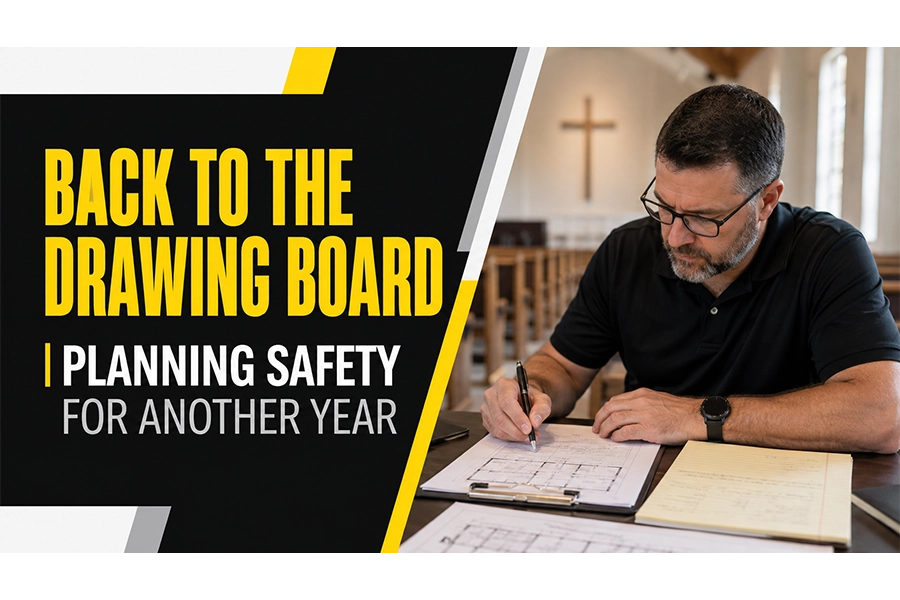
I took Mechanical Drawing (Drafting) in high school before there were computers and CAD apps. The drawings were done in pencil. When changes were to be made, it was literally back to the drawing board. It could be the existing drawing with some lines erased and/or replaced, lines added to the drawing, or an entire new document.
In church safety & security, we should go back to the drawing board at least once a year to review the record, consider changes in our situation, and make needed changes to the church’s safety blueprint.
References –
- Kris P. Moloney, “How to Conduct a Risk Assessment,” Church Security Guide, Sheepdog Church Security Academy, June 9, 2023 [https://sheepdog-church-security.thinkific.com/pages/security-articles?p=how-to-conduct-a-risk-assessment].
- Rachel M. Moloney, "Building an Effective Church Safety Ministry," Church Security Guide, Sheepdog Church Security Academy, August 5, 2025 [https://sheepdog-church-security.thinkific.com/pages/security-articles?p=building-an-effective-church-safety-ministry-key-lessons-for-safety-teams-and-directors]
- Kris P. Moloney, "How to Start a Church Safety Ministry," Church Security Guide, Sheepdog Church Security Academy, June 9, 2023 [https://sheepdog-church-security.thinkific.com/pages/security-articles?p=how-to-start-a-church-safety-ministry-in-5-simple-steps].
- Kris P. Moloney, "Developing a Church Safety Plan Beyond Active Threats," Team Briefing | Expert Resources, Sheepdog Church Security Academy, June 1, 2023 [https://sheepdog-church-security.thinkific.com/pages/security-articles?p=beyond-active-threats-a-well-rounded-church-safety-plan-for-prepared-protectors].
- “Summer Church Safety Readiness Checklist,” Sheepdog Church Security Academy, [https://sheepdog-church-security.thinkific.com/products/digital_downloads/church-safety-checklist].
- Contributors and Editors, "The Times They Are a-Changin' (Bob Dylan album)," Wikipedia, May 17, 2004 to February 3, 2026 [https://en.wikipedia.org/wiki/The_Times_They_Are_a-Changin%27_(Bob_Dylan_album)].
- WGV, "The Community Climate - Part 1," Articles, Sheepdog Church Security, October 30, 2023 [https://sheepdogchurchsecurity.net/articles/the-community-climate-part01/].
- WGV, "The Community Climate - Part 2," Articles, Sheepdog Church Security, November 7, 2023 [https://sheepdogchurchsecurity.net/articles/the-community-climate-part02/].
- Critical Response Group [https://www.crgplans.com/places-of-worship/].
- “Navajo Nation Churches,” Google Maps, accessed August 30, 2026 [https://www.google.com/maps/search/Navajo+Nation+churches/@36.5605991,-110.4655001,390244m/data=!3m1!1e3!5m1!1e4?entry=ttu&g_ep=EgoyMDI2MDgyNi4wIKXMDSoASAFQAw%3D%3D].