




Use of Force Standards
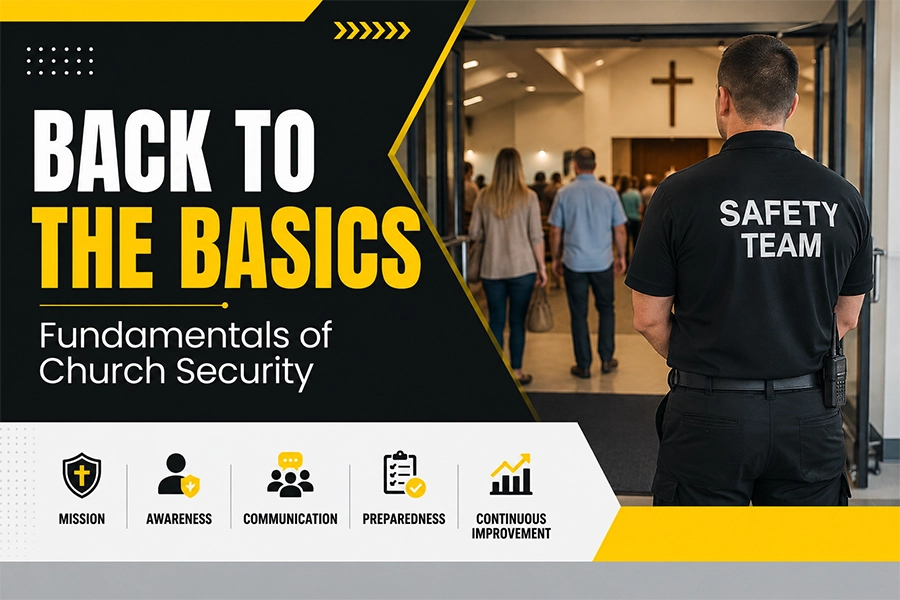
This article is based on the Safety Member Certification training module “Safety Team Fundamentals V5” and the Church Security Guide article “Church Safety Team Basics.” [1][2][3][4].
From the Bible
Of old hast thou laid the foundation of the earth: and the heavens are the work of thy hands (Psalm 102:25).
* Note that David referred to the “foundation of the earth.” The fundamentals of a Church Safety Team are its foundation.
Introduction –
Legendary Green Bay Packers head coach Vince Lombardi was known to begin training camp by holding up a pigskin and saying, “Gentlemen, this is a football.” The obvious message was that the most important thing to know and remember was the fundamentals of the game. Training camp began with going Back to the Basics.
Likewise, in any enterprise, including a church safety team, we need to review the basics from time-to-time. It is too easy to forget something that is not always in mind, and at some time that one thing may be vital. This is why a Safety Member Certification is for only two years – renewing the certification is a time to review the basics.
Another benefit of certification renewal is updating the basics, or at least their presentation, as seen in the core training module Safety Team Fundamentals V5. This course has been changed from the original Sheepdog Church Security Volunteer Academy, which many Safety Team members took years ago.
In this article, we are not focusing on the details of “Safety Team Fundamentals,” but its concepts and principles.
What Are the Basics?
The basics of being a member of a church safety team are:
- Mission,
- Character,
- Awareness,
- Prevention,
- Communication,
- Documentation,
- Emergency Readiness,
- Continuous Improvement.
Mission:
The primary basic of church safety & security is the mission. All else is seen within this context. Befitting a religious institution, the nature of our mission is spiritual: stewardship, service, and protection.
Stewardship,
The Apostle Paul said, “… you are not your own, for you are bought with a price …” (1 Corinthians 6:19-20). Therefore, since it all belongs to God, we are stewards (caretakers) of everything we have, and we should consider what we do in the church as a stewardship. Our stewardship role in the church is the safety and security of those coming to study, worship, and fellowship. Knowing this, we then take our responsibility seriously.
Service,
Paul also wrote, “… by love serve one another” (Galatians 5:13). Our mission as members of a Church Safety Team is to serve the congregation, its members, its children, and its leaders. Our service enables the pastors, teachers, and worship leaders to minister, and the members and visitors to worship, learn, and share fellowship.
Protection,
David wrote, “Preserve me, O God: for in thee do I put my trust” (Psalm 16:1). In this verse “preserve” means “protect.” As God’s stewards, we are to protect his house and his people. We are also to protect the church’s reputation, not by hiding abuse and theft, but by preventing them when we can.
Safety in General:
At first, the people protecting a congregation were called the “security team.” It didn’t take long to broaden security to include fire protection, First Aid, and CPR. Then child abuse and abductions were added concerns. “Security” didn’t really stretch that far with the common understanding of that word. “Safety” covers it all, including security, so now we call the organization a “Church Safety Ministry.” Identified that way, the congregants see our jobs as more than stopping attacks with weapons, lockdowns, and unarmed defense skills. We are more than just guards. We are deacons, and safety is our ministry.
The titles of Safety Member Certification training modules and Church Security Guide articles are a short list of the aspects of the mission of congregational safety:
Training Modules:
- Violent Intruder Response
- Deescalating Disruptive Persons
- Protecting the Vulnerable
- Use of Force
- Arson and Fire Safety
- Storms and Disasters
- Mass Trauma Emergency
Security Guide Articles:
- How to Conduct a Risk Assessment
- Fire Safety in the Church
- Preparing Your Church for Natural Disasters
- Protection of Children and Vulnerable Adults in the Church
- Self Defense Laws, Your Rights and Use of Force
- Disruptive Individuals: How to De-escalate the Situation
- Church Safety Teams and Active Shooter Training
As a list, this does not include everything.
For Safety Team members, safety in general means being alert for safety issues, whether standing or sitting in one location, walking from one room to another, patrolling, hearing about a situation, etc.
Character,
A song written by Bill & Gloria Gaither’s daughter and son-in-law is titled, “A Few Good Men.” For a church safety ministry, we need a few good persons, namely those with not only the right aptitudes, but also the right attitudes and character.
Safety ministry volunteers need to be disciplined. This is Biblical. Paul listed “self-control” as part of the Fruit of the Spirit, and that term describes many of the admonitions in the Bible. In Proverbs 16:32, Solomon wrote, “He that is slow to anger is better than the mighty; and he that ruleth [controls] his spirit than he that taketh a city.”
For a safety team member, Kris Moloney says that a disciplined Safety Ministry volunteer is “serving under church leadership, paying attention to ordinary risks, communicating well, documenting what matters, protecting vulnerable people, and preparing for the emergencies that churches actually encounter.”
The Church Safety Ministry will vet each volunteer to meet certain qualifications in a process that begins with an application and includes a background check, interviews, and checking of references. The character of a safety team member should have:
- Honesty,
- Integrity,
- Initiative,
- Loyalty,
- Compassion,
- Humility,
- Faith,
- Faithfulness.
Awareness,
Members of a Church Security Team are likened to sheepdogs, whose responsibility is guarding the flock. This means being aware, alert to any threat to the safety and well-being of those they protect. This awareness ranges from small tripping hazards and blocked halls and exits to fires, tornadoes, and violent intruders. A descriptive term for this is “spherical awareness,” aware in all directions and with all senses. [5].
This should not be a state of being paranoid, but calm awareness. On the Cooper’s Colors of Awareness scale, this is Yellow. If a threat is detected, then it is Orange.
Prevention,
Benjamin Franklin said, “An ounce of prevention is worth a pound of cure.” This means that the team in general and each member in particular work toward preventing harm, which is better than having to deal with it. Many things can be prevented in daily activity. A few examples are:
- Removing loose rocks, bricks, etc. outside that can be used by a vandal or burglar,
- Closing a door left open or ajar to prevent unfriendly entrance,
- Removing a fire hazard.
- A friendly greeting to a person with suspicious behavior might prevent a serious incident by letting them know they’re seen or by cooling anger.
- Discerning hidden weapons may lead to stopping a shooter.
Communication and Documentation,
Communication keeps the team working together, even when they’re scattered around the church and its campus. We communicate in real time by speaking personally and by using radios, phones, hand signs, and debriefing. Documentation is a way of communicating to those coming in behind us. This includes patrol logs and incident reports. Written policies and procedures communicate what is expected and how to do it.
Emergency Readiness,
We should be ready for emergencies, such as a missing child, an accidental injury, fire, medical incident (heart attack, seizure, heat stress, choking, etc.), structural failure, sudden storm, violence, etc. To be ready we need to be trained to respond and be equipped. Here are a few examples:
- Medical Response – Outside training in CPR, AED use, and First Aid is recommended for Safety Team members in most churches (some large churches may have qualified members to conduct medical response training). Key organizations offering this training are the American Red Cross, the American Heart Association, and the National Safety Council. In some locations, fire departments or local colleges ma offer this training. [6][7][8].
- Medical response drills for Safety Team Members and other volunteers will stress coordination and triage and getting professional help when needed.
- Missing Child – The church and the safety ministry should formulate procedures for responding to reports of a missing child. Safety Team Members, ushers, greeters, teachers, childcare workers, and others need to participate in missing child drills.
- Evacuation Drills – Safety Team Members will be key coordinators for evacuations, lockdowns, and shelter-in-place for certain emergencies, such as fires, tornadoes, hazardous materials, earthquakes (in certain areas), and violent intruders. They will participate in drills for these emergencies.
- Violent Intruder Response – Team members will learn and rehearse their roles in responding to a violent intruder. Drills will prepare them in self-control and coordination.
- Self-Defense – Most Safety Team Members will not be in situations when they need to defend themselves or others, but they must be trained and ready. Deadly force is a last resort, so it is important to have unarmed self-defense skills.
Continuous Improvement,
A safety team member needs to be trained. However, completing some courses is not enough. The safety team member should participate in drills and be informed of updates. A key factor is the mindset of improving oneself. The team member can rehearse situations and their responses in his or her mind, considering what to do and how to do it better.
The team member can also seek coaching from more experienced members. He or she can seek outside church safety training, such as through the Worship Security Academy and Christian Warrior Training. [9][10].
Training –
Training is a key to success in a Church Safety Ministry. The Safety Member Certification program is a must. It has eight training modules (classes). “Safety Member Fundamentals V5” is the first of five core courses, and there are three standalone courses. An introductory course, “Safety Team Essentials,” has been added. Another course, “Emergency Response Leadership,” will soon be added for church leaders who are not part of the Safety Ministry, and another one, “Greeter Safety Essentials.” will follow. [11][12][13].
Conclusion –
It is important to not forget any fundamental principles of our jobs, so from time to time we need to go back to the basics.
References –
- Kris Moloney, Safety Member Certification, Sheepdog Church Security Academy, © 2025 [https://sheepdog-church-security.thinkific.com/courses/safety-member-certification-v5-2025].
- Kris Moloney, “Safety Team Fundamentals,” Safety Member Certification, Sheepdog Church Security Academy, © 2025 [https://sheepdog-church-security.thinkific.com/courses/Safety-Member-Fundamentals-V5].
- Kris Moloney, Church Security Guide, Sheepdog Church Security Academy, [https://sheepdog-church-security.thinkific.com/pages/security-articles?c=church-security-guide].
- Kris Moloney, “Church Safety Team Basics,” Church Security Guide, Sheepdog Church Security Academy, June 9, 2023 [https://sheepdog-church-security.thinkific.com/pages/security-articles?p=church-safety-team-basics].
- WGV, "The Sphere of Awareness | Situationally Aware," Team Briefing, Sheepdog Church Security Academy, April 14th, 2026 [https://sheepdog-church-security.thinkific.com/pages/security-articles?p=the-sphere-of-awareness-situationally-aware].
- American Red Cross, "Find a Class" [https://www.redcross.org/take-a-class].
- American Heart Association, "CPR & First Aid Training Classes" [https://www.heart.org/en/cpr].
- National Safety Council, “Learn First Aid from the Workplace Safety Experts” [https://www.nsc.org/safety-training/first-aid/first-aid-cpr-and-aed-courses].
- Simon Osamoh, Courses, Worship Security Academy [https://www.worshipsecurity.org/Courses].
- Keith Graves, Christian Warrior Training [https://www.christianwarriortraining.com/].
- Kris Moloney, “Safety Team Essentials,” Courses, Sheepdog Church Security Academy, 2026 [https://sheepdog-church-security.thinkific.com/courses/Safety-Team-Essentials].
- Kris Moloney, “Emergency Response Leadership,” Courses, Sheepdog Church Security Academy, 2026 [https://sheepdog-church-security.thinkific.com/collections/courses].
- Kris Moloney, “Greeter Safety Essentials,” Courses, Sheepdog Church Security Academy, 2026 or 2027 [https://sheepdog-church-security.thinkific.com/courses/Greeter-Safety-Essentials].