




Church Safety Team Response
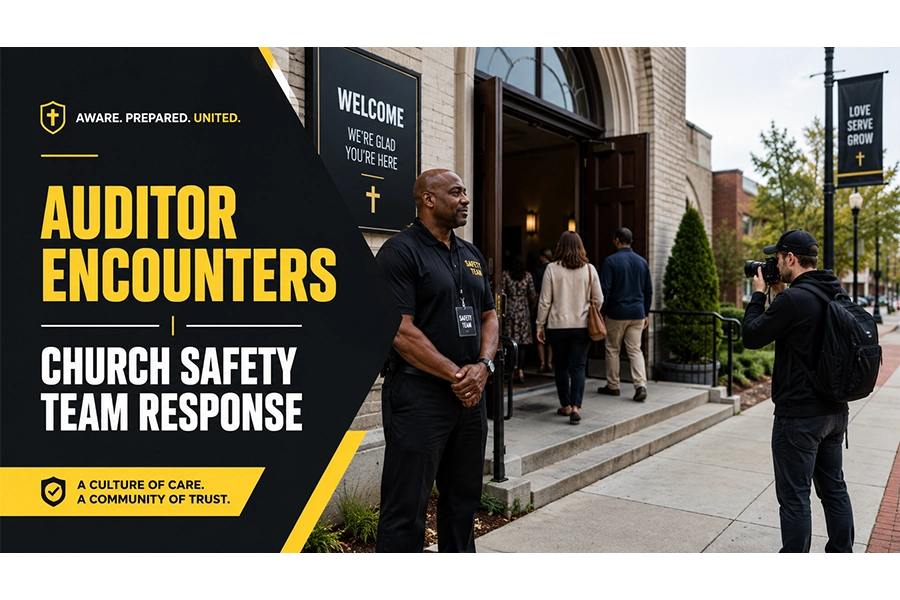
Church safety teams must know how to respond when a provocative person records, challenges, irritates, or tests church members near the property. The goal is not to win an argument. The goal is to protect people, preserve the church’s witness, and keep our own people from becoming the story.
The Panama City auditor vehicle assault gives church Safety Directors and volunteer Safety Team members a sobering training case. On Sunday, March 1, 2026, two First Amendment auditors were outside First Baptist Church in Panama City, Florida, during a dismissal period. According to the instructor notes, the encounter began as a church-front interaction involving cameras, property boundaries, firearms questions, and verbal friction. It later moved away from the main church-front area, where one auditor reported being struck by a red SUV in an alleyway. Police, fire, and EMS responded, and later public reporting stated that an arrest was made after the incident. Public reporting also described the incident as involving a First Amendment auditor outside First Baptist Church and noted that an arrest followed.
This article is not about debating auditors, politics, constitutional law, or media tactics. It is about volunteer-level church safety decisions: observation, communication, restraint, movement, de-escalation, access control, vehicle awareness, medical response, and documentation.
What Is the Core Lesson From the Panama City Auditor Incident?
The core lesson is this: your greatest risk may not be the person filming. Your greatest risk may be an irritated insider.
In many church safety situations, volunteers focus all their attention on the outsider. That is understandable. A person with a camera, a loud voice, or a confrontational attitude naturally draws attention. But the Panama City case reminds us that a frustrated church member, volunteer, or informal protector can become the person who escalates the situation.
That person may believe he is defending the church. He may think, “Somebody needs to do something.” He may be embarrassed, angry, offended, or protective. But if he follows, threatens, blocks, touches, or uses a vehicle to intimidate someone, he has moved from protector to problem.
This is why every church safety team needs a plan for managing its own people, not just the outsider.
Why Should Church Safety Teams Avoid Engaging in Arguments?
Auditor encounters are often designed to create emotion, inconsistency, and overreaction. A First Amendment auditor may film from public property, ask loaded questions, test boundaries, challenge policies, or try to expose unclear thinking. Even when the person is irritating, rude, or provocative, the church must not let him control the frame.
When multiple church-side people speak, the situation becomes harder to manage. One person says, “You’re welcome here.” Another says, “You can’t be here.” Someone else says, “You can’t record.” Another person debates rights, firearms, or property lines. The auditor now has conflicting statements on video.
That does not help the church. It creates confusion.
A disciplined church safety response uses one trained voice. Everyone else redirects concerns to that person and keeps the congregation moving.
A simple script may sound like this:
“You are welcome to attend worship under the same expectations as everyone else. Recording is not permitted inside or on private church property without authorization. You may remain on public property as long as you do not block access or threaten anyone.”
Then stop talking.
The stopping matters. Many volunteers do fine for the first sentence, then lose control because they keep explaining, defending, or debating. In a tense public encounter, fewer words are usually stronger words.
What Should the “Win Condition” Be During an Auditor Encounter?
The win condition is not making the auditor leave.
The win condition is that nobody touches him, nobody follows him, nobody threatens him, nobody improvises policy, nobody becomes the online thumbnail, worship continues, members are protected, and evidence is preserved.
That mindset changes the way your team operates. If the goal is to “make him leave,” your team may become aggressive, emotional, or legally careless. If the goal is to protect people and preserve witness, your team will focus on movement, distance, documentation, and restraint.
A church can be legally right, morally sincere, and still lose the moment if one person acts out of pride.
For Safety Directors, this needs to be stated before the problem happens. Say it in the pre-service briefing. Say it to greeters, ushers, parking volunteers, children’s workers, and armed team members.
How Should a Church Safety Team Respond When Someone Is Filming From Public Property?
A church safety team should respond with calm observation, controlled communication, and clear role discipline. If the person is on public property and not blocking access, threatening anyone, or entering restricted areas, the team should avoid confrontation.
That does not mean ignoring the situation. It means managing it wisely.
The team should identify the person’s location, behavior, direction of movement, and impact on the congregation. A designated spokesperson can make one calm contact if appropriate. Other team members should manage people, exits, traffic flow, and emotional reactions.
Here are practical response priorities:
- Observe behavior, not personality. Record what the person is doing, where he is standing, whether he is blocking access, and whether he is escalating. Do not focus on whether he is annoying, disrespectful, or trying to bait people.
- Assign one voice. Only one trained person should speak for the church. Everyone else should avoid side conversations, arguments, or comments that may be recorded and used out of context.
- Move people, not the auditor. You may not be able to move someone from public property, but you can redirect families, elderly members, children, and emotionally reactive people away from the friction point.
- Do not follow. If the person leaves the main area, let him leave. If there is a safety concern, observe from a safe position, document the direction of travel, and notify law enforcement if needed.
This approach protects the congregation without feeding the conflict.
Why Is “Do Not Follow” a Red-Line Rule?
Following is the bridge between irritation and disaster.
In the Panama City incident, the later vehicle contact reportedly happened after the encounter moved away from the main church-front area. The instructor notes emphasize that once a member follows an auditor off the main property, the church has lost control of the situation.
That lesson should become a written rule:
Do not follow. Report direction of travel and description only.
This rule applies to staff, volunteers, armed members, parking helpers, greeters, ushers, and self-appointed protectors. If the auditor leaves, that is a good outcome. Let him leave.
If there is a legitimate safety concern, the correct response is not pursuit. The correct response is documentation, communication, and law enforcement notification when appropriate.
How Should Safety Teams Manage Irritated Church Members?
Safety Teams should assign a “member de-escalator” during high-friction times, especially dismissal, parking lot movement, special events, and controversial encounters.
This role is often missing. Many teams assign someone to watch the outsider, but nobody is assigned to watch the congregation. That leaves emotionally reactive members free to confront, follow, record close-up, or make statements that embarrass the church.
A member de-escalator watches for clenched jaws, angry comments, pacing, pointing, phone recording, “I’ll handle this” behavior, or a member walking toward the situation with visible agitation.
The wording can be simple:
“I know this is irritating. Please don’t engage. We’re handling it. Go ahead to your car. Do not follow him. Do not say anything you don’t want online.”
That sentence can prevent a crisis.
This is not weakness. This is disciplined protection.
How Should Churches Use De-Escalation Without Looking Passive?
De-escalation is not passivity. It is controlled strength.
De-escalation means using calm communication, distance, listening, and clear boundaries to reduce tension. In church safety, de-escalation protects both the congregation and the witness of the church.
Sheepdog Church Security’s training resources emphasize calm communication, open-ended questions, active listening, and managing the environment during tense situations. Volunteers are encouraged to maintain a steady tone, use non-threatening body language, ask questions such as “Can you tell me what’s going on?” and create space when possible.
In an auditor encounter, de-escalation may mean refusing to debate. It may mean giving one clear policy statement and disengaging. It may mean moving families to another exit. It may mean calmly telling a member, “We’re not doing that.”
The strongest person on scene may be the one who says the least and prevents everyone else from escalating.
Why Should Vehicles Become Part of the Safety Scan?
This incident was not only about cameras. It was also about a vehicle.
Church safety teams must watch vehicles during emotionally charged encounters. A person may leave angry and still remain part of the problem. He may circle back, stop near the person filming, rev the engine, block movement, pull into an alley, or use the vehicle to intimidate.
A concerning vehicle should trigger calm communication, not confrontation.
A useful radio call might be:
“Red SUV circling. Driver appears upset. No one engage. Keep pedestrians clear. Get plate if safe.”
That call does several things at once. It identifies the vehicle, describes the concern, gives a safety instruction, and keeps the team from freelancing.
Vehicle awareness is especially important during dismissal because pedestrians, children, elderly members, and distracted drivers are all moving at the same time. A safety team that only watches doors may miss the parking lot risk developing behind them.
What Should Volunteers Document During a Public Encounter?
Documentation turns confusion into clarity. When a situation becomes tense, your team should preserve facts without escalating the encounter.
Documentation should include:
- Who was involved. Describe people objectively, including clothing, approximate age, location, and role if known.
- What happened. Record observable actions, not emotional conclusions.
- Where it happened. Note the exact door, sidewalk, parking area, alley, or street.
- When it happened. Use approximate times if exact times are not available.
- What action was taken. Record who was notified, whether law enforcement was called, whether EMS responded, and whether video or witness statements exist.
For example, do not write, “He was looking for trouble.” Write, “He stood near the main entrance recording members as they exited and asked repeated questions about church property.”
The difference matters.
Clear reporting helps leadership, law enforcement, insurance representatives, and future trainers understand the event without relying on emotion or memory.
When Should Law Enforcement Be Called?
Law enforcement should be called when there is a threat, violence, property violation after proper direction, blocking access, harassment that creates a safety issue, a weapon concern, vehicle intimidation, or any situation your team cannot safely manage within policy.
Police presence can help with documentation and enforcement, but police presence does not replace church discipline. In the Panama City instructor notes, law enforcement involvement did not automatically prevent continued engagement or later escalation.
That is an important lesson. Churches cannot outsource self-control.
Your team must know what law enforcement handles and what the church must handle internally. Police may address criminal behavior. The safety team must manage movement, members, communication, and restraint before the situation becomes criminal.
How Does This Connect to Biblical Stewardship?
Church safety is not about pride, control, or fear. It is about service.
The Sheepdog Creed describes the church protector as a companion to shepherds and a protector of the flock, serving so people may gather in a sanctuary of safety. It also emphasizes self-control, hospitality, professionalism, courtesy, kindness, alertness, and readiness.
That is the heart posture needed in an auditor encounter.
Acts 20:28 reminds leaders to pay careful attention to themselves and to the flock. That order matters. We must watch ourselves first. A Safety Team member who cannot govern his own emotions is not ready to govern a tense public encounter.
Romans 12:10 calls believers to honor others. That includes the person who is irritating us. It does not mean giving up boundaries. It means our boundaries must be delivered with dignity.
Psalm 127:1 reminds us that unless the Lord watches over the city, the watchman stays awake in vain. Preparedness matters, but spiritual humility matters too. We train, we plan, we watch, and we remember that our strength comes from the Lord.
What Should Safety Directors Change Before the Next Service?
A Safety Director should not wait for an auditor to appear before creating the response model. Build the model now.
Start with a five-minute briefing before the next service:
“If someone is filming from public property, do not confront, block, touch, follow, threaten, or debate them. Notify the safety lead. Keep members moving.”
Then assign the following roles:
- Primary spokesperson: The only person authorized to speak for the church during the encounter.
- Backup spokesperson: A calm replacement if the primary is unavailable.
- Member de-escalator: The person assigned to watch and redirect irritated church members.
- Movement coordinator: The person who redirects families, children, elderly members, and foot traffic.
- Vehicle observer: The person watching for circling, blocking, angry departures, or unsafe driving.
- Documentation lead: The person who records times, descriptions, witnesses, video locations, and actions taken.
- Medical responder: The person ready to shift into care if someone is struck, shoved, falls, or reports injury.
This does not require a large church or a professional security background. In a small church, one person may cover more than one role. The point is clarity before pressure.
Key Takeaways for Church Safety Teams
The Panama City incident gives volunteer Safety Teams several practical lessons:
- The person filming may not be the greatest risk. An angry insider can create the bigger crisis.
- One trained spokesperson should speak for the church.
- Volunteers should not debate rights, motives, politics, or theology in the middle of a recorded confrontation.
- The goal is not to make the auditor leave. The goal is to protect people, preserve witness, and prevent escalation.
- “Do not follow” must be a firm team rule.
- Vehicles must be included in the safety scan.
- Documentation, medical response, and law enforcement handoff matter.
- De-escalation is disciplined strength, not weakness.
- Christian protectors must remain self-controlled, hospitable, alert, and humble.
A Practical Operating Model for Your Next Auditor Encounter
Before your next service, gather your greeters, ushers, parking volunteers, Safety Team members, and ministry leaders. Walk through a realistic scenario.
Ask: “What would we do if someone stood on the sidewalk filming families as they left church?”
Then answer the question in practical steps.
The designated spokesperson makes one calm contact if appropriate. The member de-escalator watches for angry insiders. Greeters keep people moving. Ushers help redirect traffic inside. Parking volunteers watch vehicles. The documentation lead records facts. Nobody follows. Nobody debates. Nobody touches. Nobody threatens. Nobody freelances.
That is how a church wins the moment.
Not by overpowering the outsider, but by governing itself.
Final Encouragement: Protect the Flock Without Losing the Witness
Church Safety Teams carry a serious responsibility. We are called to protect people, support pastors, and help the church gather in peace. But we must never forget that how we protect matters.
A reckless response can damage the church’s witness as quickly as an outside disruption can. A disciplined response can protect both the congregation and the name of Christ.
If your team has not trained for auditor encounters, public recording, irritated members, vehicle intimidation, and post-incident documentation, now is the time. Start with one briefing. Assign one voice. Create a “do not follow” rule. Practice moving people away from friction points. Review how your team reports concerns.
And if your volunteers need structured, church-specific training, explore the Safety Member Certification through Sheepdog Church Security Academy. It is designed to help church safety volunteers grow in awareness, de-escalation, emergency response, team communication, and faithful readiness.
Protect the flock. Equip the saints. Strengthen the Church.