




Changes in Firearms Reciprocity
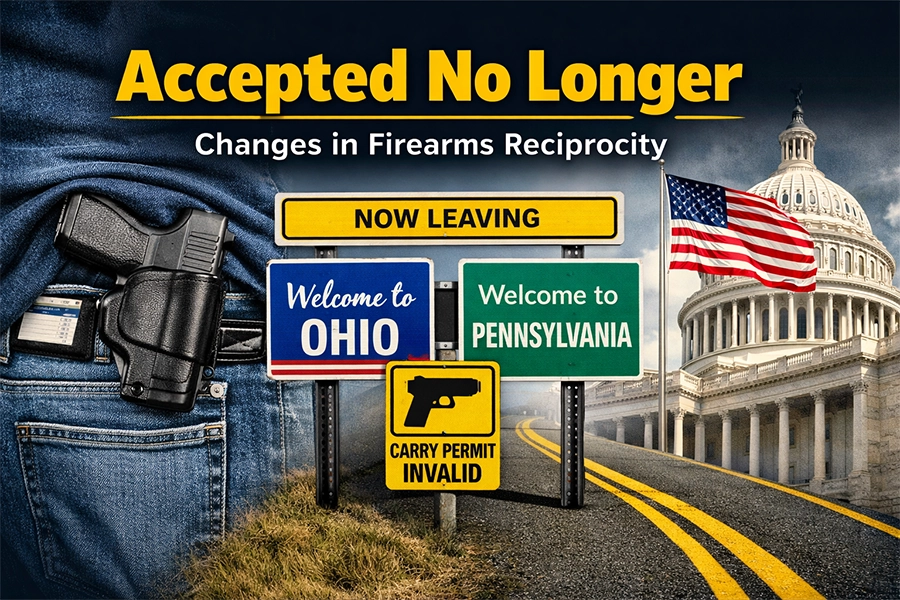
This article concerns current news about Concealed Carry Weapons interstate reciprocity.
*Israelite style concealed carry: Ehud hid the dagger by putting it on the side that would not be searched.
But Ehud made him a dagger which had two edges, of a cubit length; and he did gird it under his raiment upon his right thigh (Judges 3:16).
Location Matters –
If you carry a weapon, the legality of what, how, and where you carry it depends on the state you are in. This is not only a problem for travelers. Sometimes this also includes the local jurisdiction.
Concealed carry weapon (CCW) legality can be an at-least-weekly issue for armed church safety team members in some locations. Thanks to modern roads and motorized vehicles, the members of a church often live from few to several miles from the church building.
Some large congregations draw attenders and volunteers from several miles away. For example, I know of a congregation in Ohio where some attenders drive from over an hour away. For a location near a state line, this means several members likely come from a neighboring state. Let’s look at a few examples.
There are 6 cities in the United States divided by state lines:
- Bristol, Tennessee and Virginia,
- Kansas City, Missouri and Kansas,
- Texarkana, Texas and Arkansas,
- Texhoma, Texas and Oklahoma,
- Union City, Indiana and Ohio,
- Stateline, California and Nevada (now Stateline, Nevada, and South Lake Tahoe, CA).
Add other cities paired across state lines, such as:
- Pullman, Washington, and Moscow, Idaho,
- Portland, Oregon, and Vancouver, Washington,
- New York City and Newark, New Jersey,
- South Atteboro, Massachusetts and four Rhode Island cities.
Cincinnati, Ohio, is the major city of a tri-state metropolitan area extending into Kentucky and Indiana, and there are other multi-state urban areas.
Armed church safety team members in these urban areas who live in a different state from their church may need to consider whether their concealed weapons are legal in both jurisdictions. One writer calls the variation of CCW laws in states “a legal patchwork quilt.” [1].
The Current Concern -
For several years, now, many states have had concealed carry reciprocity agreements with states that have the same or almost the same CCW laws. According to the above-quoted author (L. Perez) and a number of others, at six states may alter their CCW reciprocity standard by the end of February (or maybe in March). While your CCW carrying in State A may have been accepted in State B, that might not be so now or later this year. The legal requirements may even change in your own state. As Perez says, "What was legal in January might be a felony in February." [1].
For those latching their hopes to a bill in Congress, H.B. 38, the Constitutional Concealed Carry Reciprocity Act of 2025, was introduced in January 2025. It is similar to bills introduced in previous Congresses. The intent is to make state-issued CCW permits legal in all states, in other words, national reciprocity. It hasn’t come to the floor of the House for a vote, and it doesn’t have much chance of getting there. [2].
The Issues –
What standards are critical and how are they applied?
Definitions of concealed weapon,
This is a bit old now, but may be an issue in some places. A few years ago, Ohio revamped its concealed weapons laws. Some devices had previously fallen into gray areas. One of these was pocket knives. The wording of the Ohio law included “other dangerous weapons,” a phrase subject to local interpretation. If a pen knife with a 1½” blade was found in your pocket, a police officer determined whether or not it was “a dangerous weapon.” When Ohio revised its laws to be a Constitutional Carry state, a small pocket knife did not have to be in a holster and visibly on your belt, and a person did not have to worry that a convenience in a pocket could be found illegal.
Most at risk of running afoul are persons from constitutional carry states with no option for getting a license going into a state requiring one, and holders of non-resident licenses.
Resident and non-resident CCW licenses,
Many CCW owners in constitutional carry states have applied for and received non-resident licenses in other states so they could legally carry in those states. More states have gone to constitutional carry. Some states that require CCW permits or licenses have changed their reciprocity in regard to those states by accepting only resident licenses. If your state (State A) is constitutional carry, and you have a non-resident CCW license in State C, State B may no longer honor the State C license. In other words, the only license honored by State B may be from the owner’s resident state, so in order carry legally there you need your own state’s resident license. If your church is in one state and you live in another, you need to meet the requirements of both states to legally carry to and at church.
Duty-to-inform laws,
The duty-to-inform laws can vary by state. Basically, it is what counts as carrying a weapon. In a traffic stop or an on-foot encounter (such as to ask you a question on the sidewalk or in a building) there is generally a duty to inform the officer of any weapons you are carrying. That depends on (1) what is considered a deadly weapon, and (2) where the weapon is.
How CCWs are carried in vehicles,
Now this can be touchy. What if a gun or knife is in the glove compartment? That’s easy, tell him before you reach for the registration. But what if it is under the seat? Or in the back foot well? Or in the trunk? Where the location is considered carrying may determined by the state. Know before you go.
Magazine capacity,
This year, the Virginia General Assembly passed a bill limiting the capacities of firearm magazines. If you are planning on driving though Virginia, make sure your magazines are not too big. Check for magazine capacity limits in other states also, if you will be going through them. [3].
Red-flag laws,
Some states have so-called red-flag laws. We know what that means, but what is covered may vary by state. Certain traits and temporary conditions may call for firearms to be held in trust pending resolution of the condition. We hope that none of us are on a red-flag list, especially one posted online.
Know Before You Go –
We can find CCW reciprocity lists online, posted by knowledgeable sources. However, with a few states changing which states’ firearms permissions they honor, some of the lists may already be out of date. The best way is to find out from each state what permits they honor. Take, for example, Pennsylvania. The State Attorney General’s office has an interactive Concealed Carry Reciprocity map (accessed on Feb. 19, 2026). Click on the neighboring state of New York, and the result is, “Concealed carry licenses issued to either non residents of New York or individuals under the age of 21 are not recognized by Pennsylvania.” This means that if you are a resident of New Hampshire, but have a New York CCW license for when you go there, you cannot use that license in Pennsylvania. Then follows a second question: “Can a resident PA license holder carry a concealed firearm in New York?”
The answer is, "No," with three situations:
- Through Written Agreement – No
- Without Written Agreement – No
- Through Unilateral Recognition or License Not Required – No
On the other hand, the answer to “Can a resident PA license holder carry a concealed firearm in Ohio?” is “Yes.” With these situations:
- Through Written Agreement – No.
- Without Written Agreement – Yes.
- Through Unilateral Recognition or License Not Required – Yes. [4].
Ohio’s Office of the Attorney General also has a Concealed Carry Reciprocity Agreements page with an interactive map. The abbreviation used is CHL (Concealed Handgun License). Clicking on New York brings this response: “New York law does not provide for recognition of out-of-state CHL permits. A letter from the State of New York can be viewed here,” while the response for Pennsylvania is, “Pennsylvania honors Ohio CHL permits. For more information, please visit the Pennsylvania Attorney General's website here.” [5].
In New York State, a non-resident CCW license is not for everyone. “Non-residents can obtain a New York State concealed carry weapon (CCW) license if they work primarily in NY or have a business there.” That certainly limits the availability, so if you’re going to or through New York, you’d better have the gun “unloaded and locked in a fire, impact, and tamper resistant storage depository that is hidden from view.” [6].
On the website of your state’s attorney general, find the page for Concealed Carry Reciprocity or a statement regarding whether your state’s CCW license will be honored in certain other states. For instance, if you are in the Chattanooga area, check Tennessee’s CCW reciprocity with Georgia and South Carolina.
Find Out More through Other Sources –
There are other online sources about the changing interstate CCW reciprocity. Two of them are:
- The Concealed Carry Map by USCCA. [7].
- 10 Key Changes in Concealed Carry Laws Changing in 2026 on Weapon Genetics LLC. [8].
You can find others in an online search.
Training –
Training is essential to team members learning safety and security principles and skills. Sheepdog Church Security has a Safety Member Certification program with eight training modules. Each safety team member needs to be trained and certified through this course. A key module related to the topic of this article is Use of Force with Andrew Branca. [9][10].
Proactively protect your congregation with information. Tell all of its members who have concealed carry weapons about the changes in CCW laws and reciprocity and how this may affect them as they travel to or through other states.
Conclusion –
If you carry a concealed weapon, pay attention to the laws of the states you may pass through on business or vacation. Find out if they honor your state CCW permit and what to do to stay legal.
References -
- Latrice Perez, “6 States May End Concealed Carry Agreements—Gun Owners Warned to Check Reciprocity Rules,” Budget and the Bees, February 2, 2026 [https://www.budgetandthebees.com/6-states-reviewing-new-concealed-carry-reciprocity-agreements-this-month/].
- Staff, “H.R.38 - Constitutional Concealed Carry Reciprocity Act of 2025,” 119th Congress (2025-2026), Introduced January 3, 2025, Last updated October 10, 2025 [https://www.congress.gov/bill/119th-congress/house].
- Brandon Curtis, “Virginia’s Major Shift: House Democrats Pass Sweeping Firearm Restrictions,” Concealed Nation, February 6, 2026 [https://concealednation.org/2026/02/virginias-major-shift-house-democrats-pass-sweeping-firearm-restrictions/].
- Staff, “Concealed Carry Reciprocity,” David W. Sunday, Jr., Pennsylvania Attorney General, Copyright © 2026 [https://www.attorneygeneral.gov/resources/concealed-carry-reciprocity/].
- Staff, “Concealed Carry Reciprocity Agreements,” Office of the Ohio Attorney General, no date given [https://www.ohioattorneygeneral.gov/Law-Enforcement/Concealed-Carry/Concealed-Carry-Reciprocity-Agreements].
- Staff, “Gun Safety in New York State: Frequently Asked Questions: New Concealed Carry Law,” Government of New York State, September 1, 2022 [https://gunsafety.ny.gov/frequently-asked-questions-new-concealed-carry-law#:~:text=Any%20individual%20who%20seeks%20to,or%20after%20September%201%2C%202022].
- Tim Schmidt, USCCA President, “Concealed Carry Map,” United States Concealed Carry Association, Copyright © 2026 [https://www.usconcealedcarry.com/uscca-info/guide/concealed-carry-map-information/].
- Anon, “10 Key Changes in Concealed Carry Laws Changing in 2026,” Weapon Genetics LLC, no date given [https://weapongenetics.com/are-concealed-carry-laws-changing-in-2026/].
- Kris Moloney, Safety Member Certification, Sheepdog Church Security, 2025 [https://sheepdog-church-security.thinkific.com/courses/safety-member-certification-v5-2025].
- Kris Moloney, “Use of Force with Andrew Branca V5,” Safety Member Certification, Sheepdog Church Security, © 2025 [https://sheepdog-church-security.thinkific.com/courses/Use-of-Force-with-Andrew-Branca-V5].