




Optimal Use of Force
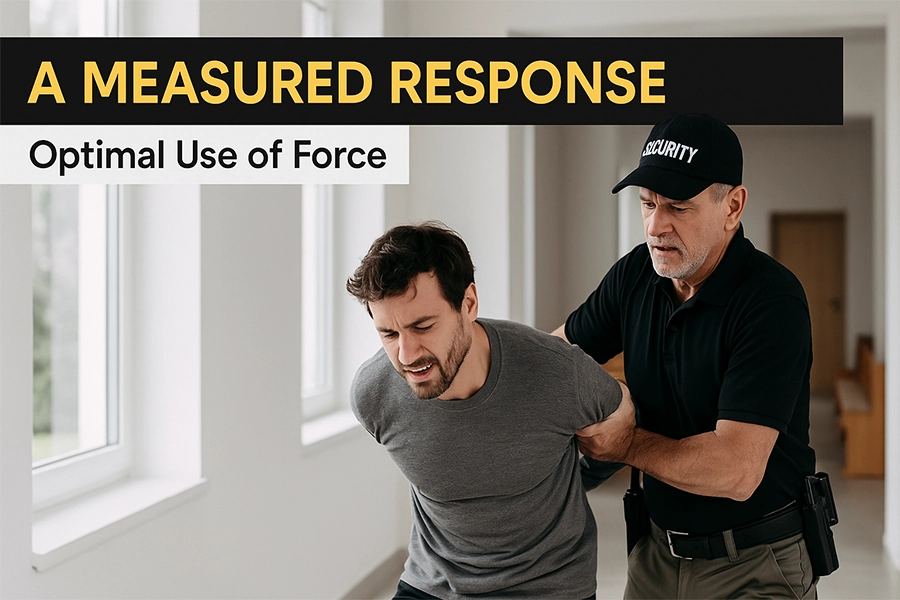
An article based on the Safety Member Certification training module "Use of Force with Andrew Branca (V5)" and the Church Security Guide article "Self Defense Laws, Your Rights and Use of Force" [1][2][3][4].
From the Bible –
* The soldiers took Paul away from a violent mob:
Then the chief captain came near, and took [Paul], and commanded him to be bound with two chains; and demanded who he was, and what he had done (Acts 21:33).
* This is an example of an ordered arrest:
And Elijah said unto them, "Take the prophets of Baal; let not one of them escape" (1 Kings 18:40a).
* Jesus corrected Peter's use of force:
And, behold, one of them which were with Jesus stretched out his hand, and drew his sword, and struck a servant of the high priest's, and smote off his ear. Then said Jesus unto him, "Put up again thy sword into his place: for all they that take the sword shall perish with the sword" (Matthew 26:51-52).
* Abram had trained his men for armed defense.
And when Abram heard that his [relative] was taken captive, he armed his trained servants, born in his own house, three hundred and eighteen, and pursued them unto Dan (Genesis 14:14).
* Elisha advised an act of restraint and mercy, which resulted in peace:
And the king of Israel said unto Elisha, when he saw them, "My father, shall I smite them [the Syrian soldiers]? Shall I smite them?"
And he answered, "Thou shalt not smite them: wouldest thou smite those whom thou hast taken captive with thy sword and with thy bow? Set bread and water before them, that they may eat and drink, and go to their master" (2 Kings 6:21-22).
Introduction -
In a disruptive or threatening situation, we want the best result. Therefore, we need to know then what the optimal (best, most effective) use of force is for that incident.
In the News -
Los Angeles, California, May 28, 2020 - The 68-year-old owner of a jewelry store chased three teenaged thieves who had just taken some of his merchandise and had run. He caught up with one suspect and grabbed her purse.
An untrained novice security guard at the parking lot of a neighboring apartment complex left his post and fought the store owner. The owner said he was the victim and the teen was the thief. He asked the guard to call 911. Instead, the guard body-slammed the man, causing serious injuries.
The jeweler sued the guard's employer for negligence for posting an untrained, unlicensed guard who either did not receive or ignored instructions to stay at his post and call 911 about the chase. The jury found for the plaintiff with an award of over two million dollars [5].
* Note: There are two use-of-force issues here, both related to citizen's arrest laws:
- The jeweler was within merchant's rights for chasing a thief when he'd actually witnessed the crime. Contrary to the guard's assumption, the older man was in the right.
- The guard was supposed to stay at his post. He should not have intervened since he had not witnessed the crime leading to the chase.
Sacramento, California, 2006 - The California Bureau of Security and Investigative Services has issued a Baton Training Manual. A student can study for a test on the use of a baton as a professional security guard. This is a requirement for a baton license. The baton training course is designed to give students the minimum level of proficiency to carry and use a baton while on duty as private security guards.
Chapter I covers the moral and legal issues of baton possession and use. Chapter II covers California's use-of-force laws. The outline of Chapter II follows the order of the Continuum of Force [6].
* Note: States differ on baton regulations. Check those of your own state.
Portland, Oregon, May 29, 2021 - An argument over pallets at a Lowe's store ended with the security guard shooting the driver of a pickup through the windshield. The incident was recorded by the guard's bodycam. The guard was indicted for murder, convicted, and sentenced to life in prison. The victim's widow sued the guard's employer and others for $25 Million and won [7][8][9].
* Note: Lethal weapons should only be used as a last resort.
Detroit, Michigan, October 23, 2025 - The security guard at an apartment building saw a man trying unsuccessfully to get into the lobby, but the door was locked. In this building, guests can get in only if a resident presses the button to unlock the lobby door. When a resident opened the door with a key to come in, the man followed.
When the man came in, the guard asked him whom he intended to visit. He also asked him to sign a visitors' register. The man began to argue, threatening to "turn you in" so he'd get fired. When the guard didn't budge, but stood in his way, the man pulled out a knife and attacked him. The guard, who is in his 60s, fought the intruder, finally disarming him while suffering cuts to his arms and hands. A resident had called 911, and officers arrested the attacker. Police, the security company, and the residents praised and thanked the guard for standing his ground. The guard had learned martial arts and unarmed defense and practiced regularly [10].
* Note: It pays to be trained in survival skills.
Optimal Force -
"Optimal" means "the best" and "the most effective." For church safety and security, optimal force is the level and means of force that will keep the church safe with the best outcome. The simplest measure would be the least force needed to keep or restore the peace. However, for a safety ministry, the goal also includes the welfare of the recipient of the force as well as of any intended victims. If this sounds like a blend of verbal de-escalation and use-of-force decisions, you're right.
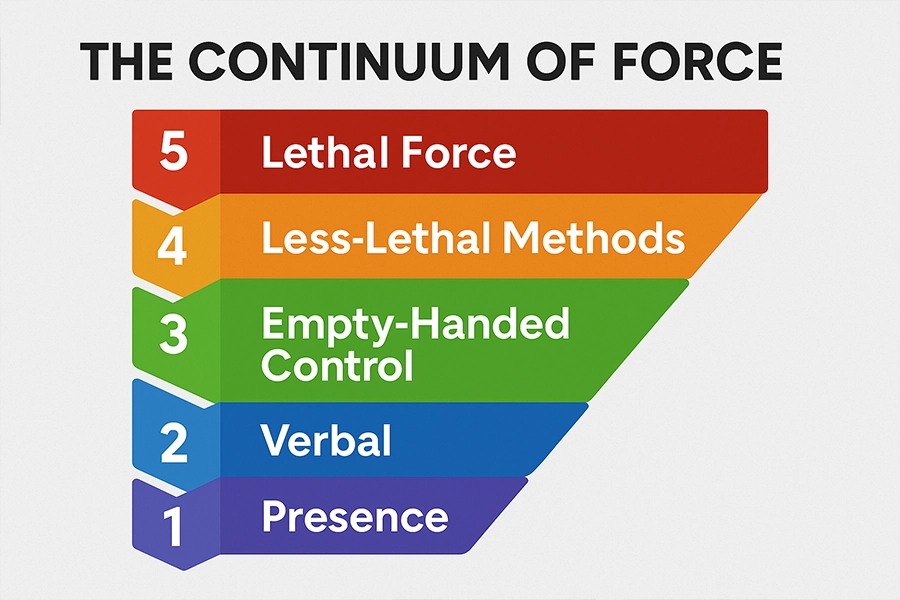
Levels of Force:
The common scale used to describe levels of force is the Use of Force Continuum. This was composed by the United States Department of Justice for use in determining whether a use of force was inadequate, justified, or excessive. This followed increased allegations of excessive use-of-force by law enforcement officers. The need arose for a means of measuring force. The Continuum has five levels: Presence, Use of Voice, Unarmed Force, Non-Lethal and Less-Lethal Weapons, and Lethal Weapons. For church safety teams, these are rephrased as Presence, Verbal De-escalation, Empty-Handed Control, Less-Lethal Methods, and Lethal Force.
- Presence – The mere presence of a security person (sometimes of anybody in general) can be a deterrent to violations of laws and rules. Miscreants are leery of law enforcement and witnesses. For example:
- When Sonny knows he should not get into the cookie jar, he raids it only when he believes no one is watching.
- On the road, speeders slow down when they see a patrol car.
- A casual thief is less likely to check the pockets of coats on the rack when he knows a safety team member is watching.
- On the positive side, the presence of a security/safety person can be reassuring to those who may need help.
- Verbal De-escalation – This is actually one application of vocal commands, such as “Wait,” “Stop,” “Please leave,” etc. In other words, using open communication to maintain or restore order.
- Verbal de-escalation focuses on preventing situations from getting out-of-hand. For church safety and security, this is a ministry focus. At its best, it can help everyone involved, which is the real focus of our job. For more on this, see the article “An Act of Mercy” [11].
- At the least, it can avoid advancing to the next level of force.
- Empty-Handed Control – Otherwise known as unarmed defense, the church safety ministry term includes physical means of controlling disruptive and disorderly persons when de-escalation won’t be sufficient:
- For church security, this is most often a guided exit.
- When a crime is involved, it may be used in a citizen’s arrest – in that case, it could have legal consequences, depending on the details of the situation and the laws of the state as interpreted by the courts. Extreme caution is advised.
- It can also be a defense against violence. An example is in the news story from Detroit. That case shows the value of learning unarmed self-defense and staying in practice. See the Expert Resources article “Less-Lethal Skills for Church Safety Teams: A Guide for Prepared Protectors,” and also the Team Briefing article “Look, Mom, No Arms’’ [10][12][13][14].
- Less-Lethal Methods – The most commonly-used methods in this level are defensive sprays (pepper and/or tear gas) and electric discharge devices (stun guns and Tasers). These are now called “less-lethal” instead of “non-lethal” because misuse or extra sensitivity of the target person can, in some cases, cause serious injury or (rarely) death. State and local regulations vary.
- Batons fall into the less-lethal end of the category in most states, since blows to the head or neck and thrusts into the torso can cause serious injury or death. Some jurisdictions tend to see batons as lethal.
- In California and some other places, training and licensing are required for baton possession and use. It’s wise to check your state’s regulations before obtaining a baton for security work [6].
- Lethal Force – Lethal force can be with or without a weapon. Lethal weapons are mostly those that were designed to kill or critically injure. These include impact, puncturing, edged, projectile, and corded weapons. Here’s a categorized list (some are ancient):
- Impact weapons – clubs, maces, batons;
- Puncturing weapons – spears, javelins, thrust rods;
- Edged weapons – knives, swords, daggers, axes, hatchets;
- Projectile weapons – slings, arrows, darts, bolas, firearms;
- Corded weapons – ropes and straps have been used for millennia as weapons to strangle someone or to cut off blood supply to limbs.
- Lethal weapons can also include weapons of opportunity, such as rocks, bricks, baseball bats, high-heeled shoes, neckties, etc.
- Hands and feet can be lethal. A professional boxer’s hands can be registered as weapons.
- This can be in person, just being there, visible, watchful, and identifiable.
- It can be a closed-circuit TV monitor showing people in the covered area, and perhaps (rarely) another public screen showing the person monitoring it, or (more common) a notice that the images are being monitored in real time.
- A security team member walking through the halls is using presence for anyone who sees him or her on patrol. When people see team members on patrol, then when security persons can't be seen there is the knowledge of potential presence - they could show up anytime.
- Be Educated - Know the levels of force and the means that can be used at these levels.
- Be Equipped - Practice means of force that are appropriate for church safety.
- Be Aware - Exercise situational awareness.
- Be Observant - This includes watching people, alert to suspicious behavior.
- Be Controlled - Controlling ourselves is a key to good decisions and actions.
- Be Compassionate - Even when we have to be tough, we need genuine compassion for those we deal with and for others who will be affected.
- Be Patient - Do not be unnecessarily hasty, yet be ready to act when needed.
- Be Empowered - As Christians, we need to be empowered by the Holy Spirit and sensitive to His leading.
- Have Priorities - Decisions are to be based on values and objectives.
- The attacker may be too close for you to pull the gun or spray out in time, and a parry or tackle would be more effective. One security team member at the West Freeway Church was killed while reaching for his weapon.
- Other bystanders may be in the line of fire, and your weapon would endanger them. For example, in the West Freeway shooting, Jack Wilson waited for a clear shot to fire his gun [15].
- Conflict De-Escalation
- Suspicious Behavior
- Threat Assessment
- Safety Team
- Medical Response
- Crisis Intervention
- Active Shooter
- Emergency Response
- Kris Moloney, Safety Member Certification, Sheepdog Church Security, 2025 [https://sheepdog-church-security.thinkific.com/courses/safety-member-certification-v5-2025].
- Kris Moloney, "Use of Force with Andrew Branca (V5)," Safety Member Certification, Sheepdog Church Security, 2025 [https://sheepdog-church-security.thinkific.com/courses/Use-of-Force-with-Andrew-Branca-V5].
- Kris Moloney, Church Security Guide, Sheepdog Church Security, posted June 2023 [https://sheepdog-church-security.thinkific.com/pages/security-articles?c=church-security-guide], also posted 2018 [https://sheepdogchurchsecurity.net/church-security-guide/].
- Kris Moloney, "Self Defense Laws, Your Rights and Use of Force," Church Security Guide, Sheepdog Church Security, posted June 2023 [https://sheepdog-church-security.thinkific.com/pages/security-articles?p=self-defense-laws-your-rights-and-use-of-force], also posted 2018 on [https://sheepdogchurchsecurity.net/use-of-force-arrest-laws].
- By Staff on information from court records, "Untrained security guard knocks man to the ground, causing injury. $2.3M. Los Angeles County," Jury Verdict Alert, Date of verdict, December 13, 2022 [https://juryverdictalert.com/negligence/excessive-force-by-security-guard].
- Staff, "Baton Training Manual, Student Text," Department Of Consumer Affairs, Bureau of Security and Investigative Services, State of California, March 2006 [https://www.bsis.ca.gov/forms_pubs/bat_stuman.pdf].
- KATU Staff, "Man shot, killed by armed security guard at North Portland Lowe's, police say," KATU2, June 1, 2021 [https://katu.com/news/local/man-shot-killed-by-armed-security-guard-at-north-portland-lowes-police-say].
- DA Staff, "UPDATE: DA Mike Schmidt Announces Guilty Verdict for Private Security Guard Who Shot and Killed a Civilian," Multnomah County District Attorney, May 9, 2023 [https://www.mcda.us/index.php/news/update-da-mike-schmidt-announces-guilty-verdict-for-private-security-guard-who-shot-and-killed-a-civilian].
- Anthony Macuk, Jamie Parfitt, and KGW Staff, "Jury awards $20M to family of man shot by security guard in Portland parking lot," KGW, September 23, 2024 [https://www.kgw.com/article/news/local/20-million-verdict-fatal-shooting-lowes-security-guard/283-0dd5f582-10c4-4b51-8485-80127d6920be].
- Darren Cunningham, "Detroit security guard survives knife attack, hailed a hero," WXYZ, October 28, 2025 [https://www.wxyz.com/news/detroit-security-guard-survives-knife-attack-hailed-a-hero].
- WGV, "An Act of Mercy," Sheepdog Church Security, November 18, 2025 [https://sheepdog-church-security.thinkific.com/pages/security-articles?p=an-act-of-mercy-de-escalating-disruptive-individuals-in-the-church], also at [https://sheepdogchurchsecurity.net/articles/an-act-of-mercy/].
- Kris P. Moloney, Expert Resources, The Sheepdog Sentinel, Sheepdog Church Security, January 1, 2023 to March 1, 2024 [https://sheepdog-church-security.thinkific.com/pages/security-articles?c=expert-resources].
- Kris P. Moloney, "Less-Lethal Skills for Church Safety Teams: A Guide for Prepared Protectors," Expert Resources, The Sheepdog Sentinel, Sheepdog Church Security Academy, April 1, 2023 [https://sheepdog-church-security.thinkific.com/pages/security-articles?p=non-lethal-skills-for-church-safety-teams-a-guide-for-prepared-protectors].
- WGV, ‘‘Look, Mom, No Arms,'' Sheepdog Church Security, May 6, 2025 [https://sheepdog-church-security.thinkific.com/pages/security-articles?p=look-mom-no-arms-unarmed-self-defense], also at [https://sheepdogchurchsecurity.net/articles/look-mom-no-arms/].
- WGV, "2019 West Freeway Church of Christ Shooting," Sheepdog Church Security, September 6, 2022 [https://sheepdogchurchsecurity.net/articles/2019-est-freeway-church-of-christ-shooting/].
- Simon Osamoh, "Decision Decks," Kingswood Security Consulting, 2023 [https://www.decisiondecks.com/].
- Kris Moloney., "Emergency Response Visualization Guide," Sheepdog Church Security, © 2023 [https://sheepdog-church-security.thinkific.com/products/digital_downloads/emergency-response-visualization-guide].
Means of Force:
Means of force is the choice of what to use. This can vary within each force level.
Take for example, presence:
At the second level, voice, this could begin with greeting a church member or visitor. The team member can give directions when asked. There may be a need to make a request or a command, such as to clear the crowd from a medical emergency or to steer them away from a hazard. The need to say something may include teaching. The upper end of this level includes verbal de-escalation, directing evacuation, and managing an emergency response.
Without going into too much detail, this indicates that there are several means available at each level of force. The real key is knowing what means to use in the situation at hand.
Discretionary Use-of-Force:
Using discretion is exercising judgment when making a decision. Since situations we encounter in keeping the congregation safe are not all exactly like scenarios in a book or a drill, we need wisdom in deciding how to handle them. Here are a few factors to consider:
Here is an example of the need for discretion. You may be armed with a concealed weapon. However, in many situations with an armed disruptor, pulling out your weapon may not be the best choice.
Training Notes -
There are several available training resources for optimal use of force.
Training Courses:
Sheepdog Church security's Safety Member Certification has eight training modules. Five of these, including "Use of Force with Andrew Branca (V5)," are core courses. All Safety Team members should take them to become Certified Safety Members [1][2].
Church Security Guide:
The Church Security Guide has 11 articles, including "Self Defense Laws, Your Rights and Use of Force" [3][4]. Members of church safety ministries are encouraged to read and discuss all the articles.
Decision Decks:
Worship Security Academy (an affiliate of Sheepdog Church Security) and its sister firm, Kingswood Security Consulting, have developed Church Safety and Security Decision Decks. These scenario cards are like the familiar flash cards, except there are no set answers. Each card presents a scenario, and the user decides how he or she should respond. The goal is not to drill for "correct" answers, but to stimulate critical thinking. There are eight sets for Church Safety and Security:
They are sold through the Kingswood Security Consulting store on Amazon. There are also Decision Decks for high schools, leadership, families, and colleges [16].
Free Download:
We have a free download this week: Emergency Response Visualization Guide. Be Ready for the Unexpected: When emergencies strike, every second counts. The Emergency Response Visualization Guide helps you mentally rehearse key scenarios so you can respond with confidence and clarity when it matters most. Get it *HERE* [17].
Conclusion -
Learn how to decide and make the optimal response in a use of force situation.