




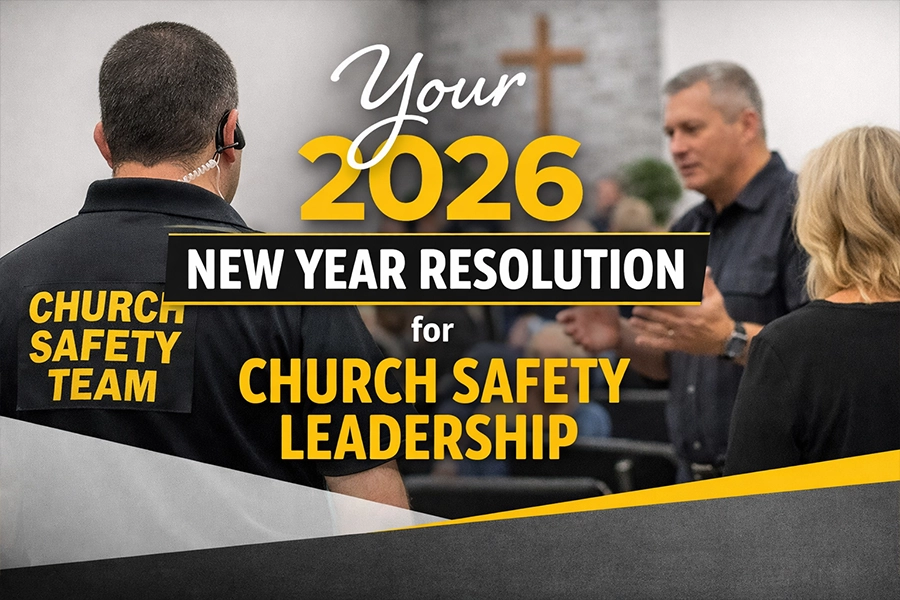
Prepare your church safety ministry for 2026 with practical resolution ideas, biblical guidance, and actionable steps to start or strengthen your Safety Team.
Practical, Faithful Steps to Start or Strengthen Protection in the Year Ahead
Every January, church leaders, Safety Team members, and Safety Directors pause to ask a familiar question: What needs to change this year?
For those responsible for church safety, the question is more urgent than ever. Threats against houses of worship continue to increase, volunteers are stretched thin, and many churches still rely on informal or incomplete safety practices. If you serve on a Church Safety Team or oversee a safety ministry, 2026 is the year to move from good intentions to deliberate action.
This article is written for volunteer-based church safety ministries of all sizes, especially those without law enforcement or military backgrounds. Whether you are starting from scratch or refining an existing program, these New Year’s resolutions are designed to help you protect your congregation faithfully, responsibly, and effectively.
I am writing to you as a fellow servant leader, not just an instructor. Over the years, I have watched countless churches struggle with the same challenges, and I have seen what works when safety is approached with clarity, humility, and purpose.
Why Church Safety Must Be a 2026 Priority
Church safety is not about fear. It is about stewardship.
Scripture reminds us in Proverbs 27:12, “The prudent see danger and take refuge, but the simple keep going and pay the penalty.” Safety ministries exist because loving people means preparing for realities we wish did not exist.
Many churches hesitate to act because they feel overwhelmed, underqualified, or unsure where to begin. Others have teams in place but lack training, documentation, or leadership alignment. Both situations create risk.
A strong church safety ministry does not begin with equipment or policies. It begins with awareness, education, and a commitment to protect the flock God has entrusted to us.
Resolution 1: Acknowledge the Need and Step Into Responsibility
What is the first step in starting or improving a church safety ministry?
It is recognizing that safety gaps already exist and choosing not to ignore them.
Nearly every effective safety ministry I have encountered started with one person who noticed something was missing. Sometimes it was a parent concerned about children’s security. Sometimes it was a greeter who noticed unchecked doors. Often, it was a volunteer quietly watching the parking lot with no guidance or support.
If that person is you, understand this: your concern is valid. Stepping up does not mean acting alone forever. It means initiating a process that invites others into shared responsibility.
In 2026, resolve to stop waiting for perfect conditions or formal permission before taking foundational steps. Safety leadership often begins informally, but it must grow intentionally.
Resolution 2: Commit to Foundational Training Before Advanced Tactics
One of the most common mistakes churches make is focusing on worst-case scenarios before mastering the basics. Firearms training, active threat response, and emergency drills matter, but they are not the starting point.
A healthy church safety ministry begins with core skills that apply every single Sunday.
Foundational skills every Safety Team should understand
- Observation and reporting: Learning how to notice abnormal behavior and document facts objectively.
- Patrol basics: Knowing how and when to check entrances, parking areas, and interior spaces without disruption.
- De-escalation: Using calm, respectful communication to prevent conflicts from escalating.
- Emergency response: Understanding basic procedures for medical incidents, evacuations, and lockdowns.
These skills do not require prior experience. They require training, repetition, and accountability. In 2026, resolve to invest in education that builds confidence instead of fear.
Resolution 3: Develop Situational Awareness as a Ministry Skill
Situational awareness is the ability to understand what is happening around you and recognize when something does not belong. It is not profiling. It is not suspicion. It is attentiveness.
How should a church Safety Team recognize suspicious behavior?
By first understanding what normal looks like.
Every church has rhythms. People enter at predictable times. Children gather in specific areas. Noise levels change throughout the service. When you know the normal patterns, irregularities become easier to spot.
Suspicious behavior often involves context, not appearance. Examples include lingering without purpose, repeated entry and exit, unusual interest in secured areas, or visible nervousness when approached.
In 2026, resolve to train your team to observe without assuming and to act without overreacting. Awareness prevents incidents long before force is ever needed.
Resolution 4: Prioritize Friendly, Non-Confrontational Engagement
Church safety must always support the mission of hospitality. A visible safety presence should reassure, not intimidate.
When someone’s behavior raises concern, the first response should almost always be a friendly engagement. A simple greeting such as, “Hello, welcome. Can I help you find something?” often resolves uncertainty quickly.
This approach accomplishes three things:
- It offers genuine assistance to those who may be lost or new.
- It allows you to observe behavior and responses calmly.
- It deters individuals with harmful intent by making them feel noticed.
Resolve in 2026 to train your team in verbal skills that keep the peace. Scripture calls us to be peacemakers, not passive observers.
Resolution 5: Build Consistent Patrol and Presence Practices
Patrolling is not about walking aimlessly. It is about consistency and intention.
A defined patrol routine allows Safety Team members to notice changes over time. It also communicates that the church takes safety seriously.
Simple patrol practices that strengthen safety
- Conduct walk-throughs before services to check doors, lighting, and parking areas.
- Maintain quiet, respectful movement during services.
- Verify building security after events conclude.
- Pay attention to secluded or low-visibility areas.
Patrols should never disrupt worship. When done correctly, most congregants will never notice them. That is a sign of good safety leadership.
Resolution 6: Document Observations and Learn from Patterns
Documentation is one of the most overlooked aspects of church safety. Many teams rely on memory or informal conversations, which leads to gaps and confusion.
Why is documentation important for church safety ministries?
Because patterns matter.
A single incident may mean nothing. Repeated behaviors over time may signal a growing concern. Written logs allow leaders to make informed decisions rather than emotional reactions.
Documentation should include:
- Date and time
- Location
- Objective description of behavior
- Actions taken
In 2026, resolve to create simple reporting systems that support transparency and accountability. Documentation protects both your team and your church leadership.
Resolution 7: Communicate Clearly with Church Leadership
Safety ministries thrive when leadership understands the mission and supports the process. Many pastors and boards hesitate because they fear complexity, liability, or disruption.
Your role is not to overwhelm leadership with tactics. It is to communicate purpose and progress.
A simple proposal should explain:
- Why safety matters for your congregation
- What your team is currently doing
- How leadership can observe or support
- What long-term growth could look like
When safety leaders communicate calmly and clearly, trust grows. In 2026, resolve to strengthen alignment between safety teams and church leadership.
Resolution 8: Make Training Ongoing and Accessible
Safety is not a one-time event. Skills fade without practice, and threats evolve over time.
Ongoing training does not require constant meetings or expensive events. It can include short discussions, shared videos, tabletop exercises, or simple drills.
What does effective church safety training look like?
It is practical, realistic, and repeatable.
Training should address:
- Verbal de-escalation
- Medical response
- Evacuation and lockdown procedures
- Team communication
- Legal and biblical principles
Resolve in 2026 to treat training as discipleship. Repetition builds readiness.
Resolution 9: Ground Safety Decisions in Biblical and Legal Clarity
Church safety exists at the intersection of faith and responsibility. Decisions must be guided by both Scripture and the law.
Romans 13 reminds us that governing authorities exist for order and protection. Churches must understand local laws related to use of force, self-defense, and duty of care.
At the same time, Scripture calls us to protect the vulnerable, pursue peace, and act with wisdom. Safety decisions rooted in fear or aggression undermine the witness of the church.
In 2026, resolve to train your team to act with clarity, restraint, and moral confidence.
Resolution 10: Equip Your Team with Proven Training and Tools
Many volunteers serve faithfully but feel underprepared. That gap creates hesitation during emergencies.
The Safety Member Certification exists to address that problem directly. It provides structured, church-specific training that prepares volunteers to respond to real-world incidents with confidence and humility.
This certification covers:
- Patrol strategies and inspections
- Communication and coordination
- De-escalation and crisis response
- Legal and biblical principles
- Protection of vulnerable individuals
- Team-based emergency drills
For churches starting from scratch, it provides a foundation. For established teams, it brings consistency and clarity.
As part of the training, teams also receive the Safety Drills Manual, a step-by-step guide for practicing realistic scenarios safely and responsibly.
Key Takeaways for 2026 Church Safety Resolutions
- Church safety is an act of stewardship, not fear.
- Strong safety ministries begin with awareness and education.
- Foundational skills matter more than advanced tactics.
- Friendly engagement prevents more incidents than force.
- Documentation and communication build trust and clarity.
- Ongoing training strengthens readiness and unity.
- Biblical and legal grounding is essential for wise decisions.
- Proven training resources reduce confusion and hesitation.
A Final Word to Church Safety Leaders
If you serve quietly, thank you. If you feel uncertain, you are not alone. Every effective safety ministry begins with someone willing to learn, listen, and lead faithfully.
In 2026, do not resolve to do everything. Resolve to do the right next thing.
If you are ready to take that next step, I invite you to explore the Safety Member Certification and equip yourself and your team with training designed specifically for churches, volunteers, and ministry leaders.
Preparation brings peace. Clarity builds confidence. Faithful action protects the flock.